

Why NZ should lower motorway speed limits for SUVs and other high-emission vehicles
- Written by: Len Gillman, Professor of Biogeography, Auckland University of Technology
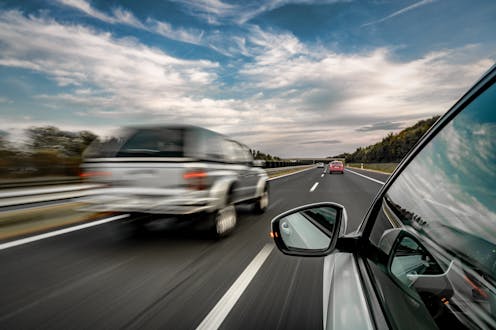
By the end of this month, speed limits on more than 2,000 roads across Tāmaki Makaurau/Auckland will have been reduced by between 10 and 60 kilometres per hour (km/h). Part of the Auckland Transport (AT) safe speeds programme, the aim is to reduce serious injuries and fatalities.
According to AT, areas where speeds have already been reduced have seen a 30% reduction in road deaths, compared to a 9% increase in deaths where they have not.
But there is another benefit to reducing speeds on our roads – a reduction in carbon emissions. Cars and other passenger vehicles were responsible for 27% of New Zealand’s gross carbon dioxide emissions in 2018. At lower speeds, vehicles use less fuel and emit less carbon dioxide.
Ultimately, it’s about climate change. The recent extreme weather events that have wreaked havoc across many communities in Aotearoa are only an entrée. The main course is yet to come.
But to see a significant emissions reduction from the country’s motor vehicle fleet, local and central government agencies must go beyond lowering speeds on small sections of inner-city and rural roads. Motorway speeds should targeted, too.
Less fuel, lower emissions
Driving slower on highways saves fuel. At higher speeds, engines must work harder to overcome drag, mainly from wind resistance. That drag increases exponentially the faster a vehicle goes. This is especially true for larger, less fuel-efficient vehicles.
A recent study found that reducing the maximum speed on New Zealand roads from 100 to 80 km/h reduced fuel use by approximately 15%.
The OECD has estimated that the fuel consumption of vehicles travelling at 90 km/h was 23% lower than at 110 km/h. In the Netherlands, increased enforcement of 100 km/h speed limits reduced average speeds by 7 km/h.
Read more: We may be underestimating just how bad carbon-belching SUVs are for the climate – and for our health
This resulted in savings of 40 million litres of petrol, 40 million litres of diesel, and 15 million litres of LPG. Conversely, an aggressive driving style involving rapid acceleration and hard braking can increase fuel consumption by up to 30%.
It’s difficult to see how New Zealand will meet CO₂ emission reduction targets by 2050. Government policies encouraging people to buy fuel-efficient cars are a start, but they fail to provide real incentives to change the behaviour of those with the most polluting vehicles.
People who can afford to drive large, luxury vehicles with poor carbon-emission ratings (such as a new Audi Q7 or Range Rover) are unlikely to be troubled by the cost of the carbon fuel tax or the high emissions fee on new vehicles. Also, these measures won’t make any difference to the emissions from existing vehicles on New Zealand roads.
Read more: To get New Zealanders out of their cars we'll need to start charging the true cost of driving
Fairer than a fuel tax
Imposing a lower maximum speed limit on high-emission vehicles would have an impact, however. New Zealand currently has a different maximum speed limit of 90 km/h for cars towing trailers, and for heavy vehicles. Why not extend this to include targeted climate-polluting vehicles?
This would achieve two things: it would make people less keen to buy high-emission vehicles, and it would cut the emissions of high-polluting vehicles already on the road. Large fossil-fuel engines produce more emissions, and therefore have the most to offer by reducing their speed.
A 10 km/h maximum speed reduction will only add two to four minutes to a 100 kilometre trip. Those who need to drive large vehicles for commercial use will have marginally increased costs due to longer drive times, but they will save on fuel bills.
This policy option is also more equitable than fuel taxes. Emission reductions will be achieved without any added cost to low-income families with older, less-efficient vehicles (unless, of course, they choose to speed.) And it is feasible because number plate recognition technology allows vehicle type to be instantly identified by police or through camera images.
Read more: Lower speed limits don’t just save lives – they make NZ towns and cities better places to live
Speed up on policy
Some may wonder, when so few people seem to obey speed limits anyway, how this change might make any difference.
But those who exceed the speed limit by, say, 10 km/h usually do so regardless of the limit. So, if they drive 110 in 100 km/h zones, they will likely drive at 100 in 90 km/h zones: still a reduction of 10 km/h.
Of course, high-performance electric vehicles don’t produce higher emissions at higher speeds. If wealthy people and businesses want the higher speed limit to apply, they can buy electric vehicles.
Lower speeds on our roads and motorways would mean a reduction in both crashes and greenhouse gas emissions. The government should speed up and act.
Authors: Len Gillman, Professor of Biogeography, Auckland University of Technology


















