When floodwater reaches the sea, it can leave a 50 metre thick layer of brown water – and cause real problems
- Written by Neil Malan, Research associate, Climate Change Research Centre, UNSW Sydney
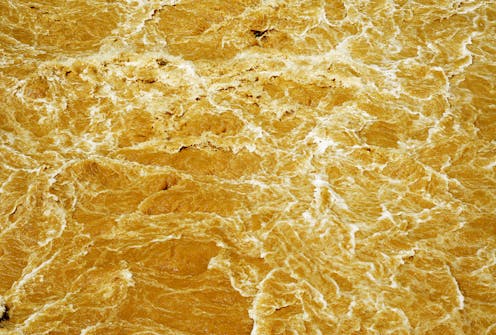
Over this wet summer, Melburnians and Sydneysiders have had to think twice about cooling off at their local beach. Heavy rainfall has swollen rivers and pumped pollutants, nutrients and murky fresh water far out to sea. Swimmers at Port Phillip Bay beaches are emerging coated in brown goo, while Sydney’s seas were contaminated last week.
During 2022, floods repeatedly hit Australia’s eastern seaboard, causing an estimated A$3.5 billion in damage and tragic loss of life. In Sydney, it was the wettest year on record, with 2.2 metres of rain falling in the year, twice as much as usual. The heavy rainfall event in March–April dropped more than 600 millimetres of rain alone.
We don’t normally think about what happens to floodwater once it pulses out to sea. But we should. Floodwater is fresh. When it hits the sea in large volumes, it lowers the coastal ocean’s salinity. In our new research, we found floodwaters in 2022 led to 116 extreme low salinity days off Sydney – ten times more than the annual average. Extreme low salinity days are those that fall into the bottom 5% of salinity values ever measured at this location.
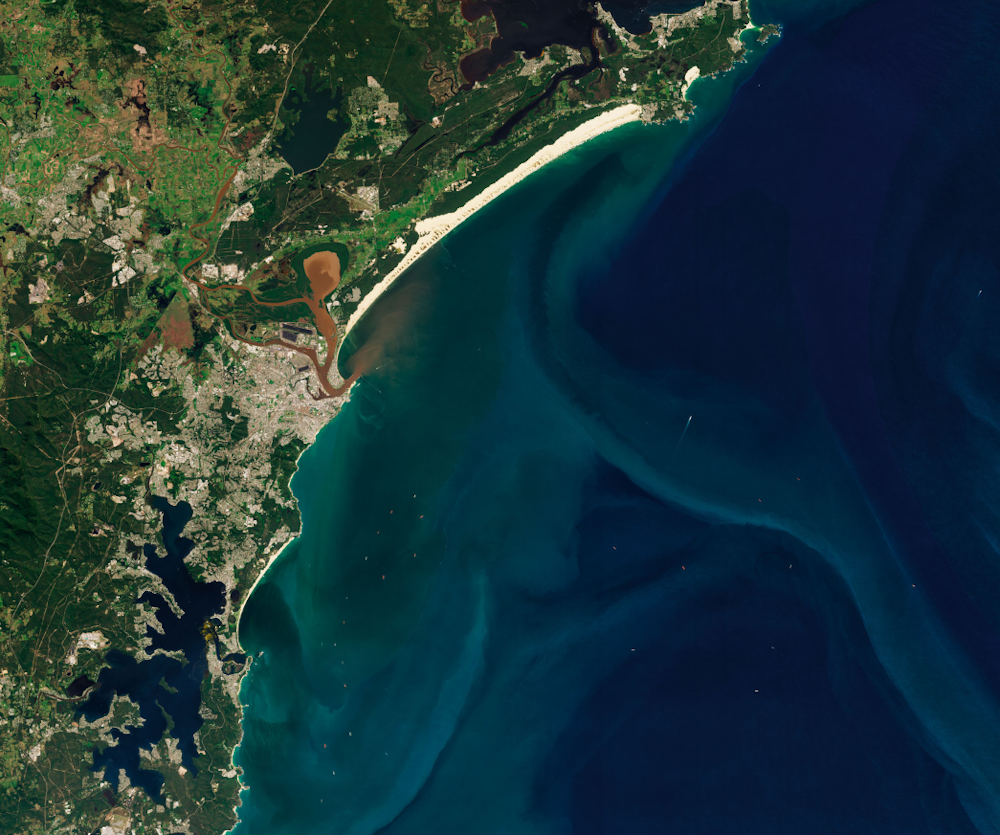
Normally, this effect clears within six days. But in 2022, extreme low salinity persisted for months in the coastal ocean. These plumes of freshwater extended as far as 70 kilometres offshore – five times further than original estimates. You could see them from space. For fish, this is confusing and dangerous. For kelp forests or sponge gardens, it can be lethal.
Unprecedented floodwaters, unprecedented impact
Why do we care about very low salt levels in our coastal seas?
First, changing salinity levels let us track where floodwaters are headed. This is important, as floodwater often carries pollutants, sediment and other contaminants from the land into the ocean.
Second, when large volumes of freshwater arrive, it can actually change the density of the ocean. Saltwater is heavier (more dense) than freshwater, which is why some seabirds can find a layer of drinking water far out at sea when it rains heavily.
The ocean’s density depends on a combination of water temperature and salinity. Off Australia’s east coast, this density is usually influenced more by temperature. But during 2022, we saw something change. For the first time, we saw the density of seawater was becoming controlled by salinity.
Rather than the hottest temperatures always being seen at the surface, the heat could be anywhere in the water column, as the weight (or density) of the water was mostly being controlled by how much salt it contains, not how warm it was.
You might look at the sea and imagine it’s the same all the way down. But in fact, there are very real changes as you go down the water column, and there are distinct layers of water.
What this pulse of floodwater did was change the structure and layering of the water column in unusual ways. In this coastal ocean, there’s usually a light layer of warm water at the top and colder water below it. During 2022, the normal ocean water was replaced by two additional layers of fresher water from successive floods.
The 50-metre deep layer of fresh water didn’t simply mix with salt. Instead, the floodwaters remained off our coastline for months, trapped between the land and the warm, swiftly flowing waters of the East Australian Current.
Read more: What's causing Sydney's monster flood crisis – and 3 ways to stop it from happening again
What does freshwater do to ocean ecosystems?
Some coastal species such as bream tolerate freshwater well. But others don’t like it at all. We expect the sudden appearance of a very large freshwater layer would have forced fish to move. The sediment and pollutants in the floodwaters can disrupt normal food supplies for the ocean’s inhabitants.
We already know floodwater can destroy kelp forests or cover verdant seagrass meadows with sediment, affecting turtles and dugong. This, in turn, can temporarily slash the catch from some fisheries.
How did we track these changes?
Off the eastern coast lies an advanced network of ocean sensors, deployed as part of Australia’s Integrated Marine Observing System. For our work, we used data from oceanographic moorings – sensors anchored to the floor and extending through the water column – as well as underwater gliders, an underwater drone packed with instruments.
Moorings give us detailed, consistent information but only at a few locations. Gliders travel hundreds of kilometres up and down the length of the coastline in a zigzag pattern, from the coast offshore and back, and diving from the surface to the bottom around every 200 metres.
We used data from moorings, gliders, satellite data and estuary monitoring sensors run by the New South Wales Department of Planning and Environment to build up a picture of where floodwaters had moved.
Even though we have a good system of sensors, our observing systems are geared towards monitoring temperature rather than salinity, meaning that this type of analysis can only be performed in certain parts of the coast that have the right instruments.
Climate change is worsening floods. Could it weaken coastal ocean salinity?
Globally, there’s little data on how salty our coastal seas are – and what floodwaters are doing, especially in areas where large rainfall is intermittent, such as eastern Australia. In 2022, severe floods also hit Pakistan and South Africa.
These regions don’t yet have ocean observing systems capable of detecting and tracking the impact of floodwaters on the ocean. We don’t know what these unprecedented floods are doing to ocean ecosystems – but it’s important we find out.
Extreme rainfall events are expected to increase globally due to climate change. We will need to determine what’s happening down there to plan our response and adapt as best we can.
Authors: Neil Malan, Research associate, Climate Change Research Centre, UNSW Sydney