The first flowers evolved before bees – so how did they become so dazzling?
- Written by Adrian Dyer, Associate Professor, Department of Physiology, Monash University
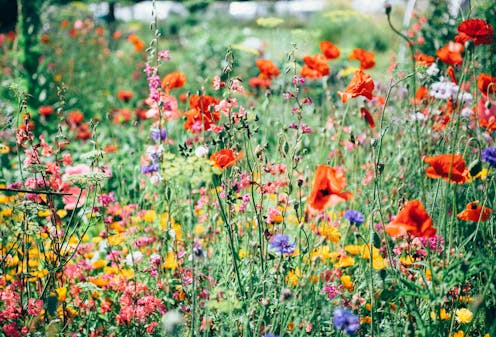
Colourful flowers, and the insects and birds that fly among their dazzling displays, are a joy of nature. But how did early relationships between flower colour and animal pollinators emerge?
In a study published in Proceedings of the Royal Society, we have unravelled this mystery by analysing the visual environments in which the ancestors of today’s bees foraged from flowers.
We measured and analysed the light reflected from today’s flowers, as well as the rocks, soil, sticks, bark and leaves that form their natural backgrounds.
From this data we built computer simulations that recreate the ancient visual environment when the first flowers emerged.
Insect colour vision came before flowers
Today, bees are prolific pollinators of flowering plants, including food crops. Bees use colour vision based on ultraviolet, blue and green sensitive photoreceptors (light-sensing cells) to detect and discriminate the most rewarding flowers. In comparison, most humans perceive colour using blue, green and red sensitive photoreceptors.
When the first flowers evolved during the Mesozoic era, between 252 million and 66 million years ago, the ancestors of bees had to orientate themselves, maintain stable flight, avoid collisions, and find food among natural backgrounds. We suspect their visual systems may have been influenced by evolution to efficiently operate in that environment.
By the time the first flowering plants appeared, bees’ ancestors had already evolved colour vision – and we know it has stuck around throughout the evolutionary history of bees.
So, while bees weren’t initially around, their ancestors were. Flower colours likely evolved the vivid colours we see today to suit this ancient visual system. At the same time, the first bees emerged as the most efficient pollinators.
What colour were flower backgrounds on the ancient Earth?
Australia is an ideal place to collect data on natural background materials that early insects would have seen, as it is a geologically ancient continent.
We collected background samples from across Australia and measured their reflective properties using a tool called a spectrophotometer.
We used this data to create a database of materials that would have been present in the visual environment of flying insects more than 100 million years ago – when the first flowers appeared.
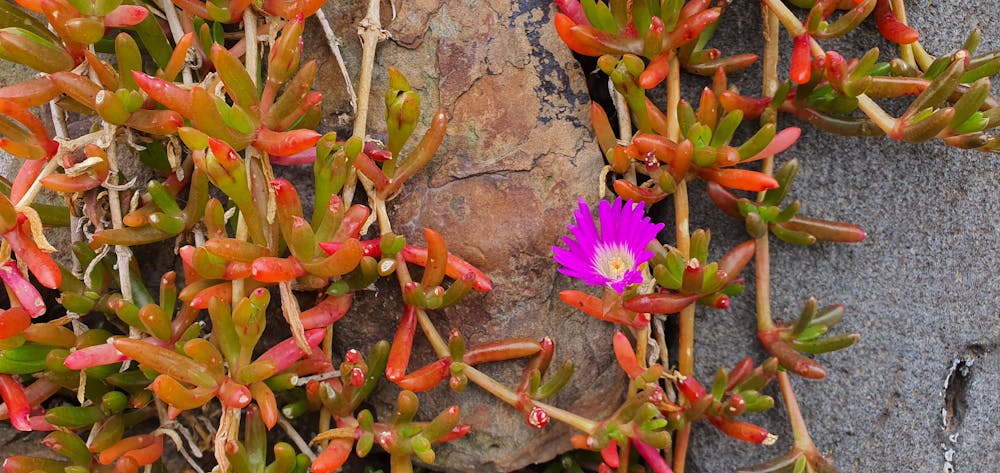
Flower colour evolved in response to bee colour vision
For our collection of natural backgrounds, insect and bird pollinated flowers, we calculated marker points – rapid changes in the intensity of light reflected from a surface, within a small wavelength band.
These marker points identify the key visual features of coloured surfaces, and we can use them for statistical testing of the evolutionary process.
Read more: Explainer: what is the electromagnetic spectrum?
We then wrote computer simulations to generate possible flower backgrounds. By analysing their marker points, we tested the visibility of today’s flowers against the simulated backgrounds.
Interestingly, we showed that the distribution of marker points on petals from plants pollinated by bees clearly indicates these flowers are “salient” – that is, they stand out as stronger signals from natural backgrounds.
This finding matches with previous studies suggesting that in the Northern Hemisphere and Australia, flowering plants evolved colour signals to facilitate colour perception by bees.
 The distribution of marker points for simulated backgrounds (brown); Australian flowers pollinated only by insects (blue) and pollinated only by birds (pink). The figure allows comparison of the markers of floral signals that have evolved in response to pressure from insect and bird vision systems and systematically straddle the markers of simulated backgrounds.
Author provided from Dorin et al. (2023), Proceedings of the Royal Society B.
The distribution of marker points for simulated backgrounds (brown); Australian flowers pollinated only by insects (blue) and pollinated only by birds (pink). The figure allows comparison of the markers of floral signals that have evolved in response to pressure from insect and bird vision systems and systematically straddle the markers of simulated backgrounds.
Author provided from Dorin et al. (2023), Proceedings of the Royal Society B.
The very first flowers were likely a dull greenish-yellow colour and initially pollinated by flies. However, as the first bees – with their tuned vision systems – started pollinating flowers, the flowers likely evolved new colours to match the bees’ visual capabilities.
The process of natural selection seems to have driven flower colours to stand out from their backgrounds in the eyes of pollinators.
Birds were involved, too
Birds became established as flower visitors millions of years after insect pollination evolved. Bird vision uses four types of colour photoreceptors, and they can see long-wavelength red colours that bees cannot easily process against natural backgrounds.
Our analysis confirmed that bird-pollinated flowers evolved marker points towards longer wavelengths than bee-pollinated flowers. Our new discovery also showed that these flowers systematically differ from natural backgrounds.
As Earth’s climate changes, it is important to consider what might happen to ecosystems and our food production systems in a world without bees. It is vital that we understand how pollination and plant reproduction may be altered.
Our research shows that bees are a major driver of floral evolution. Unless we protect these insects and their habitat, we will lose fundamental and beautiful aspects of life we all enjoy and need.
Read more: Bees can do so much more than you think – from dancing to being little art critics
Authors: Adrian Dyer, Associate Professor, Department of Physiology, Monash University