How the weird and wonderful microbes in wastewater can make our cities more sustainable
- Written by Christian Krohn, Postoctoral Researcher, School of Science, RMIT University
COVID-19 showed us how useful monitoring wastewater can be. But the genetic material in our wastewater, namely DNA and RNA, is a treasure trove of other useful information. It reveals the presence of thousands of different types of weird and wonderful wastewater microbes.
The diversity of these microbes can “talk” to us and tell us how to get more renewable energy out of our wastes. If only we could listen to them. Soon we can.
How will that work? It all starts with our poo. These types of microbes have been used since the 19th century to treat and reduce the ever-increasing volumes of sewage sludge arriving at our wastewater treatment plants, especially in urban areas. Two-thirds of the world’s people are expected to live in urban areas by 2050, hence sewage treatment will be in high demand.
Yet most people today have little idea how vital microbes are for sustainable growth of cities. We need them to treat our waste.
We also need sources of renewable energy. Thanks to naturally occurring microbes, our water utilities can produce renewable biogas from human waste. By reducing our reliance on fossil fuels, their poo biogas can help to mitigate climate change.
So we need to learn more about these microbes to ensure they are doing the best possible job of processing our waste. One way of doing that is by monitoring DNA in human waste sludge.
A living sludge mass
First of all, this promising waste-to-energy technology, which fully relies on microbes, is called anaerobic digestion.
Operating anaerobic digesters is expensive. It requires intense monitoring strategies and frequent interventions. That is because microbes can be unpredictable.
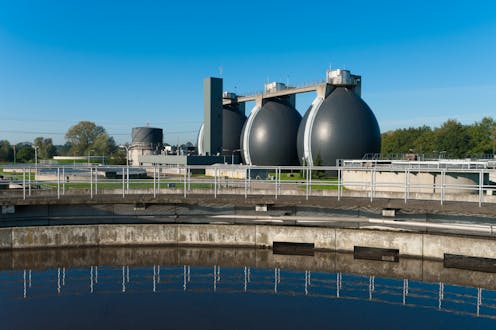
On the face of it, the process is really simple. Wastewater sludge is pumped into large vessels without oxygen, where microbes are left alone for a few days to practically eat the sludge and breathe out biogas. Sludge goes in, treated sludge plus gas goes out.
The process reduces overall sludge mass and the number of pathogens. This ultimately makes it a safer material, while also generating renewable energy. Brilliant, right?
Using anaerobic digesters to treat human waste has multiple benefits, but depends on keeping a community of microbes healthy.But there is a catch. This process is only effective if these living, breathing treatment vessels behave. Unfortunately, sometimes they get out of control without warning, making them difficult to manage.
These sludge microbes are similar to those in our gut. Once we know this, we might intuitively understand how sensitive they can be, given our experience of gastrointestinal disorders linked to our gut microbes.
So microbial happiness is not only important for our own health, it is crucial for the health of the large digester vessels managed by wastewater treatment plants. To make it cheaper to run these facilities, we urgently need to learn more about life in our sludge.
DNA, a window on an invisible world
At the ARC Biosolids Training Centre we want to make anaerobic digestion easier for water utilities by developing routine DNA-based monitoring tools. Essentially, we are looking for a way to predict the process to manage it better.
DNA tells the story of thousands of different types of microbes that work together to treat our sludge. To optimise the wastewater treatment process we need to identify them, the troublemakers and the do-gooders.
But sludge life is complex. Before it can tell us its story, we require empirical studies. We have to be able to relate microbial DNA to the process.
To show how that works we produced a review of the role of microbes for monitoring anaerobic digestion. This includes some of the diversity metrics that ecologists use to assess the health of the whole system based on the composition of microbes.

The weird and the wonderful
The microbes that are used to treat sludge consist of a diverse range of ancient, weird, at times alien-like bacteria and archaea (another form of single-celled organisms). They can metabolise materials that no other lifeform can.
Amazingly, some of them existed 3.5 billion years ago – the Earth formed 4.5 billion years ago. There is even a chance some have existed on Mars.
And sludge life is a very active community of microbes: some are bullies, some collaborators. Through their DNA, we count them to learn how many different types of microbes there are and how often they appear. This counted diversity can then tell us if a system is healthy or not.
For a healthy, productive system, we need diversity – as many different microbes as possible – to provide stability. If a particular organism somehow starts to grow faster or slower, it means something is getting out of control.
We can exploit that knowledge to develop risk scores for the operators of treatment facilities. And that is what we try to do.
We will keep working so that someday we can properly listen to our sludge-eating microbes and get more value out of our poo.
Authors: Christian Krohn, Postoctoral Researcher, School of Science, RMIT University