Getting to the heart of coal seam gas protests – it's not just the technical risks
- Written by: Hedda Ransan-Cooper, Research Fellow, College of Engineering and Computer Science, Australian National University
Opposition to coal seam gas (CSG) in Australia is remarkable. CSG proposals – mostly affecting rural areas – have spawned hundreds of opposition groups across the country. Some are now household names, like Lock the Gate and Knitting Nannas Against Gas (KNAG). But there are also many others; small local groups without logos or official websites.
Our research reveals all sorts of concerns motivate the opponents of CSG. But one factor, emotions – in particular how people “do” emotions – helps explain how people mobilise and unite in their opposition.
It’s fair to say the scale of this resistance has been a shock all round: to industry, to government, and even to organisers in the movement itself.
Read more: Fracking policies are wildly inconsistent across Australia, from gung-ho development to total bans
One of the defining characteristics of the Australian anti-CSG movement is that it involves alliances between diverse kinds of people, such as rural residents (many of them farmers) and urban-based environmental organisers. These groups can be at odds with one another on other issues, for example land-clearing policy. But with CSG, they have found common ground.
There may be differences in terms of emphasis and specific concerns, but overall the movement has been very effective at building and maintaining a momentum of opposition to the CSG industry.
CSG opposition in and around Narrabri
We were interested in what it is that brings these diverse groups together. Our research focused on the movement opposing the Narrabri Gas Project proposed for south of the town of Narrabri, 500km northwest of Sydney.
The project has been described as the “most-protested-against gas developments” in New South Wales. SBS Television’s Insight series recently devoted a program to this particular controversy.
Our research into CSG in and around Narrabri finds potential impacts on water and land are core issues that unite a broad range of people. Shared concerns also encompass questions of energy supply, climate change, procedural shortcomings and perceptions of government and industry collusion.
Yet there are also factors beyond these substantive issues that help to explain the strength of opposition to CSG in rural Australia. Our research suggests that emotions play a crucial role in building alliances and mobilising opponents of CSG.
Conversations with people involved in opposing the CSG proposal in and around Narrabri reveal the following key insights about the role of emotions.
Joy – as well as anger – sustains a movement
Anger is one of the most commonly expressed emotion by participants in the anti-CSG movement. People are angry about the possibility of having to face the negative impacts of the CSG industry. They are also angry at the government for not listening to community concerns.
Yet, while anger is a central sentiment in mobilising CSG opposition, it is the combination of anger with joy, especially the joy of social connection, that helps to sustain involvement.
Opposition to CSG is often integrated into people’s daily lives – like bringing the kids along to a highway protest. For many involved, anger and frustration at the industry and government are combined with the joy of coming together, “doing community” and employing a wide range of creative acts of protest, such as those performed by the Knitting Nannas Against Gas.
These activities bring together people with ideological differences and blur the distinctions between political and social identities. They also offer a space for participants to connect with one another in the face of “burnout” and other frustrations.
Social obligations and ‘holding back’ help
As Gabrielle Chan notes in her recent book, Rusted Off, human contact is very important in Australian rural communities. Similarly, we find that a key element of social life in Narrabri is about getting along with others. This feature of rural communities creates a significantly different context compared to environmental controversies elsewhere.
Being respectful in small rural communities often means being non-confrontational. In a small community, people rely on one another, often over multiple generations. You never know when you might need help from a neighbour.
Compared to big cities, it can be difficult to manage disagreements in small rural communities. This leads residents to “hold back” from confrontational communication styles, which contributes to sustaining relationships across different viewpoints. This has been critical in building alliances between people in the community.
Don’t neglect people’s emotions
The CSG debate can’t be fought on “the facts” alone. There is too much at stake for the community of Narrabri. Decisions that result in dramatic landscape changes – whether for wind farms, CSG wells or other energy infrastructure – are inherently emotional. Such changes can disrupt people’s sense of place or potentially threaten livelihoods.
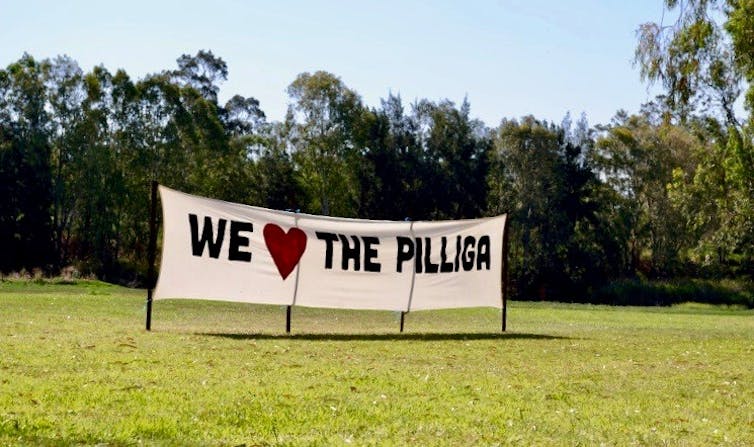 A banner at the Narrabri ‘Big Picture’ event in November 2015 is a reminder of the emotions involved in this controversy.
Selen Ercan
A banner at the Narrabri ‘Big Picture’ event in November 2015 is a reminder of the emotions involved in this controversy.
Selen Ercan
It’s not just emotional for those who oppose big energy infrastructure projects. Supporters of new projects are also worried about the future of their regions – as we’ve seen in Narrabri. Concerns include an over-reliance on existing industries and whether there will be enough jobs to keep young people in the area.
While people in the community are generally respectful of those who sit on the other side of the debate, there are still isolated incidents in which people’s concerns have been painted as “emotive” in a derogatory sense. Dismissing emotions in this way is not helpful in advancing the debate or bringing the community together.
It’s still uncertain whether the Narrabri Gas Project will proceed or not, and the strong opposition continues. Whichever side “wins”, there could be long-term effects on the social fabric of the region.
Some may feel a stronger connection to their community as a result of being actively engaged in the debate. Others may feel burnt out and concerned that their community has been so divided.
Such possible consequences are never given the attention they deserve in environmental impact statements or in other technical reports on CSG. Providing safe spaces for people to express the emotions that arise in response to large industrial projects is crucial for finding our way forward in an era of rapid energy change.
Authors: Hedda Ransan-Cooper, Research Fellow, College of Engineering and Computer Science, Australian National University