

How 'access journalism' is threatening investigative journalism
- Written by: Peter Manning, Adjunct Professor of Journalism, University of Technology Sydney
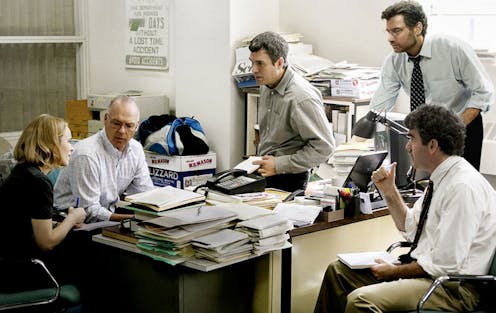
A series of memoirs are appearing for Christmas – by Mike Carlton, Kerry O’Brien and the like – as the baby boomer generation of journalists gets some quality time to reflect, laugh, and reveal some new secrets.
As the receiver of a cheapo massive cardboard screed in 1972 for “investigative journalism” from my colleagues in the ABC’s This Day Tonight, my recollection was that “investigative journalism” was a cool, new genre any young journo wanted to be associated with.
I accepted the award with honour. It was mainly the result of reporting the corrupt antics of then NSW Liberal premier Sir Robin Askin.
Amid denials that illegal casinos existed, we found one well-known establishment across the road from the ABC’s radio headquarters in Forbes Street, near Kings Cross, and arrived with cameras at the front door one night to see if we could film inside. The answer was no, but we phoned our TDT presenter, the great Bill Peach, and asked him to ring the police because we had helpfully found one of these establishments for them. At the end of the show we reported the constabulary had not arrived and wished to remain in ignorance.
It was a laugh, but had a point. Not long later, I repeated this method with a mate of mine from Sydney University, conscientious objector Michael Matteson. When federal Liberal Minister Phillip Lynch said he couldn’t find any “draft dodgers” refusing to go to Vietnam, we found the very articulate pacifist in the university canteen where he sat every day. He gave a great interview.
Back then, no-one in our gang of young troublemakers had formulated a methodology for what we were doing on a daily basis. But we instinctively knew it was a different form of the trade from what we had learned from crusty old news heads as cadets. It was:
evidence-based
“transparent” in inviting the public to see our reasoning
balanced in giving the “other side” a time and place to respond
not pursuing a government or opposition agenda.
A decade later, both ABC’s Four Corners and Brian Toohey’s National Times would make an art of developing “the document trail” or “the money trail” and letting the public see for itself where these trails led. Many of the stories were about “secrets” that security agencies such as ASIO or the CIA didn’t want revealed (for example, Pine Gap and how it operated).
Hundreds of books have since been published on what constitutes “investigative journalism”. I taught at UTS from some of them (and my own experience) a decade ago.
Now comes what I detect to be a new form of journalism. It is often badged as “exclusive investigation”, but in fact has little in common with traditional methodologies. Very often it appears to be a leak from security agencies, not about them. The stories become a convenient form of government propaganda.
The great investigative journalist Seymour Hersh recently called this new form “access journalism”. In this form, journalists report the access, usually an allegation, and do not either prove or disprove the allegation. This form has the following features:
the evidence is based on sources who cannot be named
there is no evidence base (such as a document or money trail)
it lacks transparency, in that the evidence cannot be independently verified
it serves one side’s agenda (usually the government’s)
it uses words in the text that have little definition (especially “is linked to”
it can be written and published very quickly.
The form is undoubtedly a response to the need for media to move faster for stories with big impact. But while allegations might suit US law, in Australia, where depth of research can be a useful legal defence, it is also particularly dangerous under our defamation laws.
Compare the traditional form of “investigative journalism”, which bears these traits:
it is based on identifiable sources whose standing and credibility enhance the claims
it is evidence-based (including documents, finances, and so on) proving a specific thesis or proposition formally stated in the text
its evidence is available for checking
it serves no-one’s agenda, in that several sides of the argument are heard, allowing readers/viewers to make up their own minds as to the truth
it does not use words that unnecessarily pre-judge the final conclusion
it takes a painstaking amount of time to build the evidence base, allow balance, and get legal advice if needed.
No media are immune to taking shortcuts in this transition to a digital future. Even the best, including Fairfax (now part of Nine) and the ABC can be seen to be sipping at the “access journalism” spring.
Read more: Nine-Fairfax merger rings warning bells for investigative journalism – and Australian democracy
But an allegation is not necessarily a story, nor is a “link to something” automatically evidence. There needs to be larger conversation about what constitutes proper public evidence, proper reliable sources and transparency in both.
Authors: Peter Manning, Adjunct Professor of Journalism, University of Technology Sydney
Read more http://theconversation.com/how-access-journalism-is-threatening-investigative-journalism-108831


















