

Fast serves don't make sense – unless you factor in physics and 'cheating'
- Written by: Anthony Blazevich, Professor of Biomechanics, Edith Cowan University
The serve is arguably the most important component of the modern tennis game – and the faster, the better.
But when broken down to very simplistic scientific considerations, the speeds we routinely see top players reach when they deliver a serve are theoretically impossible.
So how do they do it? The answer involves Isaac Newton, ping pong and a little bit of “cheating” (from a physics point of view).
Read more: Get a grip: the twist in the wrist that can ruin tennis careers
Serving fast seems impossible
A ball hit fast and straight cannot clear the net and still land in the service square unless the ball is struck from at least 2.6 metres above the ground. According to this equation, there’s simply not enough time for gravity to drag a high-speed ball down inside the service square.
Even if a player and their racket combined could reach up nearly three metres, the margin for error would be just 13 centimetres. And that’s only if you can serve over the lowest part of the net.
So unless you’re well over six feet tall (183 cm), serving super fast is impossible – from a physics point of view. Yet we regularly see even the shortest players serving over 180 km per hour with great accuracy.
So how is it done?
The answer of course is that players impart topspin on the ball.
This phenomenon was observed and at least partly described in 1672 by Isaac Newton (after watching court tennis) – but a more well-known description of top-spin is linked to German physicist HG Magnus, who observed it in ping pong.
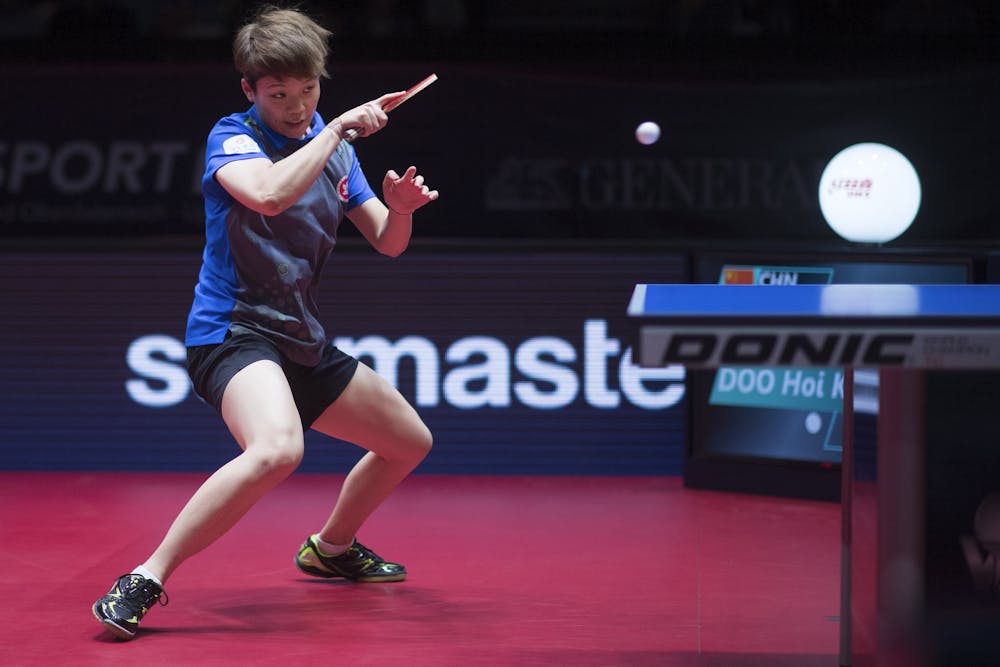 Spin is a crucial part of elite table tennis.
AAP/EPA/ANDREAS SCHAAD
Spin is a crucial part of elite table tennis.
AAP/EPA/ANDREAS SCHAAD
If the racket is brushed over the top of the ball during the serve, the ball will spin forwards as it travels. The air surrounding the ball also starts to spin with it.
Physicists call this air the “boundary layer”, and it forms around all moving objects as they travel (you’ll feel this as a rush of wind when a car, truck or train rushes past). As the ball pushes into the oncoming air, the air that travels over the top of the ball collides with the oncoming air. That air is slowed and deflected upwards away from the ball.
The air travelling under the ball meets oncoming air travelling in the same direction and is dragged behind the ball and then also upward.
According to Newton’s third law, every action has an equal and opposite reaction. So if air is drawn upwards behind the ball, then the ball must move downwards in response.
A great demonstration of this effect can be seen in this video:
Players often use the topspin tactic to great effect during the second serve. Despite the risk of not clearing the net, a top level player usually serves with a high racket head speed, to allow them to put even more topspin on the ball.
With less of the racket speed being used to give the ball forward velocity and more going across the ball to create spin, the ball will certainly travel slower than in a first serve.
But the greater topspin allows a greater margin for error as the ball easily clears the net but still drops rapidly to land well inside the service square.
Read more: You'll never see another teenage tennis champ – here's why
Beyond brute force
Of course, muscle power also has a role to play in delivering a serve with heat – but perhaps not as much as you might think.
Our muscles are amazing motors and produce the incredible forces we need to lift heavy objects, walk up mountains and climb trees.
But it has long been known, and demonstrated experimentally 80 years ago, that muscles can’t produce much force when they shorten very quickly. It’s theoretically impossible to serve at high speeds by relying on muscle power alone. To do this, we humans must cheat a little.
You might have noticed that the best tennis players “throw” their racket at the ball when they serve, as you can see in this video:
Watch Roger Federer serve in slow motion.This throw-like movement requires the player’s body to move before their arm, the upper arm to move before the lower arm, the lower arm to move before the hand, and the hand to move before the fingers.
The wrist snaps forward. The racket moves quickest when the legs have already extended and the upper arm has stopped moving forward.
When we use this throw-like pattern, much of the energy generated by the legs and shoulder muscles early in the movement is transferred to the forearm, then hand.
This is because the forearm and hand are still moving at the end of the serve and much of the energy that was located in the body moves to them during the serving action. The hand is much smaller than the whole body, or the whole arm. But it has a lot of energy, so it moves incredibly quickly.
Read more: The terrible toll tennis can take on top players who play too much
The time difference between movements of the lower and upper body also allows elastic tissues, like tendons, to store energy. These tissues recoil rapidly later in the serve when the arm snaps forwards, releasing the stored energy at speeds much faster than muscles can contract.
It is this throw-like movement – rather than brute force – that causes the hand and racket to move at speeds much higher than our muscles could possibly allow.
So to serve at your best, you have to throw your racket in a way that projects the ball at a high speed – but add some spin. It’s simple physics.
Authors: Anthony Blazevich, Professor of Biomechanics, Edith Cowan University


















