

The Darling River is simply not supposed to dry out, even in drought
- Written by: Fran Sheldon, Professor, Australian Rivers Institute, Griffith University, Griffith University
The deaths of millions of fish in the lower Darling River system over the past few weeks should come as no surprise. Quite apart from specific warnings given to the NSW government by their own specialists in 2013, scientists have been warning of devastation since the 1990s.
Put simply, ecological evidence shows the Barwon-Darling River is not meant to dry out to disconnected pools – even during drought conditions. Water diversions have disrupted the natural balance of wetlands that support massive ecosystems.
Unless we allow flows to resume, we’re in danger of seeing one of the worst environmental catastrophes in Australia.
Read more: Explainer: what causes algal blooms, and how we can stop them
Dryland river
The Barwon-Darling River is a “dryland river”, which means it is naturally prone to periods of extensive low flow punctuated by periods of flooding.
However, the presence of certain iconic river animals within its channels tell us that a dry river bed is not normal for this system. The murray cod, dead versions of which have recently bought graziers to tears and politicians to retch, are the sentinels of permanent deep waterholes and river channels – you just don’t find them in rivers that dry out regularly.
Less conspicuous is the large river mussel, Alathyria jacksoni, an inhabitant of this system for thousands of years. Its shells are abundant in aboriginal middens along the banks. These invertebrates are unable to tolerate low flows and low oxygen, and while dead fish will float (for a while), shoals of river mussels are probably dead on the river bed.
This extensive drying event will cause regional extinction of a whole raft of riverine species and impact others, such as the rakali. We are witnessing an ecosystem in collapse.
Catastrophic drying
We can see the effects of permanent drying around the world. The most famous example is the drying of the Aral Sea in Central Asia. Once the world’s fourth largest inland lake, it was reduced to less than 10% of its original volume after years of water extraction for irrigation.
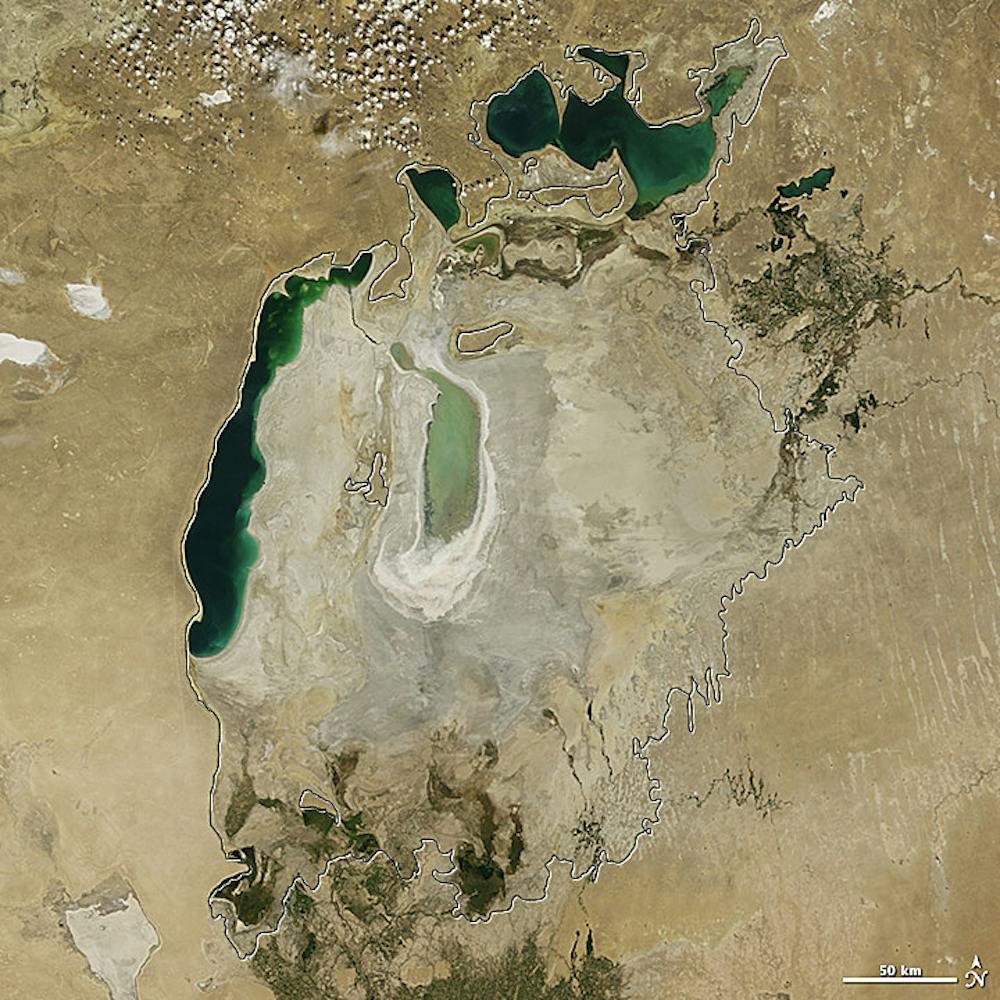 The basin that once held the Aral Sea. The giant lake has shrunk dramatically since dams were built around it in the 1960s.
AAP Image/NASA Earth Observatory
The basin that once held the Aral Sea. The giant lake has shrunk dramatically since dams were built around it in the 1960s.
AAP Image/NASA Earth Observatory
The visual results of this exploitation still shock: images of large fishing boats stranded in a sea of sand, abandoned fishing villages, and a vastly changed microclimate for the regions surrounding the now-dry seabed. Its draining has been described as “the world’s worst environmental disaster”.
Read more: Humans drained the Aral Sea once before – but there are no free refills this time round
So, what does the Aral Sea and its major tributaries and the Darling River system with its tributary rivers have in common? Quite a lot, actually. They both have limited access to the outside world: the Aral Sea basin has no outflow to the sea, and while the Darling River system connects to the River Murray at times of high flow, most of its water is held within a vast network of wetlands and floodplain channels. Both are semi-arid. More worryingly, both have more the 50% of their average inflows extracted for irrigation.
There is one striking difference between them. The Aral Sea was a permanent inland lake and its disappearance was visually obvious. The wetlands and floodplains of the Barwon-Darling are mostly ephemeral, and the extent of their drying is therefore hard to visualise.
Read more: It's time to restore public trust in the governing of the Murray Darling Basin
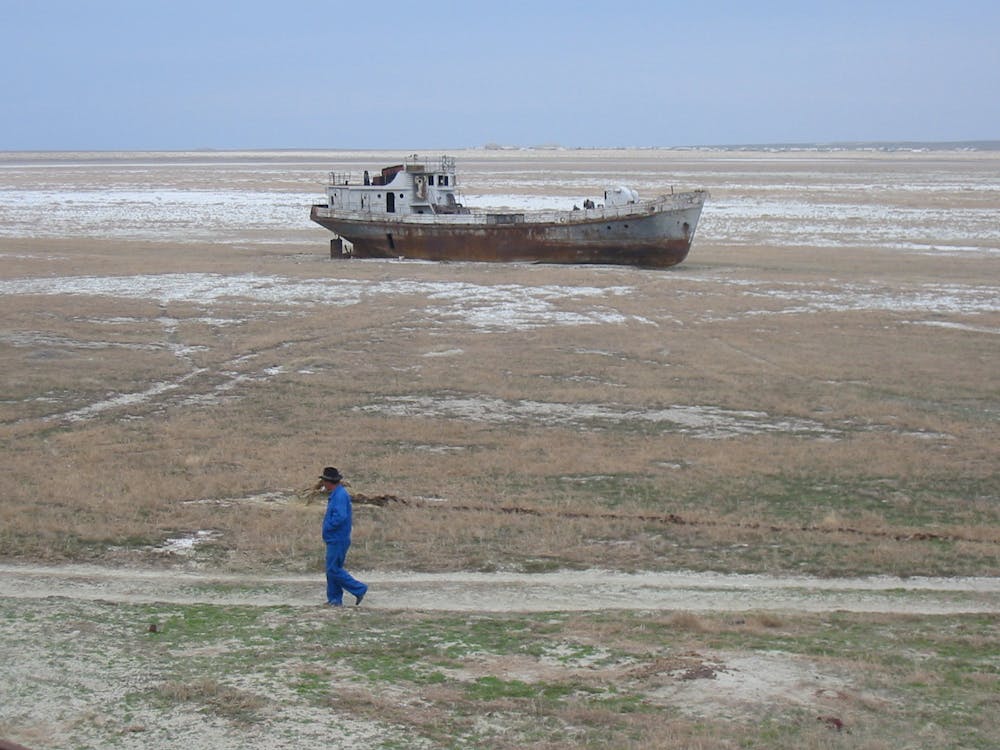 An orphaned ship in former Aral Sea, near Aral, Kazakhstan.
Wikipedia
An orphaned ship in former Aral Sea, near Aral, Kazakhstan.
Wikipedia
All the main tributaries of the Darling River have floodplain wetland complexes in their lower reaches (such as the Gwydir Wetlands, Macquarie Marshes and Narran Lakes). When the rivers flow they absorb the water from upstream, filling before releasing water downstream to the next wetland complex; the wetlands acting like a series of tipping buckets. Regular river flows are essential for these sponge-like wetlands.
So, how has this hydrological harmony of regular flows and fill-and-spill wetlands changed? And how does this relate to the massive fish kills we are seeing in the lower Darling system?
Read more: How is oxygen 'sucked out' of our waterways?
While high flows will still make it through the Barwon-Darling, filling the floodplains and wetlands, and connecting to the River Murray, the low and medium flow events have disappeared. Instead, these are captured in the upper sections of the basin in artificial water storages and used in irrigation.
This has essentially dried the wetlands and floodplains at the ends of the tributaries. Any water not diverted for irrigation is now absorbed by the continually parched upstream wetlands, leaving the lower reaches vulnerable when drought hits.
By continually keeping the Barwon-Darling in a state of low (or no) flow, with its natural wetlands dry, we have reduced its ability to cope with extended drought.
Read more: Why a wetland might not be wet
While droughts are a natural part of this system and its river animals have adapted, they can’t adjust to continual high water caused in some areas by water diversions – and they certainly can’t survive long-term drying.
The Basin Plan has come some way in restoring some flows to the Barwon-Darling, but unless we find a way to restore more of the low and medium flows to this system we are likely witnessing Australia’s worst environmental disaster.
Read more: It will take decades, but the Murray Darling Basin Plan is delivering environmental improvements
Authors: Fran Sheldon, Professor, Australian Rivers Institute, Griffith University, Griffith University



















