

Hannah Arendt wanted political thinking to be urgent and engaged. She is a philosopher for our times
- Written by: Ned Curthoys, Senior Lecturer in English and Literary Studies, The University of Western Australia
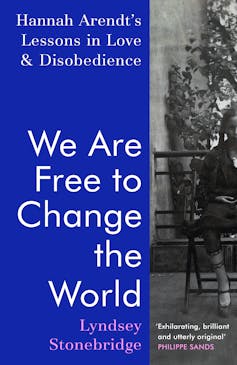
Lyndsey Stonebridge begins We Are Free to Change the World, her illuminating biography of Hannah Arendt, by reminding us of her subject’s continuing relevance.
Arendt is sometimes thought of as a lofty and abstract thinker. Yet her thinking was highly responsive to the shock of Nazism and the rise of fascism, which left her stateless and acutely vulnerable for many years. After World War II, she discarded any ready-made theories. These included comfortable notions that Nazism and Stalinism were aberrations from the eventual global triumph of Western democracy.
As Stonebridge points out, Arendt wanted political thinking to be urgent and engaged. Thinking about our times could reconcile us to the perplexities of the reality we face and help us address our common predicament. There is a need for “thinking what we are doing” – a need to respond to circumstances in a way that is creative, courageous and receptive to the texture of experience.
Readers fascinated by Arendt’s singular voice and breadth of concern with the human condition will know that reading her is, as Stonebridge reminds us, “never just an intellectual exercise, it is an experience”.
Review: We Are Free to Change the World: Hannah Arendt’s Lesson’s in Love and Disobedience – Lyndsey Stonebridge (Jonathan Cape)
Arendt narrowly escaped Hitler’s Germany and survived a detention camp at Gurs in France before she received a visa to the United States in Portugal. In 1941, she arrived in the US, where she eventually gained citizenship in 1951.
In We Are Free to Change the World, Stonebridge embarks on a memorable pilgrimage to the many places Arendt lived and departed from in her itinerant journey as a stateless person. Her biography is an attempt to experience Arendt anew, to engage with her as an adventurous spirit thinking about her own times, in such a way that we can “think more defiantly and creatively about our own”.

 In The Origins of Totalitarianism, Arendt speaks to prewar conditions eerily similar to the social media fuelled erosion of reasoned public debate. She notes that nothing illustrates the general disintegration of political life better than a “vague pervasive hatred of everyone and everything”.
Stonebridge celebrates Arendt as an advocate of public political participation. Arendt considered freedom itself to be the experience of social intercourse between political equals. Hence she was deeply concerned that loneliness, “once suffered in certain marginal social conditions like old age, has become an everyday experience of the evergrowing masses of our century”.
Arendt recognised more acutely than other observers that we live between a past that no longer guides us and an uncertain future we must collectively shape. She warned against retreating into nostalgia, of false and myopic conceptions of national sovereignty that seemingly expunge the problem of vulnerability.
The perspective of the outsider
Determined never to lose the perspective of being a refugee and outsider, Arendt was an unconventional critic of the nation state – a system that produces ethnocentric majorities and marginalised minorities, whose rights can be curtailed and citizenship repealed at the whim of the majority.
Stonebridge’s most telling point is that, for Arendt, to be a refugee was not simply an accident of war or a natural tragedy, but a structural component of the modern world. Since the 19th century, racism and imperialism had made population transfer and violent expulsion a ubiquitous possibility of geopolitics.
In The Origins of Totalitarianism, Arendt speaks to prewar conditions eerily similar to the social media fuelled erosion of reasoned public debate. She notes that nothing illustrates the general disintegration of political life better than a “vague pervasive hatred of everyone and everything”.
Stonebridge celebrates Arendt as an advocate of public political participation. Arendt considered freedom itself to be the experience of social intercourse between political equals. Hence she was deeply concerned that loneliness, “once suffered in certain marginal social conditions like old age, has become an everyday experience of the evergrowing masses of our century”.
Arendt recognised more acutely than other observers that we live between a past that no longer guides us and an uncertain future we must collectively shape. She warned against retreating into nostalgia, of false and myopic conceptions of national sovereignty that seemingly expunge the problem of vulnerability.
The perspective of the outsider
Determined never to lose the perspective of being a refugee and outsider, Arendt was an unconventional critic of the nation state – a system that produces ethnocentric majorities and marginalised minorities, whose rights can be curtailed and citizenship repealed at the whim of the majority.
Stonebridge’s most telling point is that, for Arendt, to be a refugee was not simply an accident of war or a natural tragedy, but a structural component of the modern world. Since the 19th century, racism and imperialism had made population transfer and violent expulsion a ubiquitous possibility of geopolitics.
 Hannah Arendt in 1958.
Barbara Niggl Radloff, via Wikimedia Commons, CC BY-SA
Arendt was right in thinking that the desperate plight of the refugee and asylum seeker would outlast the immediate horrors of total war and genocide. Totalitarian thinking would also outlast its more immediate fascist manifestations.
This is why, going against the grain of the triumphalism that greeted the founding of the state of Israel, Arendt lamented that “like virtually all other events of the 20th century, the Jewish question merely produced a new category of refugees, the Arabs, thereby increasing the number of stateless and rightless by 700,00 to 800,000 people”.
In words now resonating with the extreme Israeli violence in Gaza, celebrated by the political right, Stonebridge notes that, for Arendt, the growing number of stateless people demands not a “solution” but a new politics. Arendt wanted a global recognition of the “right to have rights” of every human being, so that they might be judged by their actions and opinions.
Arendt’s (after) thought on her own experience of statelessness is that when people can be deprived of belonging and visibility so easily, it is a harbinger of a future in which entire national groups can be outlawed. Stonebridge links these considerations to the current wars on Ukraine and Palestine.
In her essay Zionism Reconsidered (1944), Arendt argued in her signature ironic tone that Zionism itself, whatever its redemptive rhetoric, was a form of assimilation to 19th-century European nationalism. In the essay We Refugees (1943), she held fast to the critical perspective of the refugee as a kind of conscious “pariah”. If refugees “keep their identity”, she mused, they will represent the “vanguard of their peoples”.
Having experienced statelessness and possible oblivion, Arendt was clear-sighted about where the intensification and ideological exploitation of racism will lead. She understood that “racism may indeed carry out the doom of the Western world and for that matter human civilization”. The result will not be a more secure world for the privileged, for the manipulation of rage can only lead to “anti-political senselessness” and ethical degeneration.
Modern evil and the lunatic lunge
Stonebridge, attentive to Arendt as a thinker of her own experiences, makes an important contribution to the long-running debate over Arendt’s portrait of Adolf Eichmann. Her chapter “Who Am I to Judge” offers a balanced appraisal of Arendt’s book Eichmann in Jerusalem.
Hannah Arendt in 1958.
Barbara Niggl Radloff, via Wikimedia Commons, CC BY-SA
Arendt was right in thinking that the desperate plight of the refugee and asylum seeker would outlast the immediate horrors of total war and genocide. Totalitarian thinking would also outlast its more immediate fascist manifestations.
This is why, going against the grain of the triumphalism that greeted the founding of the state of Israel, Arendt lamented that “like virtually all other events of the 20th century, the Jewish question merely produced a new category of refugees, the Arabs, thereby increasing the number of stateless and rightless by 700,00 to 800,000 people”.
In words now resonating with the extreme Israeli violence in Gaza, celebrated by the political right, Stonebridge notes that, for Arendt, the growing number of stateless people demands not a “solution” but a new politics. Arendt wanted a global recognition of the “right to have rights” of every human being, so that they might be judged by their actions and opinions.
Arendt’s (after) thought on her own experience of statelessness is that when people can be deprived of belonging and visibility so easily, it is a harbinger of a future in which entire national groups can be outlawed. Stonebridge links these considerations to the current wars on Ukraine and Palestine.
In her essay Zionism Reconsidered (1944), Arendt argued in her signature ironic tone that Zionism itself, whatever its redemptive rhetoric, was a form of assimilation to 19th-century European nationalism. In the essay We Refugees (1943), she held fast to the critical perspective of the refugee as a kind of conscious “pariah”. If refugees “keep their identity”, she mused, they will represent the “vanguard of their peoples”.
Having experienced statelessness and possible oblivion, Arendt was clear-sighted about where the intensification and ideological exploitation of racism will lead. She understood that “racism may indeed carry out the doom of the Western world and for that matter human civilization”. The result will not be a more secure world for the privileged, for the manipulation of rage can only lead to “anti-political senselessness” and ethical degeneration.
Modern evil and the lunatic lunge
Stonebridge, attentive to Arendt as a thinker of her own experiences, makes an important contribution to the long-running debate over Arendt’s portrait of Adolf Eichmann. Her chapter “Who Am I to Judge” offers a balanced appraisal of Arendt’s book Eichmann in Jerusalem.
 Arendt understood Eichmann, in his mediocrity and thoughtlessness, as the epitome of the “banality of evil”. Stonebridge is rightly critical of Arendt’s insensitivity in the parts of Eichmann in Jerusalem that discuss the Jewish Councils’ cooperation with the Nazis. Yet the point of the book, Stonebridge reminds us, is to follow through on Arendt’s insights in The Origins of Totalitarianism that thoughtlessness, indifference and apathy are characteristics of modern evil. This meant that the “book of horrors could not be closed with the fall of the Third Reich or Eichmann’s death”.
“I don’t know if we will ever get out of this,” Arendt mused in correspondence to her great friend and mentor Karl Jaspers, who had suggested to her that evil in our times has no depth, that there is nothing demonic about it. It is more like a fungus or bacteria that can “lay waste to the entire world”.
Arendt is well known for maintaining in response that we must love the world and vigilantly care for its plurality of peoples, its phenomenal diversity, its sublimely vast ecologies. A critical point she makes is that our very sense of the real depends on the ability to enlarge our mentality and “visit” other perspectives.
In our post-truth age, the disenfranchised are “positively keen for deceit” in a last “lunatic lunge for belonging”, but Arendt maintained that our very sense of reality, our “common sense”, depends on our good will and curiosity, our adventurous enjoyment of robustly testing our opinions and perspectives against those of others.
I will leave the final words to Stonebridge’s book, which pays testament to Arendt’s attempts to make sense of our common experiences without fear or favour: “Now pay attention and get on with the work of resisting the sorry reality you find yourselves in.”
Arendt understood Eichmann, in his mediocrity and thoughtlessness, as the epitome of the “banality of evil”. Stonebridge is rightly critical of Arendt’s insensitivity in the parts of Eichmann in Jerusalem that discuss the Jewish Councils’ cooperation with the Nazis. Yet the point of the book, Stonebridge reminds us, is to follow through on Arendt’s insights in The Origins of Totalitarianism that thoughtlessness, indifference and apathy are characteristics of modern evil. This meant that the “book of horrors could not be closed with the fall of the Third Reich or Eichmann’s death”.
“I don’t know if we will ever get out of this,” Arendt mused in correspondence to her great friend and mentor Karl Jaspers, who had suggested to her that evil in our times has no depth, that there is nothing demonic about it. It is more like a fungus or bacteria that can “lay waste to the entire world”.
Arendt is well known for maintaining in response that we must love the world and vigilantly care for its plurality of peoples, its phenomenal diversity, its sublimely vast ecologies. A critical point she makes is that our very sense of the real depends on the ability to enlarge our mentality and “visit” other perspectives.
In our post-truth age, the disenfranchised are “positively keen for deceit” in a last “lunatic lunge for belonging”, but Arendt maintained that our very sense of reality, our “common sense”, depends on our good will and curiosity, our adventurous enjoyment of robustly testing our opinions and perspectives against those of others.
I will leave the final words to Stonebridge’s book, which pays testament to Arendt’s attempts to make sense of our common experiences without fear or favour: “Now pay attention and get on with the work of resisting the sorry reality you find yourselves in.”
 ‘Nobody has the right to obey.’ Portrait of Hannah Arendt in the courtyard of her birthplace in Linden, Germany.
Hannes Grobe, via Wikimedia Commons, CC BY-SA
Authors: Ned Curthoys, Senior Lecturer in English and Literary Studies, The University of Western Australia
‘Nobody has the right to obey.’ Portrait of Hannah Arendt in the courtyard of her birthplace in Linden, Germany.
Hannes Grobe, via Wikimedia Commons, CC BY-SA
Authors: Ned Curthoys, Senior Lecturer in English and Literary Studies, The University of Western Australia 



















