

How do economists judge Australia’s response to the COVID pandemic?
- Written by: Adrian Esterman, Professor of Biostatistics and Epidemiology, University of South Australia
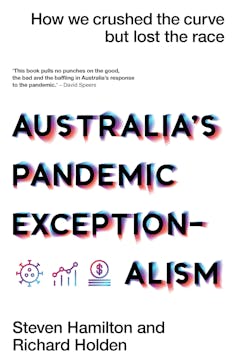
It was only a matter of time before someone wrote a book about Australia’s response to the COVID-19 pandemic. I was expecting it to come from an eminent epidemiologist or public health expert, but it has been written by two economists. As an epidemiologist who covered the pandemic closely for The Conversation, I read it with interest.
The authors are Steven Hamilton, assistant professor of economics at George Washington University, and Richard Holden, a business academic and regular columnist for the Australian Financial Review.
The book covers Australia’s response to the pandemic in roughly chronological order, starting with Australia’s first case on January 25 2020. Although the authors praise the quick border closures, they have some issues with Australia’s early response. For example, they point out that incoming travellers from Italy, where COVID-19 was running rife, were not screened well enough.
Review: Australia’s Pandemic Exceptionalism: How we Crushed the Curve But Lost the Race by Steven Hamilton and Richard Holden (NewSouth)
They describe the formation of a National Cabinet, which included all state and territory leaders, and first met on March 13. I must admit, at the time, I was surprised the Labor opposition leader was not invited, which would have made it a truly bipartisan approach.
The National Cabinet immediately restricted gatherings of over 500 people and all international arrivals were required to quarantine. Social distancing measures were encouraged. Cruise ship arrivals from foreign ports were banned. Then, finally, on March 20, the Australian border was closed to all non-residents and non-citizens.
The authors argue the response was all a bit too gradual and indecisive.

The overarching goal over that period was to prevent an exponential outbreak of the virus, they point out. Once this happened, it would be almost impossible to get it back under control without draconian measures.
This was the start of using hotels for quarantine. In my view, this was a poor decision: hotels were simply not built for this purpose. The authors explain that the government was trying to help out the hotel operators, who had lost business because of the pandemic, by giving them a role in managing it.
Economic exceptionalism
But what of Australia’s economic response to the pandemic? The authors note its close link to the public health response – which they praise, especially in the early months. They highlight that in 2020, the Coalition government provided about one third of a trillion dollars in financial support to a wide variety of recipients. These include individuals and families, businesses who benefited from schemes like JobKeeper, social security recipients, and the childcare and aged care sectors. This shows, they argue, that governments can step up in times of crisis, regardless of ideology.
They note that while some industries, like toilet-paper manufacturers and supermarkets, benefited from the pandemic, others were shut down. (Why there was a run on toilet paper at the time is beyond me!)
The authors describe Australia’s economic response as exceptional – both of the right magnitude and well-tailored. In particular, they praise JobKeeper, the wage subsidy program that supported businesses significantly affected by the pandemic by helping them retain their employees. Maintaining this link between workers and their employers was important, they say.
They also spend a lot of time discussing Australia’s financing and tax system (they call it economic plumbing), and the massive part the Australian Tax Office’s Single Touch Payroll system played in the economic recovery. They describe it as the “pandemic’s unsung hero”. The system requires every employer to report salaries and wages, tax withholding and superannuation liabilities every time they do a pay run. It was critical in designing JobKeeper, they point out.
What didn’t we do well?
In early 2020, we really had no idea whether or not it would be possible to develop a successful vaccine for COVID-19. However, we were helped by the 2005 discovery of a technique to produce customized mRNA, later licensed to Pfizer and Moderna.
In May 2020, Donald Trump announced Operation Warp Speed, aimed at coordinating and accelerating the development of COVID-19 vaccines, to the tune of US$11 billion provided to eight companies.
At the same time, the Gates foundation provided hundreds of million dollars to set up a vaccine supply chain. As the authors put it:
So, between two Ivy League scientists, the former host of American reality TV show The Apprentice, and the world’s second richest man, the critical elements of successful vaccines had been put in place.
 President Donald Trump hands a pen to Vice President Mike Pence after signing an executive order on vaccine distribution during an Operation Warp Speed Vaccine Summit.
Evan Vucci/AAP
President Donald Trump hands a pen to Vice President Mike Pence after signing an executive order on vaccine distribution during an Operation Warp Speed Vaccine Summit.
Evan Vucci/AAP
The authors argue our government only needed to do three things:
secure enough effective vaccines
convince the public to get vaccinated
manage the vaccination roll-out process efficiently.
While they commend the government for the latter two, they criticise the failure to secure enough effective vaccines.
The government gambled on a limited range of vaccines, including the University of Queensland vaccine, which never reached the market, and AstraZeneca, which had rare adverse events: fatal blood clots and low platelet counts, also known as thrombosis with thrombocytopenia syndrome. The authors also criticise the Therapeutic Goods Administration (TGA) and the Australian Technical Advisory Group on Immunisation (ATAGI) for being too slow and cautious.
Lockdowns and testing
The authors only briefly discuss lockdowns, and suggest they were justified from both a public health and economic viewpoint. They believe much of the economic contraction at that time was due to voluntary, rather than mandatory, social distancing. I know not all Australian economists agree.
They are in favour of mass testing, pointing out if you don’t test, you don’t know how many cases you have. My most vivid recollection of that time is Donald Trump’s claim that if we didn’t test, we would have fewer cases. Clearly flawed logic.
The authors criticise the “fetishisation of PCR tests”, saying that calling them the “gold standard” was both wrong and extremely damaging. They had two reasons for this criticism.
Firstly, they think PCR tests were too sensitive, producing false positives due to the presence of dead virus particles. “Too accurate”, they call them. This put an “enormous strain on the contact tracing system”. I don’t buy this argument. PCR tests for COVID-19 have almost 100% specificity: that is, they have very few false positives.
Instead, the authors advocate for Rapid Antigen Tests (RATs) which are much cheaper, and criticise the government and Therapeutic Goods Administration for delaying their approval.
 Were PCR tests too sensitive?
Bianca De Marchi/AAP
Were PCR tests too sensitive?
Bianca De Marchi/AAP
As for contact tracing, they talk about differences between states and territories, and how Victoria’s system was so much worse than that of New South Wales. They point out that in 2020, Victoria’s contact tracing system still relied on fax notifications. Only slowly (and almost grudgingly) did Victoria move to a more automated system.
Turning to vaccination, the authors point out that by November 6 2021, the goal of 80% vaccination of those aged 16 and over had been achieved. The population was now less likely to get infected, and to suffer serious consequences if they were.
Finally, on February 21 2022, Australia’s international borders were opened.
The authors conclude that Australia did as well as any other country in response to the pandemic – and certainly much better than the United States and United Kingdom.
The UK for example had its borders open throughout the pandemic. In the US, during the first few months of the pandemic, the federal government and most state and local governments took few actions to disrupt normal economic and social life.
Reflecting on the past to improve the future
 This book is not an easy read, but it will suit readers with an interest in the history of that pandemic period, or a background in economics or government policy. As an epidemiologist, I found much of it interesting, but got a bit lost in the detailed economic discussions.
It is well written, but would benefit from an index. For example, if you want to find out about Australia’s use of quarantine hotels, you would have to read the whole book to find any discussion about it.
In the introduction, the authors say: “Even going through the exercise of preparing this book dredged up memories for both of us that we had long forgotten”.
Yes, reviewing the book did the same thing for me. Bad memories tend to get blocked in our minds, and eventually forgotten. However, as the authors wisely point out, “only by reflecting on the past can we hope to improve the future”.
Authors: Adrian Esterman, Professor of Biostatistics and Epidemiology, University of South Australia
This book is not an easy read, but it will suit readers with an interest in the history of that pandemic period, or a background in economics or government policy. As an epidemiologist, I found much of it interesting, but got a bit lost in the detailed economic discussions.
It is well written, but would benefit from an index. For example, if you want to find out about Australia’s use of quarantine hotels, you would have to read the whole book to find any discussion about it.
In the introduction, the authors say: “Even going through the exercise of preparing this book dredged up memories for both of us that we had long forgotten”.
Yes, reviewing the book did the same thing for me. Bad memories tend to get blocked in our minds, and eventually forgotten. However, as the authors wisely point out, “only by reflecting on the past can we hope to improve the future”.
Authors: Adrian Esterman, Professor of Biostatistics and Epidemiology, University of South AustraliaRead more https://theconversation.com/how-do-economists-judge-australias-response-to-the-covid-pandemic-236403


















