

The ‘world’s mayor’ – how Michael Bloomberg uses philanthropy to change the way cities are run
- Written by: Tom Baker, Associate Professor in Human Geography, University of Auckland, Waipapa Taumata Rau
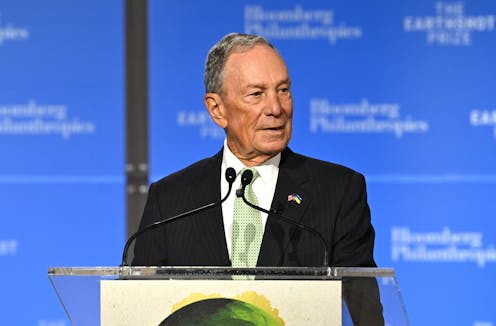
Since the end of his three-term New York City mayoralty in 2013, Michael Bloomberg hasn’t shied away from public attention. Presidential ambitions and global climate policy advocacy have kept him busy.
But what is shaping up to be one of the most ambitious projects of the 82-year-old billionaire’s public life is not happening on the highly visible stages of national and international politics. It is unfolding in the stereotypically humdrum halls of city government.
Through Bloomberg Philanthropies – the vehicle for his personal and corporate giving – he has advanced an array of initiatives for city government leaders. The organisation is now providing funding and technical support to around 700 city governments across 150 countries – including Wellington City Council’s new digital community engagement tools.
In the process, Bloomberg has created for himself a historically unique and highly influential quasi-public position.
As a kind of “world’s mayor”, he promotes a burnished version of his self-styled image while New York City mayor: eking out efficiency and effectiveness gains within city government through assiduous managerial control and better use of evidence.
But Bloomberg’s inroads into global local government also raise important questions about the reliability of philanthropy over the long term – and its democratic legitimacy.
A ‘perfect match’?
Bloomberg has described partnerships between philanthropists and government as a “perfect match”. “Philanthropists,” he notes, “have resources that governments need for innovation, and governments have powers that philanthropists need for solving problems.”
City governments are especially short of resources. Most face growing demands but diminishing financial capacity. They often contend with indifferent or actively hostile state and national governments, as well as the slow progress of international agreements.
Without the necessary resources and capabilities, they struggle to address a range of problems felt intensely at the local scale, from unaffordable housing to climate change.
Enter the “government innovation program” from Bloomberg Philanthropies, a pro-bono system of capacity-building initiatives for city governments. It has been growing for over a decade, tentatively at first, and concentrating initially on the United States.
Since 2017, more than 275 mayors and 400 city officials, mainly American, have attended year-long intensive training by the Bloomberg-funded City Leadership Initiative at Harvard University. Last year, one-third of American cities were reportedly led by a participant in the program.
But the “Bloomberg world” – as one of several city officials we interviewed described it – has expanded and diversified over time. It is now one of the most influential global players in urban policy dialogue and practice.
Soft power
Bloomberg Philanthropies’ “Mayors Challenge” competition was initially specific to the US, Europe, Latin America and the Caribbean.
But in 2021 it began to expand globally, receiving entries from 631 cities in 99 countries. Fifteen winning cities, including Wellington, were each awarded US$1 million (NZ$1.57 million) and substantial technical support.
The organisation has established around 40 “innovation teams” within city governments. And its certification system for data-driven decision making has become something city leaders now strive toward. There are over 60 “certified cities” in the US, with plans to expand abroad.
Bloomberg-funded initiatives are now announced with such consistency it would be hard for a city government practitioner to avoid them.
In just one month recently, 20 mayors signed a public declaration of their adherence to data-driven decision making, as part of their induction into the second round of the Bloomberg Philanthropies’ City Data Alliance.
Ten cities won US$1 million each to implement sustainable transport projects; 60 city leaders attended a workshop run by the Bloomberg Harvard City Leadership Initiative on making “procurement an engine of innovation”; and the tenth Bloomberg CityLab summit was announced for Washington DC.
There have been examples of philanthropic foundations using their financial heft as a form of hard power to push city governments around – Detroit’s post-bankruptcy “Grand Bargain”, for example, or New Orleans’ post-hurricane rebuild.
But Bloomberg Philanthropies favours a soft-power model. It gauges and anticipates the needs of city governments, and supports them as they align toward shared goals and methods. They “gently steer”, according to one city government official we interviewed.
Democratic legitimacy
The difference between pushing and steering is evident in Bloomberg Philanthropies’ tendency to avoid advocating for particular policy solutions. Any perception of political interference could dampen cities’ willingness to partner.
Instead, the organisation’s expanding reach and growing indispensability rest on providing know-how: offering access to technical assistance, funding and networks to implement “best process”, informed by better data.
In this sense, its role is one of “meta-governor” – adjudicating, promoting and embedding the practices of good governance.
But while Bloomberg’s philanthropy seems welcomed by city governments, it raises important political issues. Philanthropic funding can be appealing because it comes with fewer strings attached. However, it also comes without democratic accountability. And there are risks in relying on funding streams subject to the whims of billionaires.
As ever, the big question about philanthropy is not whether it is useful to those receiving it, but rather should it even exist? Faced with a forbidding fiscal outlook and mounting policy challenges, it’s a question city governments might not have the luxury of asking.
This article is based on the authors’ forthcoming paper in the International Journal of Urban and Regional Research.
Authors: Tom Baker, Associate Professor in Human Geography, University of Auckland, Waipapa Taumata Rau


















