

How we created a beautiful native wildflower meadow in the heart of the city using threatened grassland species
- Written by: Katherine Horsfall, PhD Candidate, School of Agriculture, Food and Ecosystem Sciences, The University of Melbourne
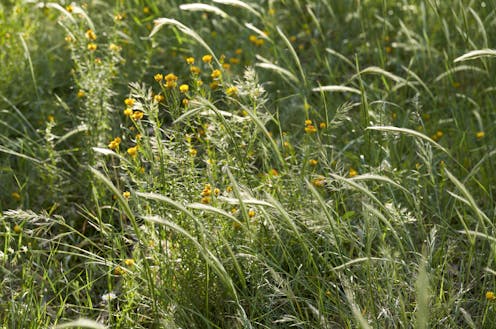
A city street may seem an unusual place to save species found in critically endangered grasslands. My new research, though, shows we can use plants from these ecosystems to create beautiful and biodiverse urban wildflower meadows. This means cities, too, can support nature repair.
Species-rich grassy ecosystems are some of the most threatened plant communities on the planet. Occupying easily developed flat land, grassy ecosystems are routinely sacrificed as our cities expand.
In south-east Australia, the volcanic plains that support Melbourne’s northern and western suburbs were once grasslands strewn with wildflowers, “resembling a nobleman’s park on a gigantic scale”, according to early explorer Thomas Mitchell. But these exceptionally diverse, critically endangered ecosystems have been reduced to less than 1% of their original area. The few remnants continue to be lost to urban development and weed invasion.

Unfortunately, efforts to restore the grasslands around Melbourne have had mixed results. In 2020 the City of Melbourne took matters into its own hands. Recognising it is possible to enrich the diversity of birds, bats and insects by providing low-growing native plants, the council set a goal to increase understorey plants by 20% on the land it manages.
Creating a large native grassland in inner-city Royal Park would help achieve this goal. Adopting a technique used by wildflower meadow designers, we sowed a million seeds of more than two dozen species from endangered grasslands around Melbourne. All but one of these species established in the resulting native wildflower meadow.
What were the challenges at this site?
Existing restoration techniques remove nutrient-enriched topsoils full of weed seeds before sowing native seeds. The target plant community can then establish with less competition from nutrient-hungry weeds.
However, this approach could not be used at the Royal Park site. Topsoil removal cannot be used on many urban sites where soils are contaminated or there are underground services. Alternative approaches are needed to reduce weed competition while minimising soil disturbance.
I saw a possible answer in the horticultural approaches used to create designed wildflower meadows.
While still rare in Australia, designed wildflower meadows can increase the amenity and biodiversity of urban environments. They also reduce the costs of managing and mowing turf grass. These meadows are designed to be infrequently mown or burnt.
Wildflower meadow designers typically use an international suite of species that can be established from seed and persist without fertiliser or regular irrigation. An abundance of flowers makes people more accepting of “messy” vegetation. Recognising this, designers select a mix of species that will flower for as much of the year as possible.
To reduce competition from weeds, these meadows are often created on a layer of sand that covers the original site soils. The low-nutrient sand buries weed seeds and creates a sowing surface that resists weed invasion from the surrounding landscape.
However, the grasslands around Melbourne grow on clay soils, not sand. Would these techniques work for plants from these ecosystems?
A deep sand layer controls weeds and slugs
To find out we sowed more than a million seeds on sites with two depths of sand (10mm and 80mm) and one without a sand layer in Royal Park. Within one year, 26 of the 27 species sown had established to form a dense, flowering meadow across all sand depths. These plants included three threatened species.
Crucially, the deepest sand layer reduced weed numbers and therefore time spent weeding.
Interestingly, slugs played a role in determining the diversity of the native meadow. South-east Australia’s grasslands have largely evolved without slugs. As a result, seedlings lack chemical or physical defences against grazing by slugs, which can greatly reduce species diversity in native meadows.
Again, sand provided a real benefit. Fewer slugs occurred on the deepest sand layer compared to bare soil. The suggestion that sand can deter slugs is consistent with meadow research in Europe.
Now to repair nature in all our cities
Our research gives us another technique to reinstate critically endangered plant communities. We can use it to bring nature back to city parks and streets.
Working in urban contexts also unlocks other advantages. There’s ready access to irrigation while the meadow gets established and to communities keen to care for natural landscapes. Creating native wildflower meadows in cities also helps native animals survive, including threatened species that call our cities home.
People will be able to engage with beautiful native plants that are now rare in cities. Enriching our experience of nature can enhance our health and wellbeing.
My colleagues and I trialled these approaches with the support of the City of Melbourne. We are continuing our research to improve the scale and sustainability of native wildflower meadows in other municipalities.
Native wildflower meadows and grassland restoration projects could genuinely help Australia meet its commitment to restore 30% of degraded landscapes. But first we need to invest much more in seed production. Reinstating native species on degraded land requires a lot of seed.
Once seed supply is more certain, we will be able to bring back native biodiversity and beauty to streets, parks and reserves across the country.
I would like to acknowledge the Traditional Custodians of the land on which the project took place, the Wurundjeri and Bunurong people of the Kulin Nations, and we pay our respects to their Elders, past, present and emerging. I also acknowledge my colleagues listed as co-authors on the research paper that formed the basis of this article: urban ecologists Nicholas S.G. Williams and Stephen Livesley, and seed ecologists Megan Hirst and John Delpratt.
Authors: Katherine Horsfall, PhD Candidate, School of Agriculture, Food and Ecosystem Sciences, The University of Melbourne


















