

Modern Australian
Men's Weekly

.

Daylight saving is about to start. But why do the days get longer?

  • Written by Laura Nicole Driessen, Postdoctoral researcher in radio astronomy, University of Sydney

Daylight saving is about to start. But why do the days get longer?

The days are getting longer and in Australia, the switch to daylight saving time is almost upon us (for about 70% of the population, anyway).

But why do we have longer days in summer and shorter days in winter?

It’s all about the tilt

Earth goes around the Sun in an almost circular orbit. But not everything is lined up perfectly. Earth’s axis is tilted by 23.44 degrees relative to its orbit around the Sun.

Imagine Earth’s orbit as a flat frisbee with the Sun in the middle and Earth as a ball on a stick going around the edge.
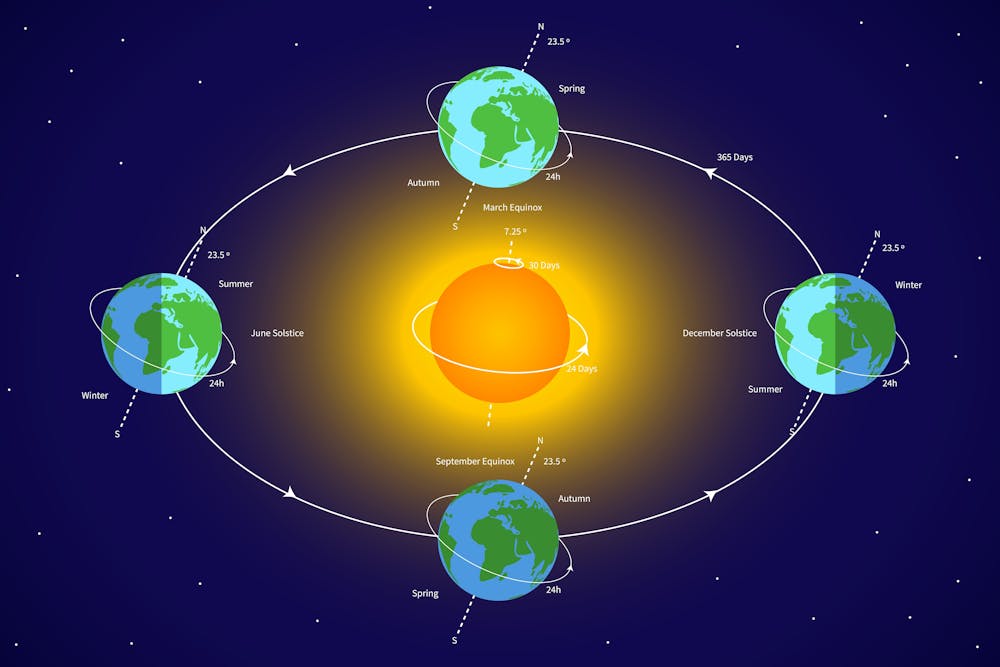
Diagram of Earth's rotation around the sun.
Earth goes around the Sun in an almost circular orbit. Angela Cini/Shutterstock

If Earth’s axis wasn’t tilted (if its tilt was zero degrees) the stick would be exactly perpendicular to the frisbee. If you grab that perpendicular stick and tip it 23.44 degrees sideways, that’s what Earth’s tilt looks like now.

As Earth orbits the Sun, the tilt of the stick does not rotate relative to the Sun. If you were in outer space looking at the Sun and you watched from the exact same position for a whole year, you would see Earth go around the Sun while the stick stayed tilted the same direction.

In other words, if the top of the stick was pointing to the right when you started watching Earth go around the Sun, it would stay pointing to the right the whole way around.

Diagram of Earth shown as a ball with a stick through it. The top half of the ball is coloured blue and the bottom half is coloured green.
Diagram of Earth showing its rotational axis that it spins around once per day. The Northern Hemisphere is coloured blue and the Southern Hemisphere is coloured green. Laura Driessen

This tilt gives us longer days in summer and shorter days in winter. Let’s set up the scenario so the Northern Hemisphere is the top of the planet and the Southern Hemisphere is the bottom of the planet.

When Earth is on one side of the Sun, the top of the stick is pointed towards the Sun. This is summer in the Northern Hemisphere and winter in the Southern Hemisphere. Six months later, when Earth is on the other side of the Sun, the bottom of the stick is pointed towards the Sun – and the seasons are reversed.

Diagram of the solstices. Earth is a ball with the top half coloured blue and the bottom half coloured green, it's orbiting a bright yellow Sun.
The summer and winter solstices happen when Earth is on opposite sides of the Sun (six months apart). Earth’s axis tilt leans the same direction, to the right in this diagram, the whole way around the Sun. The Earth and Sun are not to scale in this diagram. Laura Driessen

Solstices and equinoxes

Those two points, when the top of the stick is pointing directly towards the Sun or directly away from the Sun, are the solstices. They are the longest and shortest days of the year, depending on your hemisphere.

The shortest day of 2024 in Australia was June 21. Looking forward to sunnier times, the longest day of the year in 2024 will be December 21.

A diagram showing Earth tilted sideways, directly in front of the Sun.
The equinox occurs when Earth is side-on to the Sun (not to scale). In this diagram, the Sun is very far behind Earth. Just like in the previous image, the tilt of Earth’s axis stays leaning in the same direction the whole way around the Sun. A second equinox happens when Earth is on the other side of the Sun too. Laura Driessen

In between the summer and winter solstice, we have the equinoxes – when days and nights are almost exactly the same length. Those are the days when the stick through Earth is “side-on” to the Sun. The equinox is also the day when the Sun passes directly over Earth’s equator. In 2024 this happened on March 20 at 2:06pm AEDT and September 22 at 10:43pm AEST.

That means that since September 22, days have been getting longer than nights in the Southern Hemisphere.

What does daylight saving do?

Earth’s tilt means the Sun both rises earlier and sets later as we head towards summer. When the clocks (in some states) switch to daylight saving time, people in these states all get one hour less of sleep. However, the total length of the day doesn’t change just because we changed our clocks.

For me, daylight saving means I need an extra cup of coffee in the morning for about a week before I adjust to the daylight saving-lag (like jet lag, but without the fun of travel).

What it really gives us is more daylight in the evening, instead of more daylight in the morning. If you’re already a morning person, this isn’t the way to go. But if you prefer to have a long dinner in the summer sun it’s ideal.

Has it always been this way?

Earth’s axis hasn’t always been tilted at 23.44 degrees. It cycles from a minimum 22.1 degree tilt to a maximum 24.5 degree tilt and back again once every approximately 41,000 years.

Earth’s axis also “precesses”, where the stick through it draws a circle once every approximately 26,000 years. You can see this in the animation below.

A gif of the Earth wobbling in a circle on its axis. Demonstration of the precession of Earth’s axis. NASA/JPL-Caltech

The length of a day on Earth hasn’t always been the same, either.

At the moment, the length of a day is nearly exactly 24 hours. But it’s shifting all the time by tiny amounts. This is tracked very closely by a system of telescopes and satellites. These systems measure “Earth orientation parameters” that describe Earth’s exact orientation compared to the position of stars in the sky.

These are important to astronomers because the exact location of our telescopes is important for creating accurate maps of the sky. On top of all of this, the gravitational drag from the Moon causes days to become longer by around 2.3 milliseconds every 100 years. A few billion years ago, Earth’s day was a lot shorter – only 19 hours long.

Even though some of us are losing an hour of sleep this weekend, at least we get to enjoy 2.3 milliseconds longer every day than our great – and great-great – grandparents did.

Authors: Laura Nicole Driessen, Postdoctoral researcher in radio astronomy, University of Sydney

Read more https://theconversation.com/daylight-saving-is-about-to-start-but-why-do-the-days-get-longer-240221


When Grief Doesn’t Follow a Timeline

Grief rarely moves in a straight line. It doesn’t follow stages neatly, and it doesn’t respond well to pressure — especially the quiet pressure ...

Steel Plate And Its Role In Modern Construction And Manufacturing

A steel plate is one of those materials that quietly holds the modern world together. It does not demand attention, yet it supports bridges, buildin...

Understanding Fat Transfer to the Breast: What to Know Before Considering the Procedure

Surgical options for breast enhancement have evolved over time, offering different approaches depending on a person’s goals and body type. One opt...

What to Do When Your Car’s Side Window Is Broken

A shattered side window is more than an inconvenience. Whether caused by a break-in, road debris, or accidental impact, it leaves your vehicle exposed...

Shopify Web Development and Shopify Website Development for Scalable Online Stores

Choosing the right platform is a crucial decision for any online business, and Shopify web development has become a popular choice for brands that ...

How a Burleigh Heads Plumber Tests for Pipe Leaks

Pipe leaks can be deceptively difficult to spot. Some announce themselves with a steady drip under the sink, but many develop quietly behind walls, ...

What Local Businesses Should Expect from IT Services in Melbourne?

If you run a Melbourne business with roughly 7–100 staff, you have probably noticed something over the last couple of years. The IT problems got m...

How Professional Cleaning Improves Indoor Air Quality

Indoor air quality (IAQ) plays a crucial role in our health, comfort, and overall wellbeing. Australians spend nearly 90% of their time indoors-at hom...

Solar and Solar Battery Systems: Powering Smarter Homes in Victoria

As energy prices continue to rise and sustainability becomes a priority for Australian homeowners, more families are investing in Solar and Solar Ba...

Plumbing Emergency Melbourne: What to Do When Every Minute Counts

A sudden plumbing issue can quickly turn into a major disaster if not handled promptly. From burst pipes and overflowing toilets to leaking gas line...

Why Older Melbourne Homes Require Detailed Building & Pest Inspections

Older homes make up a large part of Melbourne’s housing stock. Victorian terraces, Edwardian houses, Californian bungalows, and post-war brick hom...

7 Essential Tips for Choosing Reliable Moving Services in Perth

Moving to a new home or office can be exciting, but it also comes with stress, planning, and plenty of decisions. One of the most important choices yo...

How to Find the Best Real Estate Agent Near You on the Central Coast

Choosing the right real estate agent can make a major difference to your final sale price, days on market, and overall experience. The Central Coast...

Unlock Durability And Beauty With Burnt Timber Cladding Solutions

Imagine a home or commercial space that not only stands the test of time but also tells a story through its very facade. In the world of architectur...

Offroad Caravans: Built for Adventure Beyond the Beaten Track

Australia’s vast and varied landscapes invite travellers to explore far beyond sealed roads and crowded parks. Offroad caravans are purpose-built ...

The Expert's Guide to Understanding Large Bore Steel Pipe Specifications

When it comes to infrastructure, construction, and various industrial applications, the choice of materials is paramount. Among the options availabl...

Preparing for Your First Trip to San Francisco in 2026

San Francisco has long occupied a particular place in the Australian imagination. It is compact yet complex, progressive but historic, and visually st...

Modern Office Painting in Australia - It's the Real Game Changer

Walk into any modern Australian office today and you'll be struck by the fact it's a whole different beast from the ones we grew up with. Gone are t...
















