

What makes Chinese students so successful by international standards?
- Written by: Peter Yongqi Gu, Associate Professor, School of Linguistics and Applied Language Studies, Te Herenga Waka — Victoria University of Wellington
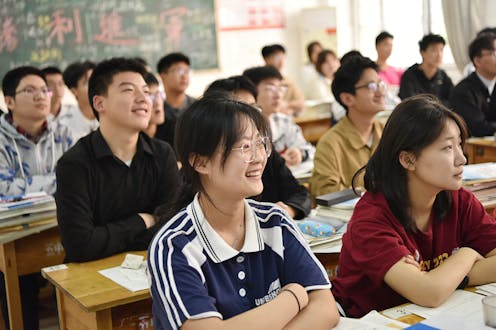
There is a belief widely held across the Western world: Chinese students are schooled through rote, passive learning – and an educational system like this can only produce docile workers who lack innovation or creativity.
We argue this is far from true. In fact, the Chinese education system is producing highly successful students and an extremely skilled and creative workforce. We think the world can learn something from this.
In a viral video earlier this year, Apple CEO Tim Cook highlighted the unique concentration of skilled labour that attracted his manufacturing operations to China:
In the US, you could have a meeting of tooling engineers, and I’m not sure we could fill the room. In China you could fill multiple football fields.
To which Tesla CEO Elon Musk quickly responded on X: “True”.
When South African President Cyril Ramaphosa visited the Shenzhen headquarters of electric vehicle manufacturer BYD earlier this year, he was surprised to learn the company was planning to double its 100,000-strong engineering taskforce within the coming decade.
He might not have been so surprised had he known Chinese universities are producing more than ten million graduates every year – the foundation for a super-economy.
The ‘paradox of the Chinese learner’
Chinese learners achieve remarkable success levels compared to their Western – or non-Confucian-heritage – counterparts.
Since Shanghai first participated in the PISA educational evaluation in 2009, 15‑year-olds in China have topped the league table three out of four times in reading, mathematics and science.
How can a supposedly passive and rote Chinese system outperform its Western counterparts? A number of Australian scholars have been studying this “paradox of the Chinese learner” since the 1990s.
Their research shows those common perceptions of Chinese and other Asian learners are wrong. For example, repetition and meaningful learning are not mutually exclusive. As one Chinese saying goes:
书读百遍其意自现 – meaning reveals itself when you read something many times.
What can Western education learn?
An emphasis on education is a defining feature of Chinese culture. Since Confucianism became the state-sanctioned doctrine in the Han Dynasty (202BCE–220CE), education has entered every fabric of Chinese society.
This became especially true after the institutionalisation of the Keju system of civil service examinations during the Sui Dynasty (581CE–618CE).
Today, the Gaokao university entrance examination is the modern Keju equivalent. Millions of school leavers take the exam each year. For three days every July, Chinese society largely comes to a standstill for the Gaokao.
While the cultural drive for educational excellence is a major motivation for everyone involved in the system, it is not something that is easily learned and replicated in Western societies.
However, there are two principles we believe are central to Chinese educational success, at both the learner and system levels. We use two Chinese idioms to illustrate these.
The first we call “orderly and gradual progress” – 循序渐进. This principle stresses patient, step-by-step and sequenced learning, sustained by grit and delayed gratification.
The second we call “thick accumulation before thin production” – 厚积薄发. This principle stresses the importance of two things:
- a comprehensive foundation through accumulation of basic knowledge and skills
- assimilation, integration and productive creativity only come after this firm foundation.
Knowledge, skill and creativity
The epitome of orderly and gradual progress is the way calligraphy is learned. It goes from easy to difficult, simple to complex, imitating to free writing, technique to art. Since 2013, it has been a mandatory weekly lesson in all primary and middle schools in China.
The art of Chinese writing embodies patience, diligence, breathing, concentration and an appreciation of the natural beauty of rhythm. It teaches Chinese values of harmony and the aesthetic spirit.
“Thick accumulation” can be illustrated in the way students study extremely hard for the national Gaokao examination, and also during tertiary education. This way they accumulate the basic knowledge and skills required in a modern society.
“Thin production” refers to the ability to narrow or focus this accumulated knowledge and skill to find and implement creative solutions in the workplace or elsewhere.
Ways of learning
On the face of it, the emphasis on gradual and steady progress, and on accumulation of basic knowledge and skills, may look like a slow, monotonous and uninspiring process – the origin of those common myths about Chinese learning.
In reality, it boils down to a simple argument: without a critical mass of basic knowledge and skills, there is little to assimilate and integrate for productive creativity.
Of course, there are problems with Chinese learning and education, not least the fierce competitiveness and overemphasis on examinations. But our focus here is simply to show how two basic educational principles underpin Chinese advances in science and technology in a modern knowledge economy.
We believe these principles are transferable and potentially beneficial for policymakers, scholars and learners elsewhere.
Authors: Peter Yongqi Gu, Associate Professor, School of Linguistics and Applied Language Studies, Te Herenga Waka — Victoria University of Wellington


















