

Psst... wanna buy a necklace? Humans have been faking jewellery for thousands of years
- Written by: Michelle Langley, ARC DECRA Research Fellow, Griffith University
Making fake jewels isn’t a modern phenomenon – it’s a human behaviour that dates back thousands of years.
New research published today suggests that traders 2,000 years ago were producing imitation amber beads, coating them with pine tree resin to make them appear to be the real deal.
Six beads found in two Bronze Age (around 3-2,000-years-ago) burial sites – La Molina and Cova del Gegant, both located in Spain – were not what they seemed to be.
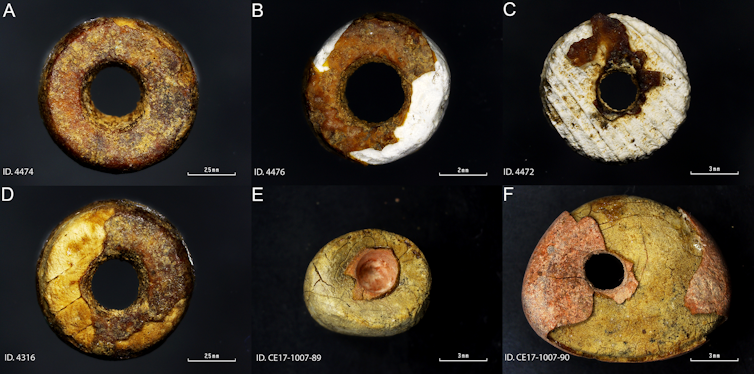 The new research shows that beads were coated in pine resin to make them look like higher value amber.
Odriozola et al., 2019
The new research shows that beads were coated in pine resin to make them look like higher value amber.
Odriozola et al., 2019
High-tech analysis of the beads found that people had carved the beads from shell and seeds before coating them in layers of gold-coloured resin from a pine tree. This resin coating would have made them appear to be legitimate amber beads.
Amber was relatively rare and of high value at the time. While appreciated as a decorative stone, amber is actually the fossilised resin of coniferous trees – which is why we sometimes find insects and other small things preserved within it.
Read more: How 'bling' makes us human
A history of fakes
As astonishing as this 2,000 to 3,000-year-old Spanish scam might seem, the manufacture of imitation jewels is actually much older.
The earliest examples go all the way back to the Aurignacian culture, some 43,000 to 37,000-years-ago. At this time, the first modern humans (Homo sapiens) were moving into Western Europe and had very particular aesthetic tastes. These tastes revolved around shiny white seashells and animal teeth which were made into necklaces and sewn onto clothing.
In some cases, getting a hold of seashells wasn’t easy. If you lived inland you had to either travel there (a trek of hundreds or even thousands of kilometres) and collect them yourself or trade for them with someone who had – which made them rare, and therefore, expensive.
Some wouldn’t have had the resources to get these sought after shell and teeth beads – but they still wanted the look, so replicas were made out of common local raw materials.
We know this because archaeologists have found replica seashells as well as red deer, fox and horse teeth carefully carved out of mammoth ivory and soft white stone at a number of sites throughout Europe and the Near East.
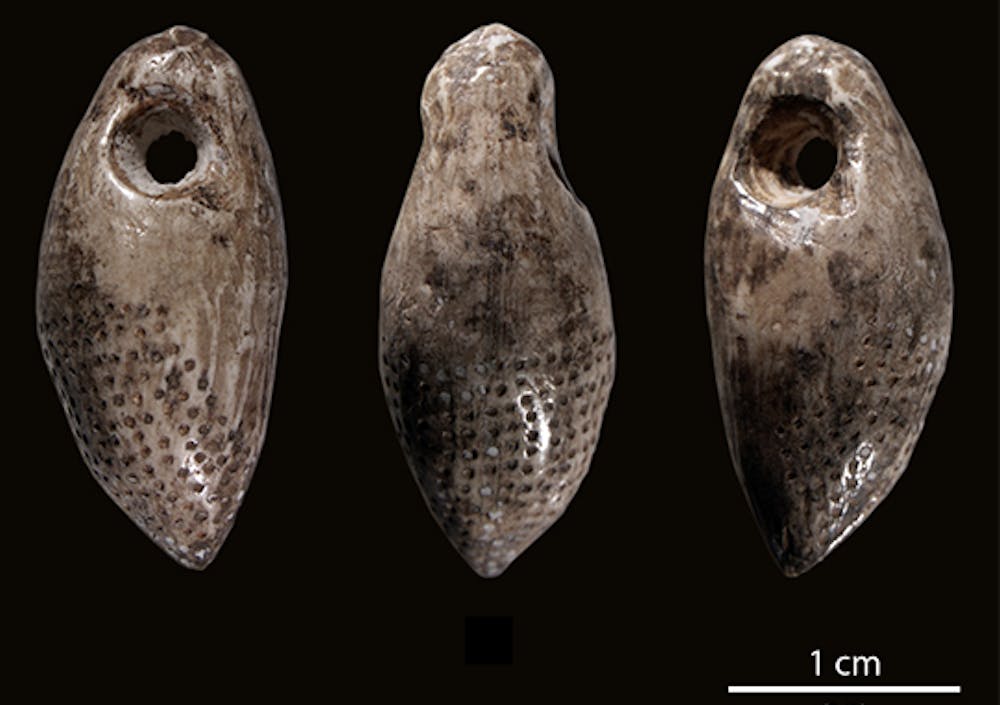 Palaeolithic forgery: a 37-35,000-year-old imitation marine shell bead made in mammoth ivory from the Aurignacian site of Abri Castanet (France).
R. White, CC BY
Palaeolithic forgery: a 37-35,000-year-old imitation marine shell bead made in mammoth ivory from the Aurignacian site of Abri Castanet (France).
R. White, CC BY
Manufacturing imitation beads became a widespread practice over the following 20,000 or so years, with rare or exotic jewellery items copied in shape and colour in numerous prehistoric and later cultures around the globe.
Read more: Ice age art and 'jewellery' found in an Indonesian cave reveal an ancient symbolic culture
There’s something about amber
People have loved amber for a long time.
The earliest beads in this warm, honey-coloured material date back to the arrival of modern humans into Europe (that is, around 40,000 years ago).
And it’s not just beads we have used amber for – but also artworks. One particularly gorgeous example is a 14,000-year-old carving of a female elk found in a Federmessergroupen (Epi-Palaeolithic) site in northern Germany.
Written records surviving from the ancient Romans and Greeks discuss the various theories peoples across Europe had for the origin of this mysterious golden material – ranging from the tears of goddesses, tears of birds, fallen drops of sunlight, and even the urine of a Lynx!
Also surviving are accounts of how these ancient peoples believed that amber had a medicinal or magical quality which protected and helped heal the human body. This belief is something that has survived into the modern era – most recently in the trend to adorn infants with amber beaded necklaces to treat the pain of teething.
 It is a common sight in Australia – and elsewhere – to see teething infants wearing amber necklaces.
from www.shutterstock.com
It is a common sight in Australia – and elsewhere – to see teething infants wearing amber necklaces.
from www.shutterstock.com
While the effectiveness of amber to treat pain, inflammation, or ability to protect you from harm is debated – its beauty remains undisputed and will no doubt continue to support its popularity worldwide.
Authors: Michelle Langley, ARC DECRA Research Fellow, Griffith University


















