

Beach shacks are an iconic part of Australian summer. Yet, they have also have a hidden, more complex history
- Written by Anna Clark, Professor in Public History, University of Technology Sydney
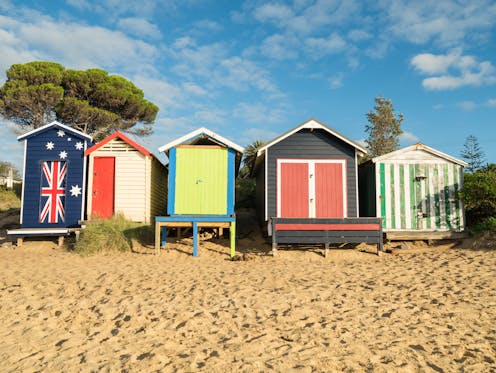
From the Torres Strait to Tasmania, and from the east coast to the west, beach shacks are an iconic part of Australian coastal history.
Beach shacks have a distinctive identity as emblems of summer holidays and unadorned simplicity. Yet, their history also reflects the complexity of Australians’ attachment to the beach.
Many Australians have associations with beach shacks, through old family connections, recent sea changes or holiday rentals. They’re seared into family memories of place and time, where generations of children play in the same rockpools and revisit the same stretch of sand.
Writing about a shack in southern Tasmania, the author Shelly O’Reilly remembers family feasts of mussels “placed on a sheet of metal to fizz with the brine inside them until they opened up”. She also recalls learning to swim in the cold, calm saltwater of the tidal lagoon as her aunts safely held her.
Across the country, the Blowholes shack community near Carnarvon in Western Australia, has been threatened for several years with demolition by state and local governments. The small collection of rough-hewn shacks tucked into the dunes survives for now. Most are empty, but clearly in use, awaiting a weekend, school break or summer sojourn.
These beach escapes might be separated by thousands of kilometres – and inhabit vastly different parts of the country – yet they still evoke a shared feeling of everyday lives being shed.
A distinctly Australian architectural style
I’m researching and writing a history of the beach in Australia, and through this work, I’ve traced how a style of building and living has developed over generations around the beach shack. Heritage professionals refer to these spontaneous, opportunistic structures, woven together with reused materials on the fly, as a type of “vernacular architecture”.
While the origins of these structures are practical and humble, it’s ironic the very isolation and simplicity of their construction on the coastal edge now makes Australia’s beach shacks privileged spaces, out of reach for most people.
My research of material archives of the shacks reveals a long history stretching back to the 19th century, when keen fishers stashed swags and cooking pots in beach scrub and dunes to return to their favourite spot when the weather and tides were right.
Sometimes these camps were fashioned into meagre little shacks, scrounged together from anything at hand, such as driftwood, tin and repurposed building supplies. They were used as fishing shacks or weekenders. Some were shelters for the destitute who had nowhere else to live.
Many didn’t last, swallowed by the growing cities, increasingly regulated public spaces or the elements themselves. Others are still standing, palimpsests of beach occupation that are constantly being added to.
First Nations’ cultural connections to the shores
This built simplicity forced by place and culture might have an identifiable, even celebrated, architectural “style” today. However, it’s misleading to think the historical significance of these beach shacks doesn’t reach much farther back into the deep past.
What we now call “architecture” has been associated with Australian beaches for millennia. When Captain James Cook sailed in through the heads of Kamay Botany Bay in 1770, he described gunyas dotted along the foreshore in his search for water:
Saw as we came in on both points of the bay Several of the natives and a few hutts.
The remnants one wooden structure — a possible sleeping platform — can still be seen at the Yindayin rock shelter above a beach on Flinders Island off Cape York, alongside a stunning gallery of rock art.
Research by archaeologists and Traditional Owners dates the human use of this place back 6,000 years, to the last sea level rise. This confirms an enduring cultural connection to the beach on Yithuwarra Country.
Colonisation profoundly disrupted First Nations life, pushing people off coastal Country in ways that facilitated settler-colonial leisure at the beach.
At other times, colonisation forced Indigenous communities onto the beach when their more arable Country further inland was invaded by pastoralists, who filled it with livestock and crops.
Coastal settlements, like Lake Tyers in Victoria, Wallaga Lake and Wreck Bay on the New South Wales south coast, and La Perouse in Sydney, provided some safety and autonomy, as well as varying degrees of financial and cultural independence, thanks to fishing.
But these First Nations communities were deliberately located on the fringes of colonial society, sometimes alongside other marginalised people, like Chinese fishers.
They were also wracked by the violent, impoverishing effects of colonisation, characterised by excessive state control on the one hand and neglect on the other.
Fringe-dwelling during hard times
During the Great Depression, swathes of non-Indigenous families were also forced into coastal shanties when they could no longer pay rent.
Those with nowhere to live took to camp life wherever they could — by the banks of the Swan and Canning rivers and on Wanneroo beachfront in Perth, along the Torrens in Adelaide, and by beaches up and down the east coast near towns and cities where there was likely to be work.
At places such as Frog Hollow (Yarra Bay) and Happy Valley in Sydney, the unemployed camped alongside the La Perouse Aboriginal reserve, blurring the racial boundaries of “fringe-dwelling” that had shaped geographies of Australian space since the early years of colonisation.
In 1932, at Yarra Bay alone, more than 1,000 people were living in 300 camps fashioned from flattened kerosene tins, packing cases, hessian and canvas.
Public attitudes to that place were a mix of disdain and admiration. “Misery camp at La Perouse”, read one desperate headline from The Sun in 1931. The paper reported:
There is no system of sanitation, and the water supply comes from a freshwater spring. The sea is their bathroom, and their food is Government rations, for which they walk weary miles into town twice a week.
Yet in that “misery” was also a sense of communitarian spirit. As the economic ripples of the Great Depression impacted more and more workers, renters and families, informal and illegal beach shacks like those at Crater Cove on Sydney Harbour, La Perouse and Royal National Park became permanently occupied.
It’s a vital part of Australian history, but not an uncomplicated one.
A precarious future
While a powerful sense of social connection and place is evoked in these historically significant shack communities, some conservationists and regulators have argued for their removal. They point out many shacks were built illegally on public land, can restrict public access to public beaches, and present ecological threats to vulnerable coastal habitats.
Yet, that very isolation and precarity, their unique vernacular style, is also what makes these beach shacks loved by shackies and their families, who have fought for their heritage protection.
Authors: Anna Clark, Professor in Public History, University of Technology Sydney

















