

Grampians National Park is still burning – here’s what we can expect will survive and recover
- Written by: John White, Associate Professor in Wildlife and Conservation Biology, Deakin University
Fire broke out in the Grampians National Park (Gariwerd) in December and raged for weeks. Then lightning strikes ignited fresh blazes late last month, which merged to form a mega-fire that’s not out yet.
This 168,000-hectare reserve, about 200km west of Melbourne, is a significant ecological and cultural landscape. Its ancient sandstone mountains and valleys maintain eucalypt woodlands and heathlands that support a rich diversity of plants and animals, making it a key conservation asset in Victoria.
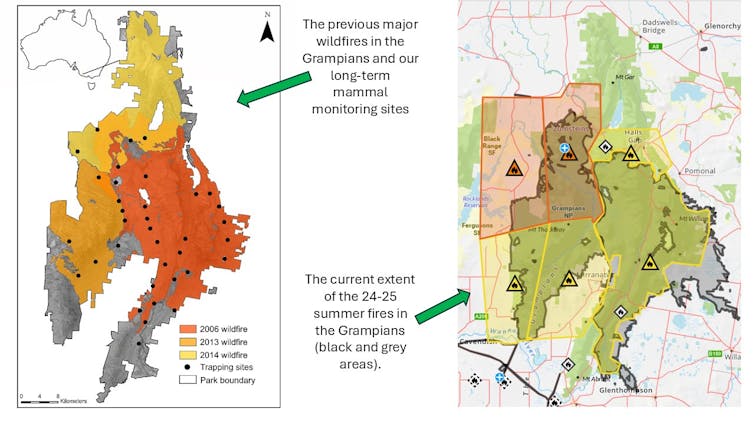
Since 2008, our team has been monitoring mammal species annually in the Grampians. This long-term effort has allowed us to learn how species respond to wildfires, droughts and floods.
We commenced our research just two years after big fires swept through the park in 2006. We also witnessed the changes following more fires in 2013 and 2014.
So while many animals have lost much of their habitat to fire this summer, we know recovery is possible. But some may need help to cope with challenges ahead.
A terrible summer as multiple fires rage
The massive December wildfire in the park’s east burned for weeks, forcing evacuations in towns such as Halls Gap, and upending Christmas for many residents. By early January, that fire was contained – but only after burning about 76,000 hectares of the park and surrounding areas.
Then, on January 27, lightning strikes in the west ignited four fires that eventually merged, burning through the entire Victoria Range and some rural properties.
The full extent of damage is not yet known. But it’s already clear the fires have been devastating. They burned much of the same areas affected by the 2006 wildfires in the east and 2013 fires in the west, as well as long-unburned areas.
Combined, fires this big have not been observed in this landscape in the past 50 years.

What is the extent of the damage to the environment?
It’s difficult to determine how much of the park has burned so far this summer, because the shaded area on the state emergency map extends beyond the park’s borders. But a rough, conservative estimate suggests at least 110,000 hectares of the 168,000 hectare park has burned since December. This is a deeply troubling scenario.
The Grampians is an isolated landscape – an “island” of native vegetation surrounded by a sea of agricultural land. So animals can’t easily migrate from other parts of Victoria to repopulate the area. Recovery largely depends on the landscape’s own ability to regenerate after fire.
Populations of small carnivorous marsupials often peak in areas that haven’t burned for 10–20 years.
So for many species, most of their habitat has been lost to fire. This includes endangered mammals such as the smoky mouse, heath mouse, brush-tailed rock wallaby, southern brown bandicoot and long-nosed potoroo. These species in particular will need considerable help for the next few years.

Recovery will happen over time
Many animals likely perished in the blaze and more will die in coming months.
Unfortunately, most native small mammals struggle to survive in freshly burned habitats. Fire depletes their food sources and strips away the vegetation that provides cover and protection from predators.
But there is hope. Our previous research shows some animals do survive. These survivors can eventually breed, sparking the slow recovery of the landscape and helping reestablish populations over the next decade or two.
The rate of recovery will be driven by rainfall. So if drought hits, recovery will be slow. But if we have wet years, recovery will accelerate.
Many native plants in the national park are more resilient to fire than the animals, so recover faster. Native heathland plants such as Australian grass trees have evolved in the presence of fire and often reshoot pretty quickly. Seeds also germinate after fires. But it takes a few years after the plants come back before many native animal species fully recover.
So the first few years after fire are usually tough for native species. From a conservation perspective this is manageable in a patchy landscape — where some areas burned recently and others haven’t burned in decades. However, the current situation is different. This year, most of the landscape burned and almost no long-unburned habitat remains.
 A native grass tree reshoots after wildfire.
John White
A native grass tree reshoots after wildfire.
John White
What are the threats?
The main challenge to recovery in the coming months and years is introduced species, especially foxes and cats. Foxes are particularly problematic, because they are drawn to recently burned areas where hunting is much easier.
To give native mammals a fighting chance, it is essential to ramp up fox management efforts for at least the next year. This will allow surviving native mammals time to recover and for vegetation to regrow, providing necessary cover.
In addition, Parks Victoria and the Victorian Department of Energy, Environment and Climate Action are erecting artificial shelters in ecologically sensitive areas. These provide temporary refuge for animals, giving them a better chance to evade predators.
What about the role of climate change?
In recent decades, the Grampians have experienced a general decline in rainfall, coupled with a significant increase in wildfires since the early 2000s.
We’re now witnessing a cycle where large fires are followed by droughts, and then wet periods such as the recent La Niña years.
During these wetter periods, vegetation flourishes. But when the inevitable dry spells return, that vegetation dries out, creating ideal conditions for wildfires. So the good years, while offering relief to the landscape, are setting the stage for the next fire. This leaves the landscape constantly vulnerable.
What can people do to help?
Fire is a natural process – albeit one increasingly driven by climate change. As climate change worsens, landscapes like the Grampians will face more frequent, large wildfires.
We should approach our natural landscapes with care, acknowledging climate change is fundamentally altering how these ecosystems function.
The best action we can take is to pressure governments to seriously address climate change and implement meaningful solutions.
Authors: John White, Associate Professor in Wildlife and Conservation Biology, Deakin University


















