

Sylvia Plath memorabilia can fetch as much as $1m. A new book reveals a treasure trove of material
- Written by: Sarah-Jane (SJ) Burton, Research Fellow, School of Literature, Languages and Linguistics, Australian National University

The task of understanding Sylvia Plath as a writer is intimidating. Her archives are vast. They span countries and colleges, and have varying levels of access and availability. Studying her oeuvre in its entirety requires years of research and travel.
The market for Plath material is also alive and well. Many colleges are active collectors, building their archives year after year. An uncorrected proof of Plath’s novel The Bell Jar, written under the pseudonym Victoria Lucas, was sold at auction in 2023 for approximately A$12,000. A first edition of the book, signed by Plath’s husband Ted Hughes, was sold in the same year for over A$30,000.
These figures were in addition to US$1 million secured in 2021 for a collection of Plath and Hughes material belonging to their only surviving child Frieda Hughes, and the many thousands of dollars paid for memorabilia at an auction in 2018.
Review: The Collected Prose of Sylvia Plath – edited by Peter K. Steinberg (Faber)
So it is not only culturally but financially clear that Plath’s writing and ephemera are still considered valuable in contemporary society. Thus, any published book that offers up more of this material to readers across the world is a literary event.

Collected Prose allows us to map how this particular story developed. It tells us why Plath wrote it and where it can be placed in her literary development. Mary Ventura and the Ninth Kingdom, which was published as a 64-page standalone book in 2019, was written in the early 1950s. It was likely written about a high school classmate of the same name. It started out as a story simply titled Mary Ventura, which, the volume informs us, was submitted to a writing class.
Steinberg has used a typescript which includes Plath’s notes and those of her instructor, and reproduces a note Plath had previously written about the story to introduce it, in many ways, to herself. In a typical piece critical self-analysis, Plath has written at the end of the note: “As usual, I am dissatisfied with the result”.
Later in the collection, the story appears in a different, more developed version. This small enclave of writing is just one of many combinations and correlations that can be traced in Collected Prose.
The heart of the volume
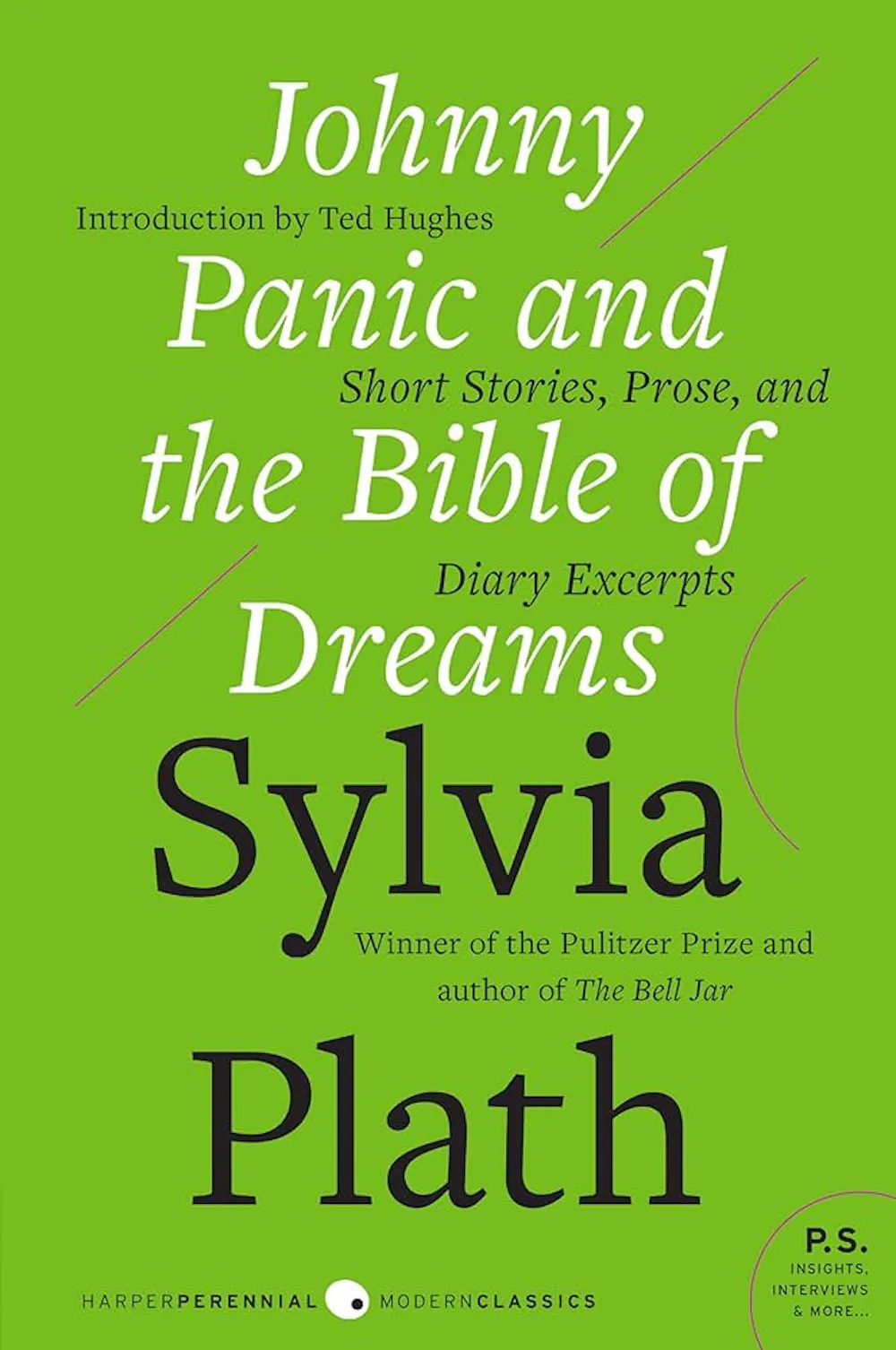
A selection of Plath’s prose was published in 1977 as Johnny Panic and the Bible of Dreams, which included 13 short stories. An expanded second edition contained over 30 pieces of writing. In Collected Prose, over 70 beautiful short stories are included, more than 50 of them previously unpublished.
 The fiction section is the heart of the volume. In her review for the Times Literary Supplement, Heather Clark proposes that some of the stories in Collected Prose may be fragments of Plath’s unpublished novel Falcon Yard, the draft of which was said to have been burned in 1962.
These stories, including Venus in the Seventh and Hill of Leopards, offer riveting insights into what could have been a scathing autobiographical novel about Plath’s relationship with Hughes, which broke down shortly before Plath’s suicide in 1963, following Hughes’ infidelity. One can only hope that a future auction of Plath ephemera will uncover an additional copy.
Topics and themes across the book are ones which readers have come to expect from Plath. She engages with the issues of second-wave feminism, female empowerment, and a woman’s place in the home as a daughter, wife and mother. Plath is often considered unique among her feminist contemporaries for her clear desire to be both a professional writer and a wife and mother. She insisted that these roles could support each other. Her struggle to negotiate these issues is evident throughout.
The politics of the time makes itself felt. The Cold War is an undercurrent in some pieces, most overtly in Youth’s Plea for World Peace from 1950, the year Plath turned 18. The second world war is also present. In the expertly crafted coming of age story Superman and Paula Brown’s New Snowsuit from 1954, Plath begins with juvenile sweetness:
The year the war began I was in the fifth grade at the Annie F. Warren Grammar School in Winthrop, and that was the winter I won the prize for drawing the best Civil Defense signs.
But in a newspaper article titled The Atomic Threat, Plath is more overt about her apocalyptic fervour and considerations of war:
the atom bomb is not just another weapon […] in a third world war, the atom bomb would, in all probability, be used as a weapon.
The bombs in Collected Prose are not only literal. They are in the tiny moments of interaction, in the thoughts and feelings of Plath’s characters, and in her musings on everything from cooking to fashion to life itself. Witty statements abound.
Throughout Collected Prose, Plath proves herself an exceptional scholar, brilliantly adept at taking history, popular culture and humankind and sharpening them into the point of her pencil. As in her poetry, journals and letters, Plath shows that she was deeply emotional and a deep thinker. As she wrote in a piece for the London Magazine in 1961:
For me, the real issues of our time are the issues of every time – the hurt and wonder of loving; making in all its forms – children, loaves of bread, paintings, buildings; and the conservation of life of all people in all places.
All of this and more is on display in Plath’s Collected Prose.
Authors: Sarah-Jane (SJ) Burton, Research Fellow, School of Literature, Languages and Linguistics, Australian National University
The fiction section is the heart of the volume. In her review for the Times Literary Supplement, Heather Clark proposes that some of the stories in Collected Prose may be fragments of Plath’s unpublished novel Falcon Yard, the draft of which was said to have been burned in 1962.
These stories, including Venus in the Seventh and Hill of Leopards, offer riveting insights into what could have been a scathing autobiographical novel about Plath’s relationship with Hughes, which broke down shortly before Plath’s suicide in 1963, following Hughes’ infidelity. One can only hope that a future auction of Plath ephemera will uncover an additional copy.
Topics and themes across the book are ones which readers have come to expect from Plath. She engages with the issues of second-wave feminism, female empowerment, and a woman’s place in the home as a daughter, wife and mother. Plath is often considered unique among her feminist contemporaries for her clear desire to be both a professional writer and a wife and mother. She insisted that these roles could support each other. Her struggle to negotiate these issues is evident throughout.
The politics of the time makes itself felt. The Cold War is an undercurrent in some pieces, most overtly in Youth’s Plea for World Peace from 1950, the year Plath turned 18. The second world war is also present. In the expertly crafted coming of age story Superman and Paula Brown’s New Snowsuit from 1954, Plath begins with juvenile sweetness:
The year the war began I was in the fifth grade at the Annie F. Warren Grammar School in Winthrop, and that was the winter I won the prize for drawing the best Civil Defense signs.
But in a newspaper article titled The Atomic Threat, Plath is more overt about her apocalyptic fervour and considerations of war:
the atom bomb is not just another weapon […] in a third world war, the atom bomb would, in all probability, be used as a weapon.
The bombs in Collected Prose are not only literal. They are in the tiny moments of interaction, in the thoughts and feelings of Plath’s characters, and in her musings on everything from cooking to fashion to life itself. Witty statements abound.
Throughout Collected Prose, Plath proves herself an exceptional scholar, brilliantly adept at taking history, popular culture and humankind and sharpening them into the point of her pencil. As in her poetry, journals and letters, Plath shows that she was deeply emotional and a deep thinker. As she wrote in a piece for the London Magazine in 1961:
For me, the real issues of our time are the issues of every time – the hurt and wonder of loving; making in all its forms – children, loaves of bread, paintings, buildings; and the conservation of life of all people in all places.
All of this and more is on display in Plath’s Collected Prose.
Authors: Sarah-Jane (SJ) Burton, Research Fellow, School of Literature, Languages and Linguistics, Australian National University 

















