

The muscle-wasting condition 'sarcopenia' is now a recognised disease. But we can all protect ourselves
- Written by: Robin Daly, Professor of Exercise and Ageing, Institute for Physical Activity and Nutrition, Deakin University, Deakin University
As we grow older, the size and strength of our muscles progressively deteriorates. This can affect our capacity to perform everyday activities like standing up from a chair, climbing stairs or carrying groceries.
For some people, muscle wasting becomes more severe, leading to falls, frailty, immobility and a loss of autonomy.
People who experience a marked loss in their muscle mass, strength and function may be suffering from a major but poorly recognised muscle-wasting condition called sarcopenia. Sarcopenia is to our muscles what osteoporosis is to our bones.
Sarcopenia is now recognised as a disease after being added to Australia’s formal list of diseases, called the (ICD-10-AM).
Read more: I've Always Wondered: why do our muscles stiffen as we age?
Given the condition may affect almost one-third of older adults in the community, it’s high time its impact is recognised and talked about.
The good news is that people with sarcopenia can rebuild their muscle mass and strength via strength or resistance training and some diet modifications. In fact, these are things we can all do to protect ourselves.
What causes sarcopenia?
Ageing disrupts the body’s ability to produce the proteins needed to grow or maintain muscles. As we age, fewer signals are also sent from the brain to the muscles, leading to a loss in the mass and size of our muscles.
Other causes of sarcopenia can include:
- Physical inactivity
- Malnutrition
- Changes in hormones like testosterone and growth hormones
- Increased inflammation
- The presence of other age-related diseases
Read more: Diseases through the decades – here's what to look out for in your 40s, 60s, 80s and beyond
Who gets sarcopenia?
It’s been estimated that sarcopenia affects 10-30% of older adults living in the community, varying by age and ethnicity. This increases to around 40-50% in those aged over 80 or living in nursing homes, and up to 75% in older hospital inpatients.
Sarcopenia is most common in older people, but can also occur earlier in life. In our 40s, muscle mass and strength begin to decline, and without intervention such as regular exercise, this loss accelerates with age. By the age of 70, up to half of muscle mass is lost and this is often replaced with fat and fibrous tissue, particularly in people who are inactive.
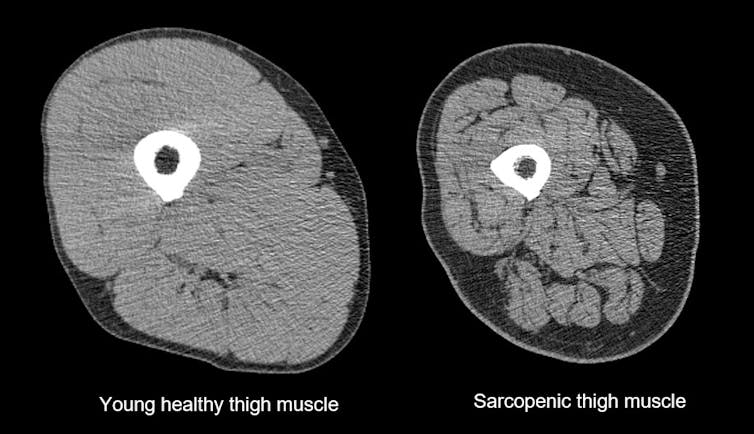 On the left, a young, healthy thigh muscle. On the right, a thigh muscle affected by sarcopenia.
Author provided, Author provided
On the left, a young, healthy thigh muscle. On the right, a thigh muscle affected by sarcopenia.
Author provided, Author provided
Sarcopenia is common in people with other diseases such as cancer, type 2 diabetes, chronic kidney disease and chronic obstructive pulmonary disease. Many of the drugs used to treat these conditions can contribute to sarcopenia, as they can cause an imbalance in muscle metabolism and disrupt the pathways that control muscle mass.
Yet because many health professionals have little knowledge of sarcopenia and its consequences, they don’t necessarily consider or treat age-, diet- or drug-related muscle wasting.
Consequences of sarcopenia
Skeletal muscle is the largest organ in the body, making up around 40% of body weight. It’s essential for both movement and metabolic functions such as regulating blood glucose levels. So it’s not surprising that sarcopenia is linked to many adverse health outcomes.
Sarcopenia has been associated with impaired mobility, osteoporosis, falls, fractures, frailty, poor outcomes after surgery, institutionalisation, hospital admissions, impaired quality of life and premature death.
Treating sarcopenia
There are currently no approved medications to treat sarcopenia, and research to identify new drugs has been inconclusive. The most effective approach we have is resistance or strength training, which should be done at least twice a week in combination with a nutritional (protein-enriched) intervention.
Skeletal muscle has a remarkable ability to adapt and regenerate in response to loading. Gains in muscle mass of 5-10% and improvements in muscle strength or power of 30-150% have been observed after 12 weeks of resistance training, even in older nursing home and hospitalised patients and the very old. This is equivalent to regaining the muscle mass lost over a decade.
Read more: Why hip fractures in the elderly are often a death sentence
Everyone will respond to resistance-type exercise if it’s appropriately prescribed, but fewer than 15% of older Australians participate in twice-weekly resistance training.
Accredited exercise physiologists are best positioned to prescribe and deliver evidence-based exercise programs for older people and those with chronic diseases including sarcopenia.
Nutritional factors, such as protein, are also important for maintaining muscle, particularly in older patients who may be malnourished. To ensure an adequate intake of protein each day, most people should aim for one to three serves of lean meat, poultry, fish/seafood, eggs, nuts/seeds, or legumes.
Low vitamin D has also been linked to muscle weakness and falls. Sunlight exposure is the main way to get vitamin D, but where appropriate, a doctor may recommend a vitamin D supplement.
Moving forward
Recognition of sarcopenia as a distinct disease in Australia is critical to raise awareness of the condition among health professionals and the wider community.
Improved awareness will lead to better routine treatment for people with sarcopenia. For example, a GP who identifies a patient with sarcopenia can refer them to an exercise physiologist under a chronic disease management plan, which includes up to five Medicare-rebated sessions with an allied health professional over a calendar year.
Read more: Do you even lift? Why lifting weights is more important for your health than you think
More broadly, recognition is an essential step if we’re going to see any changes to public health policy. It will enable the collection of more rigorous data on the prevalence of sarcopenia, and pave the way for additional resources to be targeted towards prevention.
Right now, the biggest challenge in the field is accurately and consistently diagnosing the condition. The type of assessments for muscle mass, strength and function used to diagnose sarcopenia continue to be debated. We need to progress towards a single international definition that includes region- and ethnic- specific criteria.
Authors: Robin Daly, Professor of Exercise and Ageing, Institute for Physical Activity and Nutrition, Deakin University, Deakin University


















