Farming within Earth’s limits is still possible – but it will take a Herculean effort
- Written by Michalis Hadjikakou, Senior Lecturer in Environmental Sustainability, School of Life and Environmental Sciences, Faculty of Science, Engineering & Built Environment, Deakin University
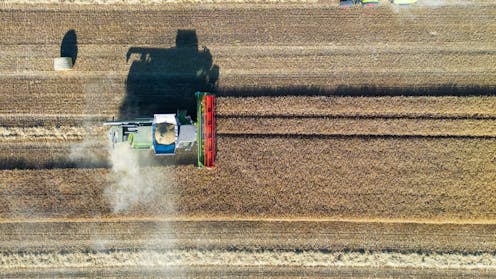
The way we currently produce and consume food takes a big toll on the environment.
Worldwide, farming is responsible for more than 20% of greenhouse gas emissions and uses more than 70% of all fresh water taken from rivers, lakes and groundwater. It’s the leading driver of deforestation and nutrient pollution, largely from fertiliser run-off. All of these pose a serious threat to ecosystems.
If this sounds serious, it’s because it is. If emissions and land clearing trends continue, the world’s food system alone could make it impossible to meet climate targets. If we continue eating and producing food in the same way we are now, we will almost certainly exceed crucial environmental limits by 2050.
What can be done? In our new research, we looked for ways to keep the food system within environmental limits by 2050. We found only one approach worked: combine high-impact changes such as shifting to flexitarian (low meat) diets, improving farming practices and reducing food waste.
Why will farming take us past environmental limits?
Environmental limits are also known as planetary boundaries. These nine boundaries are Earth’s natural safety limits. They range from freshwater resources to the biosphere to the climate. Human activities have pushed past six out of nine safe boundaries through clearing too much land, overusing water for irrigation, overapplying fertilisers or emitting more than our shrinking carbon budget permits.
If we cross these thresholds, we risk dangerous and irreversible changes to the conditions supporting a stable planet.
Transforming the way we farm and eat is essential if we are to keep humanity in a safe operating space within environmental limits.
The 2021 documentary Breaking Boundaries focused on the very real dangers of breaching planetary limits.What does this transformation look like?
The challenge of making food production sustainable is long-running. Previous research has compared the effectiveness of different changes authorities and consumers could make. But most studies used different models, making it hard to compare changes.
To overcome this problem, we synthesised information from previous studies and built a database of thousands of future food system scenarios and possible changes. Then we performed a meta-analysis to combine data from multiple studies and draw more robust conclusions.
This approach allows policymakers and researchers to compare apples and apples, as well as see which combination of changes would let us stay within crucial safety limits by 2050.
We focused on four vital indicators: how much land and water is used for farming; the amount of greenhouse gases emitted; and the flows of two key nutrients, nitrogen and phosphorus.
What works best?
What stood out was the sheer variation in effectiveness. Some changes would work very well across several areas, while others would take a lot of effort for not enough result.
Two changes punch well above their weight on land, water and emissions.
The first is shifting to a flexitarian diet with fewer foods sourced from animals. This is similar to traditional regional diets such as the Mediterranean and Okinawan diets, where meat and dairy are eaten in much smaller proportions compared to whole grains, fruits, vegetables, nuts and legumes.
Returning to this diet could shrink how much land we use for farming by almost a quarter (24%), cut water demand by 14% and slash greenhouse gas emissions by 47%.

The second is breeding better livestock. Livestock today are much better at converting their feed into meat or milk than their precursors. But this could be better still. More productive animals could enable an 18% reduction in land use, a 10% drop in water use and a 34% cut to emissions.
Modern fertilisers have made it possible to produce many more crops and fodder. But if too much fertiliser is applied, it can wash off after rain and pollute waterways.
Better timed and more precise application of fertiliser is by far the best way to cut nutrient pollution. Major improvements here could cut nitrogen pollution by 39% and phosphorus pollution by 42%. As a side benefit, it could save farmers money.
Increasing crop yields, lowering agricultural emissions through better soil management and other practices, and taking up technologies such as methane-reducing supplements can significantly reduce our risk of exceeding environmental limits. So too can cutting food waste and using water more wisely in farming. Our extended results show the relative benefits of ten possible interventions.
There is no silver bullet
We found no single change was up to the task of making food production and consumption sustainable.
We considered over a million possible combinations of changes. Of these combinations, only a tiny fraction – 0.02% – give us a fighting chance of staying within all environmental limits.
In almost all successful combinations, the world would need to make significant cuts to how many calories come from animals, make big improvements to fertiliser use and nutrient management, and focus research and development on finding ways to farm land and livestock with less resources and emissions.
Most successful combinations also rely on halving food waste and reducing overconsumption.
Is it still possible?
Farming within the limits of Earth’s systems will be hard. But it is possible.
Some work is already being done. Global organisations such as the United Nations are making a concerted effort to accelerate changes to food systems across many countries.
Research like ours can make people feel powerless. But individual change is always worthwhile. Reducing your intake of animal products benefits your health and the planet.
Properly addressing these very real issues will take concerted, collective work. If we don’t succeed, we risk triggering ecological collapse – and threatening the foundation for human civilisation.
The knowledge and tools are at hand. What’s needed now is ambition – and a sense of what’s at stake.
Authors: Michalis Hadjikakou, Senior Lecturer in Environmental Sustainability, School of Life and Environmental Sciences, Faculty of Science, Engineering & Built Environment, Deakin University