Modern Australian
The Times

South Australia’s algal bloom may shrink over winter – but this model suggests it will spread to new areas in summer

  • Written by Jochen Kaempf, Associate Professor of Natural Sciences (Oceanography), Flinders University
South Australia’s algal bloom may shrink over winter – but this model suggests it will spread to new areas in summer

South Australia is desperate for help to tackle an unprecedented harmful algal bloom that has decimated marine life up and down the coast. While the extent of the damage is still unknown, my preliminary research suggests there’s no end in sight. It may just get better over winter before it gets worse next summer.

The Karenia mikimotoi bloom first appeared in March on two surf beaches outside Gulf St Vincent, about an hour south of Adelaide. It has since spread, killing all kinds of marine organisms – from crabs and small fish to sharks and rays. Only the neighbouring Spencer Gulf, far west coast and southeast coasts have been spared. For now.

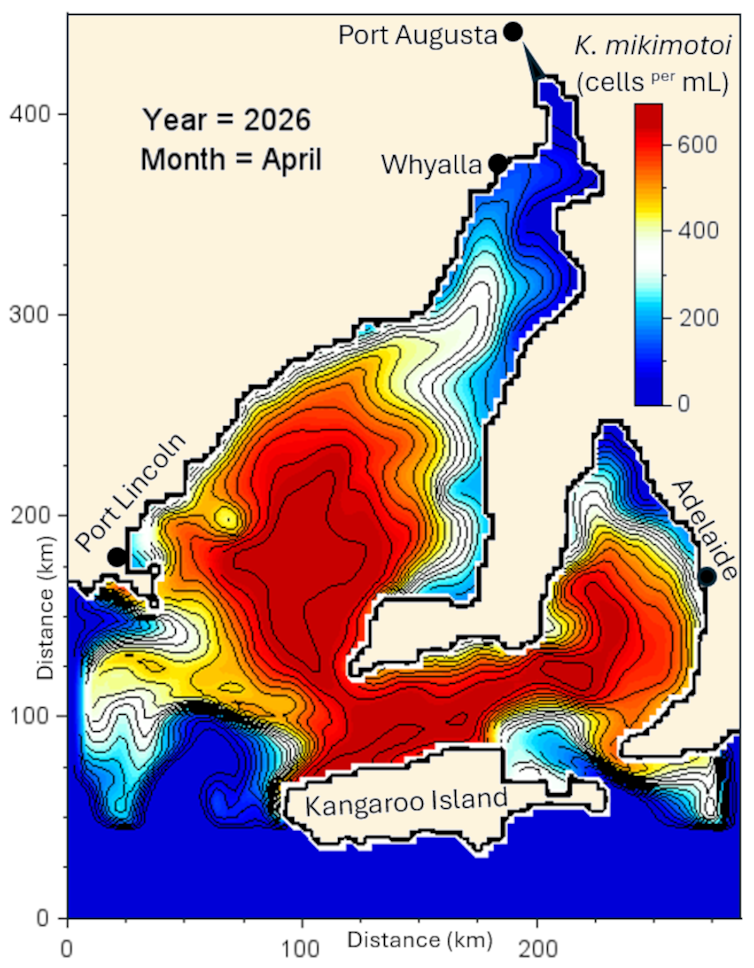
In preliminary research now undergoing peer review, I have predicted the bloom’s future spread using a new computer model. In the worst-case scenario, the harmful algal bloom would reach the Spencer Gulf and spread – from Port Lincoln to Whyalla and across to Port Pirie – next summer and autumn. That would be extremely bad news for the thriving seafood, aquaculture and tourism industries. They may need help to prepare.

Some help is on the way. Federal Environment Minister Murray Watt yesterday announced A$14 million in federal funding. SA Premier Peter Malinauskas convened an Emergency Management Cabinet Committee meeting today and signed off on a $28 million support package.

A map of South Australian showing worst-case scenario predictions from the model for April 2026, with high concentrations of harmful algae in both gulfs.
The worst-case scenario forecasts high concentrations of K. mikimotoi in both South Australian gulfs next April. Jochen Kaempf

A rolling disaster

The algal bloom was first noticed when dozens of surfers and beachgoers on the southern coast of the Fleurieu Peninsula fell ill after exposure to seawater in March.

Soon, dangerous sea foam appeared. Then the killing began in earnest. Many marine species started washing up dead or dying.

The bloom began to spread. In mid-April, K. mikimotoi was detected in water samples from Edithburgh and Coobowie on the southeastern corner of Yorke Peninsula.

In early May, the Kangaroo Island Council announced the bloom had spread across the Investigator Strait affecting the island’s northern coastline.

Wild weather in June pushed the bloom through the Murray Mouth into the Coorong.

By July, the state government had detected K. mikimotoi along Adelaide’s metropolitan coastline. Videos of fish kills near the Ardrossan Jetty in the northern Gulf St Vincent also emerged.

So far, the bloom has not been detected in Spencer Gulf. But my modelling suggests it’s only a matter of time.

Predicting the future

I was the first to discover the seasonal upwelling of nutrients in several regions along SA’s southern coastal shelf. This nutrient source fuels the marine food chain. It’s a big part of the reason why the marine life in our Great Southern Australian Coastal Upwelling System is so diverse.

I also simulated the ocean currents in South Australian gulfs using computer models as early as 2009.

I have now developed a computer model to predict where the algae will spread next.

Preliminary results from this research have been submitted to the journal Continental Shelf Research and are being reviewed. But given the speed at which this situation is developing, it’s worth sharing a preprint of this manuscript.

My model matches what’s known about the early spread of the bloom. It began in the coastal waters of the southern Fleurieu Peninsula. It then invaded Investigator Strait, between the Yorke Peninsula and Kangaroo Island, before slowly spreading in a clockwise circulation across the wider Gulf St Vincent.

When the model is used to forecast how the algae bloom will evolve, the story becomes deeply concerning. It predicts the algal bloom will weaken over this winter, as the growth rate will slow in cooler water. In my model, the algae had already invaded the lower Spencer Gulf in May 2025 but at very low concentrations. Then, in the worst-case scenario of high growth rates and nothing stopping it, the model predicts the bloom will affect both gulfs – Gulf St Vincent and Spencer Gulf – and Investigator Strait, with severe conditions predicted for the coming summer. A bloom in the Spencer Gulf could decimate stocks of Australian sardine in the lower gulf, and potentially also western king prawns and the giant Australian cuttlefish in the upper Spencer Gulf. Some research suggests algal growth may be limited in the hypersaline upper reaches of the gulfs, but the spread of the algae as far as Ardrossan indicates otherwise. Under the best-case scenario, the algae’s natural predator, zooplankton, would eat more of the algae, suppressing future flare-ups. So there is some hope, but more research is needed to better understand how zooplankton could control these algae. SA also needs to make continuous efforts to monitor K. mikimotoi concentrations. This includes analysis of water samples in both gulfs. It’s important to note satellite images only show the peak phase of the toxic algal bloom, and can be misleading as they also display other species including blooms of “good” algae. Fortunately, the $28 million support package includes $8.5 million for early detection and monitoring of harmful algal bloom species. This will involve real-time sensors (buoys), satellite imagery and oceanographic modelling. A new $2 million national testing laboratory will check for toxins, while $3 million will be spent on a rapid assessment of fish stocks and fisheries. But if the algae stick around, there may be little anyone can do to protect our marine environment.

Authors: Jochen Kaempf, Associate Professor of Natural Sciences (Oceanography), Flinders University


Read more https://theconversation.com/south-australias-algal-bloom-may-shrink-over-winter-but-this-model-suggests-it-will-spread-to-new-areas-in-summer-261549

Why Material Handling Hose Is Critical for Industrial Efficiency

A high-performance material handling hose is an essential component in industries that transport abrasive, dry, or bulk materials on a daily basis...

How to Choose the Right Lawyer in Melbourne for Your Situation

Choosing legal support can feel difficult, especially when the stakes are personal or business-related. The right lawyer in Melbourne should underst...

Hoteliers Look to Clever Value Adds to Increase Revenue

The Australian hospitality industry is still in recovery mode after a notoriously rough patch in recent years. While there has been a post-COVID tra...

Moving to Queensland? Here’s How to Prep Your Car for the Big Move North

There’s no sign of the northern migration slowing down, with thousands of southerners fleeing from chaotic lifestyles and cooler climates for a brig...

Diesel Shortage to Impact Trades and Contractors

Strait of Hormuz blockage affecting all major parts of trades and construction Trades and construction across residential, commercial and industria...

Why Holiday Home Owners Turn to Rental Management Agents

The Allure — and the Reality — of Renting Out Your Property Owning a holiday home is a dream for many Australians. Whether it's a beachside sha...

Why Finding Reliable Doctors In Bundoora Is Important For Long-Term Health

Access to quality healthcare plays an important role in maintaining overall wellbeing and managing health concerns early. Trusted Doctors in Bundoor...

Understanding the Different Types of Car Services: Minor vs Major

When it comes to car maintenance, one of the most important things every vehicle owner should understand is the difference between a minor and a maj...

How Superannuation and TPD Insurance Work Together

Superannuation is an essential part of financial planning in Australia. It is designed to provide individuals with income during retirement, helping...

Tiny Towns funding granted for Mt Hotham and Mt Buller upgrades

Alpine Resorts Victoria (ARV) has welcomed funding support from the Victorian Government’s  Tiny Towns Fund, with both Mt Hotham and Mt Buller se...

Locksmith Services: Why Professional Security Solutions Matter More Than Ever

Security is a critical concern for homeowners, businesses, and vehicle owners alike. Whether it involves protecting a property, replacing damaged lo...

Why Tooth Fillings Are Important For Protecting Damaged Teeth

Cavities and minor tooth damage are common dental problems that can worsen if left untreated. Professional tooth fillings help restore damaged teeth, ...

The Connection Between Visibility and Driver Confidence

Operating a vehicle safely requires an immediate, uncompromised stream of visual information from the surrounding road environment. A driver's decis...

Important Things To Know Before Starting An SMSF Setup

Planning for retirement requires careful financial decisions, and many Australians are now looking for more direct control over how their superannua...

Why Retail Cleaning Plays a Key Role in Customer Experience and Business Success

Professional retail cleaning services are an essential part of maintaining a welcoming, safe, and professional environment for customers and staff...

Simple Ways to Make a Commercial Property More Appealing to Buyers

Selling or leasing a commercial property isn’t just about listing the square metres, taking a few photos and waiting for the right person to appea...

What Café Owners Should Know Before Upgrading Their Display Setup

A café display fridge does a lot more than keep cakes cold and sandwiches fresh. It quietly shapes the way customers browse, the way staff move beh...

Creating a Backyard That Feels Comfortable All Year Round

A great backyard doesn’t need to be huge, expensive or perfectly styled. Most of the time, the spaces people actually use are the ones that feel e...