

Australia’s food labelling system isn’t working – here’s how we can fix it
- Written by Mark Lawrence, Professor of Public Health Nutrition, Institute for Physical Activity and Nutrition, Deakin University
If you’ve ever read a food label and come away feeling more confused, you’re not alone.
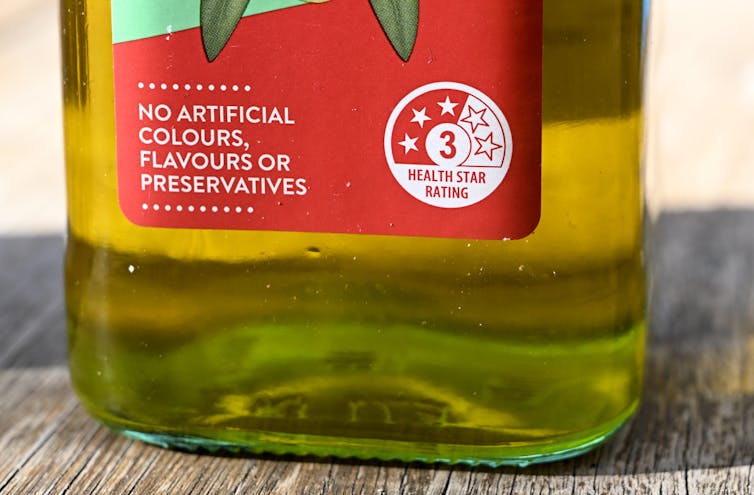
Since 2014, Australian shoppers have relied on the Health Star Rating scheme to help them choose which foods to eat. This system ranks food products on a scale from half a star to five stars, to help consumers compare the nutritional value of similar types of food.
This system is far from perfect. Nevertheless, Australia’s food ministers are meeting today to consider making it mandatory, with the aim of helping Australians eat more healthily.
Should we mandate a flawed system? And is there an alternative?
How does the current system work?
The Health Star Rating system was designed to help consumers make healthier eating choices, by providing accessible and relevant nutrition information.
The current system uses an algorithm that claims to assess how healthy or unhealthy a certain food product is. To do this, it looks at the nutritional value of some of the product’s ingredients, then rates it on a scale of half a star to five stars.
The system is currently voluntary. This means food companies are not obliged to include Health Star Ratings on their products. However those that do are encouraged to do so across their full product range.
A flawed system
The existing system is controversial for two main reasons.
1. What’s healthy?
First, it’s not an objective way of measuring how healthy a food is.
Over the past decade, some food companies have appeared to use the Health Star Ratings as a marketing tool. This is especially the case among companies that produce ultra-processed and discretionary foods such as breakfast cereals, muesli bars and protein drinks.
Under the current system, it is possible for companies to manipulate the Health Star Ratings algorithm. This involves replacing so-called “risk nutrients” with synthetic ingredients.
For example, a company may replace sugar with certain sweeteners, or fats with emulsifiers and gums. They might also add new ingredients such as fibre powders that improve their scores without making the product any healthier.
A study from 2020 found about three quarters of ultra-processed foods that display stars do so with at least 2.5 or more stars, giving them a “healthy” pass mark.
As a result, consumers often try to make healthier choices by swapping one lower-rated ultra-processed food for another higher-rated one. Unfortunately, they do not realise they are still consuming an unhealthy food.
There is no such thing as a healthy ultra-processed food.
2. It’s confusing
Second, it is a confusing system. Consumers find the current system difficult to navigate.
A 2024 report found only just over half (52.3%) of participants agreed the Health Star Rating system was accurate and honest. Less than half (41.3%) thought it had a good reputation.
Could this flawed system become mandatory?
Possibly. In 2020, food ministers from around Australia agreed to consider making the system mandatory if fewer than 70% of products were using it by 2025.
The latest data shows just 37% of products have a Health Star Rating. This has dropped by 4% since 2019.
The government’s push to mandate the Health Star Rating system appears to have divided the public health community.
Various organisations and practitioners have sent letters to food ministers, both supporting and opposing the proposal.
Those in favour of mandating the current system acknowledge the system is not perfect, but believe it is better than having no system.
Those who oppose this move would prefer to scrap the existing scheme and start from scratch. They point out that after 12 years of continual tweaks to the system and reassurances that it will improve, the health star ratings system is still fundamentally flawed. Food companies may still manipulate the algorithm, and consumers will remain in the dark. Another concern is instituting a flawed system would make it even harder to introduce a better one in the future.
So, is there an alternative?
Yes – warning labels.
Using simple statements or symbols, warning labels are designed to inform consumers if a food product is high in fat, sugar or salt. In future, they may also indicate whether a product is an ultra-processed food.
Several countries are already using warning labels. In Mexico, for example, consumers have embraced this system and have changed their food purchasing behaviours to be more in line with healthy eating recommendations.
In the past few months, countries including Canada and the United States have moved towards adopting the warning label approach.
And just this week, the Indian Supreme Court asked the country’s food standards agency to consider developing warning labels. Before this, India was on track to adopt a version of the Health Star Rating system.
A global study published in late 2025 suggests warning labels are the most effective way to reduce the consumption of ultra-processed foods. This is compared to other ranking-style labelling schemes such as Health Star Ratings.
Given its design and governance flaws, mandating the current health star rating system would be a mistake. Fortunately, there is a better option. Other countries have adopted a warning label system, with promising results. Now it is time for Australia to do the same.
Authors: Mark Lawrence, Professor of Public Health Nutrition, Institute for Physical Activity and Nutrition, Deakin University

















