

There are 10 catastrophic threats facing humans right now, and coronavirus is only one of them
- Written by Arnagretta Hunter, ANU Human Futures Fellow 2020; Cardiologist and Physician., Australian National University
Four months in, this year has already been a remarkable showcase for existential and catastrophic risk. A severe drought, devastating bushfires, hazardous smoke, towns running dry – these events all demonstrate the consequences of human-induced climate change.
While the above may seem like isolated threats, they are parts of a larger puzzle of which the pieces are all interconnected. A report titled Surviving and Thriving in the 21st Century, published today by the Commission for the Human Future, has isolated ten potentially catastrophic threats to human survival.
Not prioritised over one another, these risks are:
- decline of natural resources, particularly water
- collapse of ecosystems and loss of biodiversity
- human population growth beyond Earth’s carrying capacity
- global warming and human-induced climate change
- chemical pollution of the Earth system, including the atmosphere and oceans
- rising food insecurity and failing nutritional quality
- nuclear weapons and other weapons of mass destruction
- pandemics of new and untreatable disease
- the advent of powerful, uncontrolled new technology
- national and global failure to understand and act preventatively on these risks.
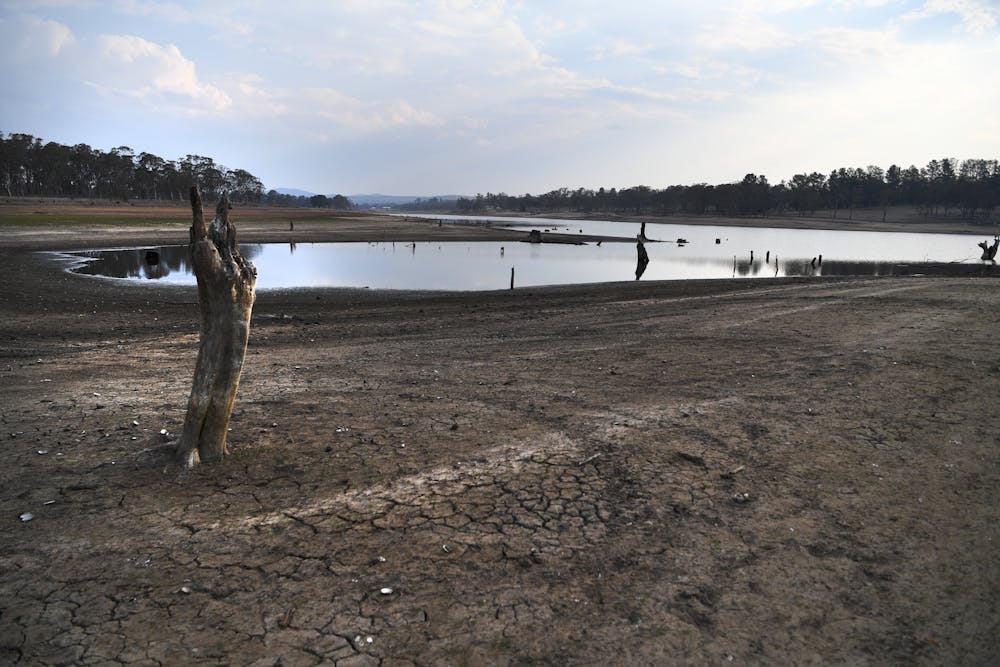 In October, low water levels and dry land was recorded at Storm King Dam near Stanthorpe, Queensland. The dam’s water level was at 25%.
DAN PELED/AAP
In October, low water levels and dry land was recorded at Storm King Dam near Stanthorpe, Queensland. The dam’s water level was at 25%.
DAN PELED/AAP
The start of ongoing discussions
The Commission for the Human Future formed last year, following earlier discussions within emeritus faculty at the Australian National University about the major risks faced by humanity, how they should be approached and how they might be solved. We hosted our first round-table discussion last month, bringing together more than 40 academics, thinkers and policy leaders.
The commission’s report states our species’ ability to cause mass harm to itself has been accelerating since the mid-20th century. Global trends in demographics, information, politics, warfare, climate, environmental damage and technology have culminated in an entirely new level of risk.
The risks emerging now are varied, global and complex. Each one poses a “significant” risk to human civilisation, a “catastrophic risk”, or could actually extinguish the human species and is therefore an “existential risk”.
The risks are interconnected. They originate from the same basic causes and must be solved in ways that make no individual threat worse. This means many existing systems we take for granted, including our economic, food, energy, production and waste, community life and governance systems – along with our relationship with the Earth’s natural systems – must undergo searching examination and reform.
COVID-19: a lesson in interconnection
It’s tempting to examine these threats individually, and yet with the coronavirus crisis we see their interconnection.
The response to the coronavirus has had implications for climate change with carbon pollution reduction, increased discussion about artificial intelligence and use of data (including facial recognition), and changes to the landscape of global security particularly in the face of massive economic transition.
It’s not possible to “solve” COVID-19 without affecting other risks in some way.
Shared future, shared approach
The commission’s report does not aim to solve each risk, but rather to outline current thinking and identify unifying themes. Understanding science, evidence and analysis will be key to adequately addressing the threats and finding solutions. An evidence-based approach to policy has been needed for many years. Under-appreciating science and evidence leads to unmitigated risks, as we have seen with climate change.
The human future involves us all. Shaping it requires a collaborative, inclusive and diverse discussion. We should heed advice from political and social scientists on how to engage all people in this conversation.
Read more: From the bushfires to coronavirus, our old 'normal' is gone forever. So what's next?
Imagination, creativity and new narratives will be needed for challenges that test our civil society and humanity. The bushfire smoke over the summer was unprecedented, and COVID-19 is a new virus.
If our policymakers and government had spent more time using the available climate science to understand and then imagine the potential risks of the 2019-20 summer, we would have recognised the potential for a catastrophic season and would likely have been able to prepare better. Unprecedented events are not always unexpected.
 This photo from December shows NSW Rural Fire Service crews protecting properties as the Wrights Creek fire approaches Mangrove Mountain, north of Sydney.
DAN HIMBRECHTS/AAP
This photo from December shows NSW Rural Fire Service crews protecting properties as the Wrights Creek fire approaches Mangrove Mountain, north of Sydney.
DAN HIMBRECHTS/AAP
Prepare for the long road
The short-termism of our political process needs to be circumvented. We must consider how our actions today will resonate for generations to come.
The commission’s report highlights the failure of governments to address these threats and particularly notes the short-term thinking that has increasingly dominated Australian and global politics. This has seriously undermined our potential to decrease risks such as climate change.
Read more: Listen to your people Scott Morrison: the bushfires demand a climate policy reboot
The shift from short to longer term thinking can began at home and in our daily lives. We should make decisions today that acknowledge the future, and practise this not only in our own lives but also demand it of our policy makers.
We’re living in unprecedented times. The catastrophic and existential risks for humanity are serious and multifaceted. And this conversation is the most important one we have today.
Authors: Arnagretta Hunter, ANU Human Futures Fellow 2020; Cardiologist and Physician., Australian National University

















