

When the Coronavirus Supplement stops, JobSeeker needs to increase by $185 a week
- Written by: Peter Whiteford, Professor, Crawford School of Public Policy, Australian National University
The Morrison government’s changes to welfare payments were among its most significant responses to the coronavirus crisis.
In April, the new Coronavirus Supplement roughly doubled the level of benefits for unemployed people on the JobSeeker Payment (called Newstart until March) and a range of other working-age payments.
But this huge increase will not last, with the $550 fortnightly supplement due to expire in late September.
If we want to keep unemployed Australians out of poverty in future, significant changes will be required to the base rate of JobSeeker.
According to my analysis, an increase of $185 a week is needed.
Debate brewing over the future of JobSeeker
A political debate is now brewing about what happens next to the JobSeeker Payment.
Before coronavirus, there had been consistent calls across parliament, business and community groups to raise the rate of Newstart/JobSeeker, which has scarcely increased in real terms since 1994.
Prime Minister Scott Morrison appears to be holding firm to the idea that the increased payments will stop later this year.
As he recently said,
we’ve put a COVID supplement in place for the period of the pandemic and that’s what we’ve budgeted for and that’s what our policy is.
But Labor and the Greens say there should be a permanent increase to the JobSeeker Payment (although they do not agree on an amount). Some Coalition MPs are also pushing for a boost.
Millions of Australians will need JobSeeker support
There are currently about 1.6 million Australians receiving the JobSeeker Payment, while the Coronavirus Supplement also goes to recipients of other payments, including Youth Allowance, Parenting Payment, Farm Household Allowance and Special Benefit.
In December 2019, there were more than 400,000 people receiving these payments – and possibly more now.
It is also possible that many of the estimated 6.1 million people currently on JobKeeper will need to claim JobSeeker as the former is phased out. So, would the government really halve income support for more than two million people at the end of September?
As the Grattan Institute has pointed out, cutting income support in this way this would be “a recipe for a second downturn”.
The Coronavirus Supplement and the “benefit cliff”
While the Coronavirus Supplement is a crucial element of support for newly unemployed Australians, it is not well designed. This reflects the speed with which it was developed and the fact it was intended to be temporary.
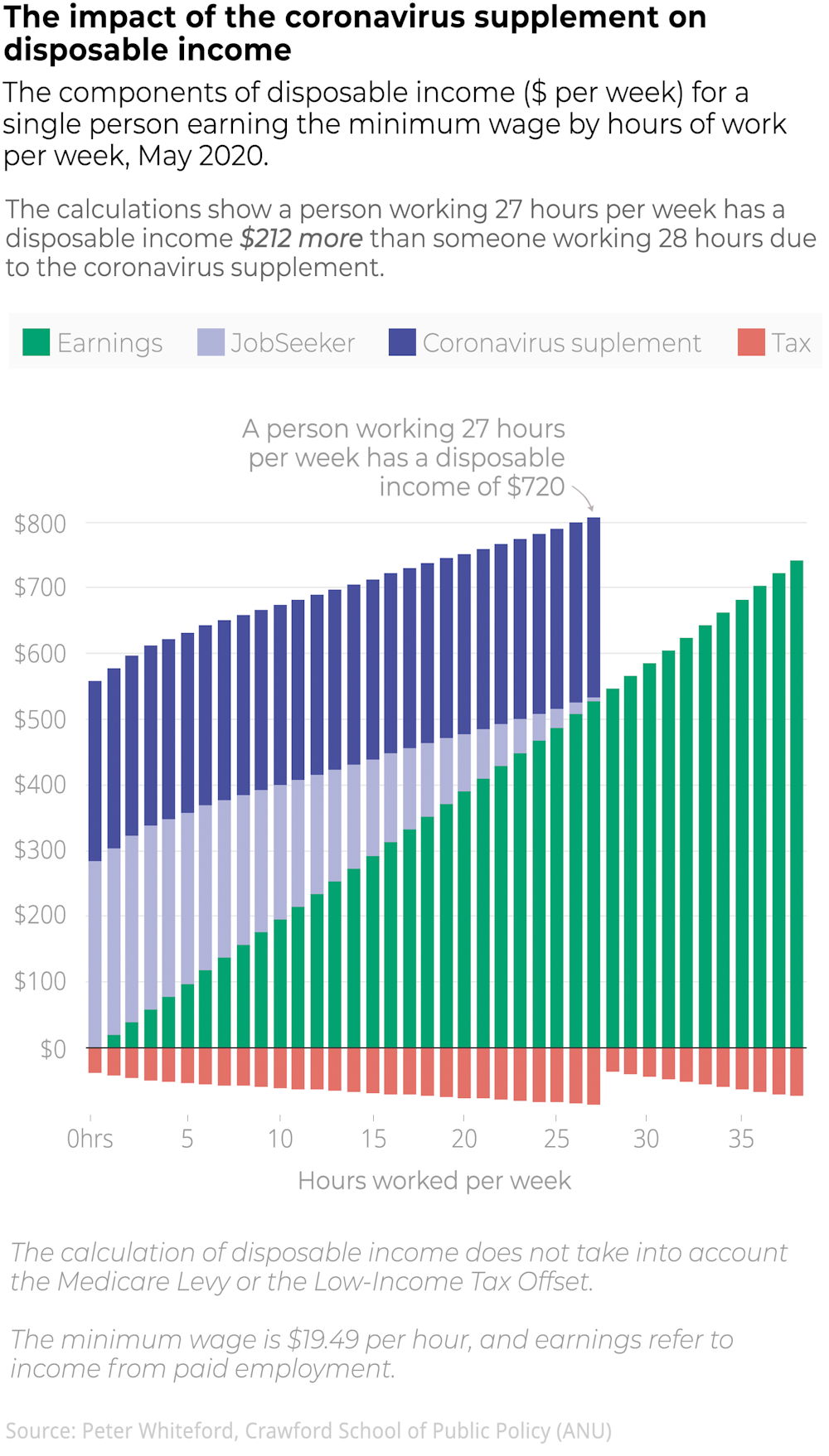
The chart below shows how the supplement combines with the basic JobSeeker Payment for a single person, and how the package of assistance changes by hours of work per week, paid at the minimum wage of $19.49 per hour.
 The Conversation, CC BY-ND
What is most striking here is the “benefit cliff”: a person working 27 hours per week takes home around $720, but a person working 28 hours takes home $508. This is the result of the loss of the entire Coronavirus Supplement when the last dollar of JobSeeker is lost under the current income test.
This also creates significant anomalies: a person working up to three hours per week would have a higher disposable income than someone working 28 to 31 hours per week. And someone working 38 hours would have a lower disposable income than someone working between 19 and 27 hours.
Read more:
What'll happen when the money's snatched back? Our looming coronavirus support cliff
The same benefit cliff applies to couples, but because of the relaxation of the couple income test, the effect is not felt until higher levels of income.
At the moment, these anomalies and the benefit cliff are not very pressing because many people on payments will have reduced hours of work, if any.
But as workplaces open up and people return to employment, these design issues will become more problematic. Put simply, the Coronavirus Supplement in its current form should not be continued.
We need to increase the basic JobSeeker rate
This means that to continue to adequately support unemployed Australians and avoid a double dip economic downturn, the basic rates of payments need to be increased.
Last month, a Senate inquiry released its report into the adequacy of Newstart/JobSeeker.
The report by non-government members made 27 recommendations, including:
once the Coronavirus Supplement is phased out, the Australian Government increase[s] the JobSeeker Payment, Youth Allowance and Parenting Payment rates to ensure that all eligible recipients do not live in poverty.
They also recommended that
the Australian Government set a national definition of poverty. The Government should immediately commence work in collaboration with academic experts and the community sector to determine this definition.
Keeping people out of poverty
Clearly, we need to look at how to make the payment more adequate immediately, without waiting for an inquiry to determine how much is enough - a process that could take months.
There is a simple benchmark already available that can be used. This is the rate of pension paid to the aged, people with disability and carers. Including supplements, a single pensioner currently receives up to $944.30 per fortnight.
When the Coronavirus Supplement ends, a single person on the JobSeeker Payment will receive $574.50 (including the Energy Supplement) - a gap of $370 per fortnight or $185 per week.
Setting working-age payments at the same rate as pensions will significantly simplify our overly complex system and provide a consistent treatment of all adults.
It will reduce incentives for people to seek to qualify for higher payments.
It would also mean that if the federal government sets up an inquiry into poverty standards - as the Senate recommended - we would not have to worry about anomalies in current payment rates. We could focus on clear principles of adequacy for all Australians instead.
JobSeeker must increase by about $185 a week
In January, the Australian Council of Social Service called for a minimum $95 a week increase to Newstart.
Read more:
How to tweak JobKeeper, if we must
This would have applied at the time to around 850,000 people, at a cost of about $3.8 billion a year.
I estimate that an increase of $185 per week could cost around $7.4 billion, but this does not factor in the projected increase in the number of people needing support.
If we have more than two million people on working age payments in September this year, this would imply a rough budget cost of around $17 billion in a full year.
Raising JobSeeker payments is a substantial budgetary cost. But the current cost of the Coronavirus Supplement over a full year is likely to exceed $30 billion.
The alternative of cutting rates is also extremely costly: a deep increase in poverty among millions of Australian households and the likelihood of a double dip recession.
The Conversation, CC BY-ND
What is most striking here is the “benefit cliff”: a person working 27 hours per week takes home around $720, but a person working 28 hours takes home $508. This is the result of the loss of the entire Coronavirus Supplement when the last dollar of JobSeeker is lost under the current income test.
This also creates significant anomalies: a person working up to three hours per week would have a higher disposable income than someone working 28 to 31 hours per week. And someone working 38 hours would have a lower disposable income than someone working between 19 and 27 hours.
Read more:
What'll happen when the money's snatched back? Our looming coronavirus support cliff
The same benefit cliff applies to couples, but because of the relaxation of the couple income test, the effect is not felt until higher levels of income.
At the moment, these anomalies and the benefit cliff are not very pressing because many people on payments will have reduced hours of work, if any.
But as workplaces open up and people return to employment, these design issues will become more problematic. Put simply, the Coronavirus Supplement in its current form should not be continued.
We need to increase the basic JobSeeker rate
This means that to continue to adequately support unemployed Australians and avoid a double dip economic downturn, the basic rates of payments need to be increased.
Last month, a Senate inquiry released its report into the adequacy of Newstart/JobSeeker.
The report by non-government members made 27 recommendations, including:
once the Coronavirus Supplement is phased out, the Australian Government increase[s] the JobSeeker Payment, Youth Allowance and Parenting Payment rates to ensure that all eligible recipients do not live in poverty.
They also recommended that
the Australian Government set a national definition of poverty. The Government should immediately commence work in collaboration with academic experts and the community sector to determine this definition.
Keeping people out of poverty
Clearly, we need to look at how to make the payment more adequate immediately, without waiting for an inquiry to determine how much is enough - a process that could take months.
There is a simple benchmark already available that can be used. This is the rate of pension paid to the aged, people with disability and carers. Including supplements, a single pensioner currently receives up to $944.30 per fortnight.
When the Coronavirus Supplement ends, a single person on the JobSeeker Payment will receive $574.50 (including the Energy Supplement) - a gap of $370 per fortnight or $185 per week.
Setting working-age payments at the same rate as pensions will significantly simplify our overly complex system and provide a consistent treatment of all adults.
It will reduce incentives for people to seek to qualify for higher payments.
It would also mean that if the federal government sets up an inquiry into poverty standards - as the Senate recommended - we would not have to worry about anomalies in current payment rates. We could focus on clear principles of adequacy for all Australians instead.
JobSeeker must increase by about $185 a week
In January, the Australian Council of Social Service called for a minimum $95 a week increase to Newstart.
Read more:
How to tweak JobKeeper, if we must
This would have applied at the time to around 850,000 people, at a cost of about $3.8 billion a year.
I estimate that an increase of $185 per week could cost around $7.4 billion, but this does not factor in the projected increase in the number of people needing support.
If we have more than two million people on working age payments in September this year, this would imply a rough budget cost of around $17 billion in a full year.
Raising JobSeeker payments is a substantial budgetary cost. But the current cost of the Coronavirus Supplement over a full year is likely to exceed $30 billion.
The alternative of cutting rates is also extremely costly: a deep increase in poverty among millions of Australian households and the likelihood of a double dip recession.
Authors: Peter Whiteford, Professor, Crawford School of Public Policy, Australian National University


















