

Stopping, blocking and dampening – how Aussie drugs in the pipeline could treat COVID-19
- Written by: Vasso Apostolopoulos, Professor of Immunology and Associate Provost, Research Partnerships, Victoria University
While widespread vaccination is key in our fight against COVID-19, people who are infected still need better treatment to improve their chance of survival and making a full recovery.
Early on, the world had high hopes for a range of repurposed medications which had previously been approved to treat other conditions – including hydroxychloroquine, remdesivir and ivermectin – to treat COVID-19. But the results have been disappointing.
Diseases caused by viruses are among the most difficult to treat, due to their ability to invade and repurpose infected cells. This limits the ability for drugs to directly act on the virus.
Read more: Developing antiviral drugs is not easy – here's why
Yet researchers around the world are finding ways to overcome these barriers and directly target the coronavirus, including in Australia. So what’s being developed here and how do they work?
Interfering with the virus
Researchers at Queensland’s Menzies Health Institute, in collaboration with scientists from the United States, have developed a novel treatment which targets key genes of the coronavirus, stopping the virus’s ability to replicate.
The treatment uses an engineered particle called a small interfering RNA (si-RNA), which detects and binds to areas of the host’s genome, where the virus resides.
The si-RNA is encased in a nanoparticle to protect it as it travels through the bloodstream. It enters all cells in the host’s body, but will only act on the cells infected by the virus.
Studies in mice showed the treatment reduced the amount of the virus in the lungs by more than 90%.
It’s unclear if the results will translate to humans, but if they do, it could potentially protect infected people from severe disease and make them less likely to transmit the illness to others.
If it is successful, the researchers estimate the treatment could be available in 2023.
Enhancing our antibodies
Another strategy is to block the virus from invading all together.
A number of research teams across Australia are working on engineered antibody treatments, which hunt out and bind to the virus before it enters a cell, effectively blocking it out.
Researchers at the Garvan and Kirby institutes in New South Wales are building on research developed after the 2003 SARS outbreak to create treatments using monoclonal antibodies. These antibodies are generated in the lab and mimic the immune system response to infection.
Once these monoclonal antibodies are injected into an infected person, they bind to the virus and stop it from invading host cells. They also mark it for destruction by the other immune cells.
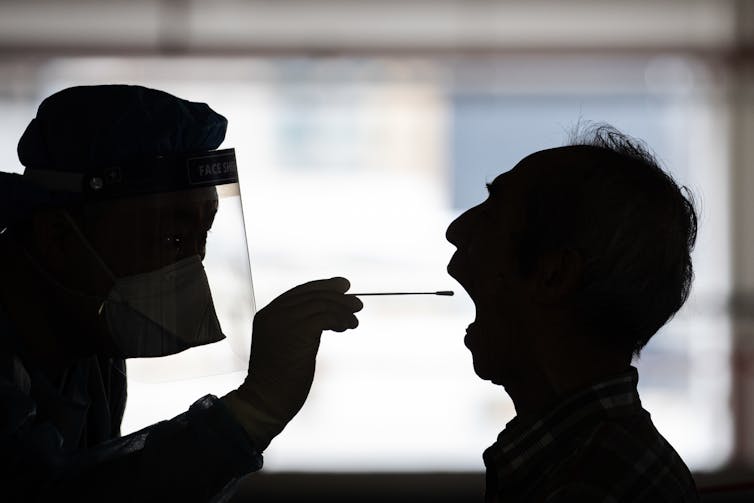 Monoclonal antibody treatment therapy builds on research developed after the SARS outbreak.
Jerome Favre/EPA
Monoclonal antibody treatment therapy builds on research developed after the SARS outbreak.
Jerome Favre/EPA
While this research is in the pre-clinical (lab testing) phase, the researchers at Garvan are already working with clinicians at the Kirby institute to identify the best antibodies and move them through to human clinical trials.
As monoclonal antibody treatments are widely used in a range of diseases, these could potentially be deployed quickly for patients with COVID-19, or to protect people who have been exposed to the virus, to stop them getting sick and becoming infectious.
Another team at the Walter and Elizabeth Hall Institute in Melbourne is harnessing unique “nanobodies”, which are significantly smaller than human antibodies, derived from the immune system of alpacas.
These nanobodies have powerful and specific binding capacity. By vaccinating the alpacas with a synthetic component of the SARS-CoV-2 virus, nanobodies targeting the virus can be identified and synthesised for human use.
While these treatments are in the very early stages of development, they could prove revolutionary for all kinds of infectious and non-infectious diseases.
Preventing serious lung injury
While some treatments aim to neutralise the virus, others are being developed to protect patients from the consequences of COVID-19.
One of the most severe reactions to an infection with the coronavirus is a widespread inflammatory reaction known as a “cytokine storm”, causing severe damage to the lungs.
While potent anti-inflammatory drugs such as hydrocortisone can help to prevent this response, they also can have severe side-effects such as bone weakening, immune system weakening, psychiatric symptoms and insomnia.
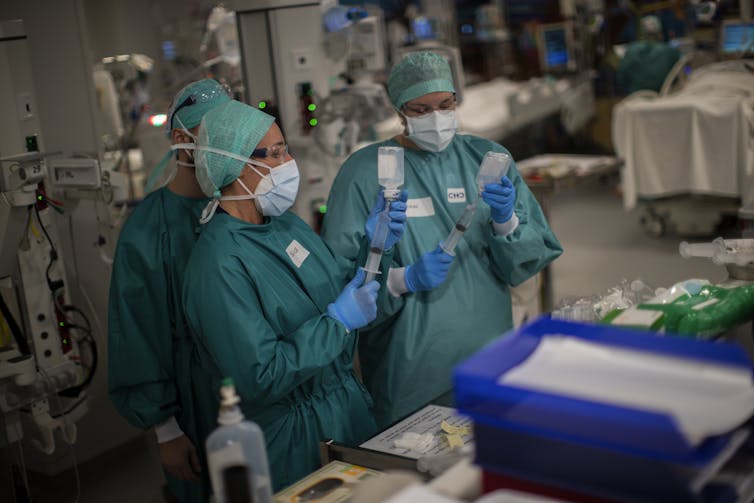 Some researchers are developing drugs that prevent severe responses to COVID-19.
Francisco Seco/AP
Some researchers are developing drugs that prevent severe responses to COVID-19.
Francisco Seco/AP
Researchers at the Victor Chang Cardiac Institute and St Vincent’s hospital in Sydney are proposing to trial a novel stem cell therapy, in an attempt to counteract this inflammatory storm.
While they haven’t disclosed specifically which cells they are planning to use, human studies show stem cell treatments can suppress inflammatory responses from the immune system.
The researchers are seeking approval for clinical studies and are using a stem cell that has been used in humans previously – potentially speeding the pathway to clinical use.
Read more: Could a simple pill beat COVID-19? Pfizer is giving it a go
Another anti-inflammatory drug to control the damaging levels of immune response to the viral infection is being developed by Implicit Bioscience.
Its drug has already shown promising preliminary results in small trials for acute lung injury and amyotrophic lateral sclerosis (AML, a rare neurological disease also known as motor neurone disease), with phase 2 trials for AML due to be completed in 2021.
Two trials at major medical centres, one led by the US National Institutes of Health and the other by Quantum Leap Healthcare Collaborative, are now underway to test whether the drug is effective in patients with severe COVID-19.
Nasal sprays to stop coronavirus infecting us
Australian biotech company Ena Respiratory is developing a nasal spray to fight COVID-19.
These nasal sprays contain a compound designed to trigger a rapid immune response in the upper airways. This allows the immune system to destroy the virus and infected cells before serious disease can occur.
Ena Respiratory’s product, called INNA-051, has produced promising results in animal models, with up to a 96% decrease in SARS-CoV-2 virus replication.
The next step is to see if these results translate to humans.
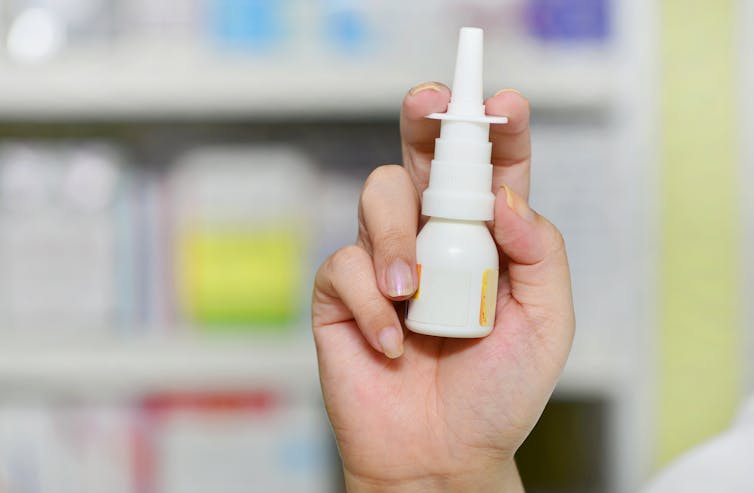 A nasal spray in development aims to trigger an immune response in the upper airways.
Shutterstock
A nasal spray in development aims to trigger an immune response in the upper airways.
Shutterstock
Australia has a long history of strong performance on the world stage in research. Fortunately, this has continued through the COVID-19 pandemic, with a number of key developments and innovations as described, which show promise for translation to human clinical trials.
Developments are continuing, including research by Vasso and her team into novel re-purposed and experimental drugs aimed at stopping coronavirus replication. This is a collaboration between Victoria University and researchers from the United States and Greece, and the team hopes to be able to report on its progress soon.
Authors: Vasso Apostolopoulos, Professor of Immunology and Associate Provost, Research Partnerships, Victoria University


















