

'Forever chemicals' have made their way to farms. For now, levels in your food are low – but there's no time to waste
- Written by Ravi Naidu, Laureate Professor, University of Newcastle
They stop your food from sticking to the pan. They prevent stains in clothes and carpets. They help firefighting foam to extinguish fires. But the very thing that makes “forever chemicals” so useful also makes them dangerous.
Forever chemicals – the catchier name for the class of chemicals known as PFAS, per- and poly-fluoroalkyl substances – don’t break down in the environment. Since we invented and began using them in the 1940s, these chemicals have stuck around, contaminating water and soil. And when they make it into our bodies, they can bind to proteins and accumulate in organs, which may increase your cancer risk or damage your health. Major manufacturers are now facing lawsuits over the potential health impact of the chemicals.
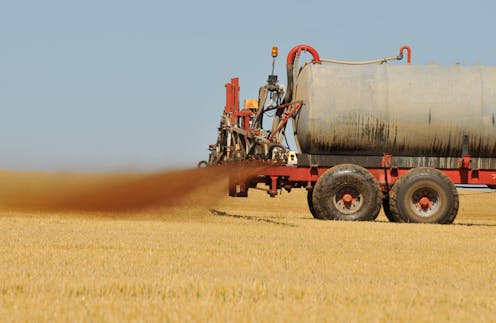
How do they make it into your body? There’s been a lot of concern over their presence in drinking water. But there’s another risk – food. Like many countries, Australia has long used biosolids as fertiliser. Made from processed stormwater and sewage, this soil-like substance adds vital nutrients to our notoriously poor soils.
The problem is, forever chemicals are now in biosolids. Even though the levels are low, authorities are expected to soon make a precautionary change to regulations which would prevent the use of biosolids, as we now understand crops can accumulate these chemicals and pass them on to us.
Thankfully there are ways of making these chemicals harmless.
Read more: 'Forever chemicals' are everywhere – here's what you need to know about them
How exactly do these chemicals get into our food?
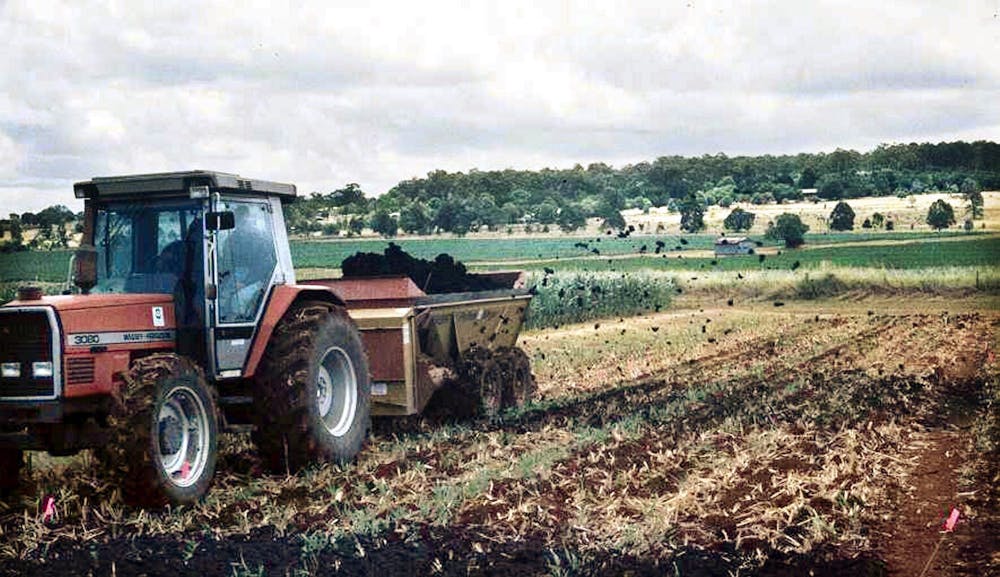
Most of Australia’s biosolids are used on farms as a type of fertiliser. While it might sound icky, this substance is vital. Similar to compost made with human waste, it’s processed by bacteria and dried for at least three years. So, it’s not that different from using cow or sheep manure on your garden.
Biosolids help maintain soil structure and help sequester carbon from the atmosphere. They’re essential for growing crops in Australia’s nutrient-depleted soils as they provide plants with nutrients and trace metals.
 Biosolids are a form of compost made from treated human waste.
Shutterstock
Biosolids are a form of compost made from treated human waste.
Shutterstock
That’s why it’s so unfortunate forever chemicals have found their way here. PFAS was first discovered in biosolid waste in Australia in the early 2000s. The way it gets there is via domestic and industrial wastewater, which flows through stormwater drains and ends up being turned into biosolids at treatment plants.
Authorities are concerned PFAS may become more concentrated in future as we cycle it through our water and fertilisers, into our food, into our bodies, back through our waste systems and then eventually back to our fertilisers and so on.
If the chemicals are present only at very low levels, you might wonder if it matters. But these chemicals accumulate up the food chain. For example, a corn crop may contain only trace elements of PFAS chemicals. But if the corn is then fed to pigs, the pigs will end up with higher levels of PFAS over time.
We, too, are storing these chemicals in our bodies. The more we eat food with trace levels of PFAS, the more we accumulate – and the greater the health risk. That’s why prospective bans are being looked at – not just here, but around the world.
What should we do?
You might think we should immediately ban biosolids use on farms. Unfortunately, if we did that, there would be major flow-on effects.
Biosolids boost the sustainability of farming. Without them, small to medium crop farmers across Australia would have to buy more expensive fertiliser, which is usually synthetically produced from fossil fuels such as natural gas. What’s more, prices have soared, due to energy turbulence and war.
So banning biosolids would put food costs up even more. Water authorities providing biosolids would also need to stockpile them until we find new ways of processing this valuable resource. Stockpiling is expensive and not a permanent solution.
We need to be realistic. Rather than labelling all biosolids as contaminated PFAS waste, the government’s new plan should ideally lay out ways to minimise damage done by forever chemicals in biosolids.
Can we make these chemicals harmless?
Yes.
One option is to chemically lock PFAS chemicals, which means plants can’t absorb them – and can’t pass them on. Products which chemically lock PFAS are already available, and represent a relatively cheap solution to the problem.
This is precisely how we’ve handled trace levels of cadmium – a toxic heavy metal – in farming soils: we lock the cadmium away so it’s not available for plants to absorb.
Another option is to turn biosolids into biochar. If you heat up biosolids to very high temperatures without oxygen, the PFAS will break down and become harmless. All you’re left with is very useful biochar, a nutrient rich charcoal-like substance useful as fertiliser – and as a way to tackle climate change by storing carbon in the soil.
While water authorities are researching better ways of tackling the problem, it’s clear we’ll need a national and well-coordinated approach.
What can you do?
This isn’t a problem created by consumers, but there are ways to protect yourself.
 Non-stick pans can have hidden dangers.
Shutterstock
Non-stick pans can have hidden dangers.
Shutterstock
While some cookware manufacturers no longer use PFAS chemicals, many still do. If it isn’t labelled PFAS-free then consider choosing stone, stainless steel, cast-iron or aluminium cookware instead. Unlabelled cookware is likely to have a coating of forever chemicals, which can wash down the drain – or cook into your food.
We still don’t have proper labelling of products containing PFAS. Many of us may be eating PFAS or smearing them on our skin without even realising. That’s because, worldwide, these chemicals aren’t being properly labelled.
Now that we’ve opened this chemical Pandora’s box, we can never fully close it. Forever chemicals will always be in our environment to some degree.
The challenge now is to use science, policy and consumer choices to reduce the levels as much as possible.
Authors: Ravi Naidu, Laureate Professor, University of Newcastle

















