

Activists are warning of a return to the Jim Crow era in America. But who or what was Jim Crow?
- Written by: Clare Corbould, Associate Professor, Centre for Contemporary Histories, Deakin University
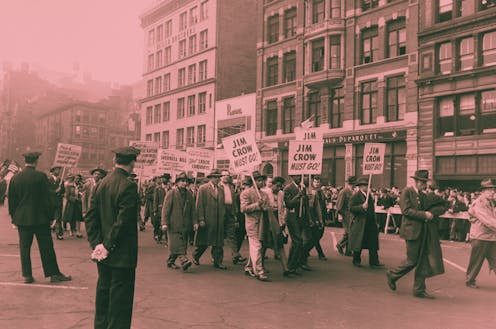
Since becoming president, Donald Trump has issued a record number of executive orders. Several aim to dismantle federally funded initiatives based on the idea that “diversity, equity, and inclusion” (DEI) are goals worth achieving.
In response, many commentators have warned Trump may be dragging the United States back to the dark days of the “pre-civil rights” Jim Crow era.
But who or what was Jim Crow?
The term Jim Crow refers to the long period in US history when black Americans could not exercise the same rights of citizenship as white Americans.
“Jim Crow” segregation began when slavery ended in northern states such as New York, between 1777 and about 1830. There was a brief reprieve from some of the era’s excesses just after the Civil War, when African Americans could do things such as run for political office, vote, and own land even in the South.
But by 1877, conservative forces had regrouped. In the next few decades they enforced inequality through acts of violence such as lynching and by passing laws mandating separate public spaces and schools for black people and preventing them from voting.
The Jim Crow era ended with the mass mobilisation in the 1950s and 1960s of civil rights campaigners, which forced the federal government to take, in the words of President John F. Kennedy, “affirmative action” to make things more fair.

Who was Jim Crow?
The character of “Jim Crow” first came to life in 1828 on a New Orleans stage. An itinerant white performer, Thomas Dartmouth Rice, blackened his face and claimed to be mimicking the songs and dances of an enslaved man, named Jim Crow.
White performers and later even black ones wore makeup and outfits accentuating the supposed difference of black people from white norms of beauty. They performed songs, skits, and sometimes excerpts of other well-known stage plays, all designed to malign black people. One of those songs was “Jump Jim Crow”.

Within ten years of Rice’s first rendition, the theatrical genre of minstrelsy took hold of audiences in the US, and spread across the British world, including Australia and New Zealand. Its popularity lasted right into the 20th century, as late as the 1960s.
Historians have never quite solved the mystery of how, by the 1890s, the mythical figure of Jim Crow became the shorthand name for the system of laws, violence, and caricature under which black Americans laboured for so long.
But by naming it as such, the shorthand implied the system was required in order to keep an inferior group of people, illustrated by the dissolute and comical character of Jim Crow, in check. The name stuck.
 Actor Thomas D. Rice dancing blackface as the enslaved man ‘Jim Crow’ in 1836.
Wikimedia Commons
Actor Thomas D. Rice dancing blackface as the enslaved man ‘Jim Crow’ in 1836.
Wikimedia Commons
The name also travelled. In Australia, several Indigenous men were named Jim Crow (and Indigenous women named Topsy, after another caricatured figure in the wildly popular American novel and stage show, Harriet Beecher Stowe’s Uncle Tom’s Cabin).
In central Victoria, Jim Crow Creek was renamed Larni Barramal Yaluk in 2023 after a long campaign by Dja Dja Wurrung leaders.
Why separate people by race?
The Jim Crow era emerged after slavery ended because wealthy white people wanted to maintain a cheap labour force.
They justified this system by claiming the aim of keeping white and black people apart was to maintain “racial purity.” (The very word, “miscegenation” emerged in 1864, just a year before the end of slavery in the US.) This rhetoric also helped make segregation appealing to poorer whites, because it enabled them to feel superior to non-white people.
 Little Rock, 1959: a rally at the state capitol, protesting the integration of the local high school.
Wikimedia Commons
Little Rock, 1959: a rally at the state capitol, protesting the integration of the local high school.
Wikimedia Commons
While segregation is now often imagined to have been total, in fact white and black Americans continued to inhabit many of the same spaces. White and black agricultural workers often tilled the same fields, while African American women worked throughout these decades as maids or cooks in white people’s homes, a very intimate role.
Maintaining inequality
The system of unequal opportunities – “Jim Crow” – was maintained in three main ways. First, with violence. More than 4,000 African Americans were killed in a ritual known as “lynching” between 1877 and 1950. Untold numbers suffered other forms of violence and lived constantly with the fear that they might be its victim.
Secondly, local and state governments passed laws and ordinances to control African Americans. These included dictates on mobility such as curfews; vagrancy laws to force black Americans to sign desperately unfair labour contracts; and prohibitions on black people owning firearms. Later, these laws were expanded to prevent black men (and later women) from running for office, voting, or sitting on juries.
And the laws mandated separate public spaces, such as in train travel or in the theatre, as well as separate educational facilities. In 1896, the provision of “separate but equal” public facilities was given the stamp of approval by the US Supreme Court. That decision was only overturned in 1954.
 At the bus station in Durham, North Carolina, May 1940. Photo by Jack Delano.
Wikimedia Commons, CC BY
At the bus station in Durham, North Carolina, May 1940. Photo by Jack Delano.
Wikimedia Commons, CC BY
Thirdly, the racism that had underpinned justifications for the trafficking of 12 million people from Africa across the Atlantic in the slave trade was expanded in new ways.
Grotesque caricaturing of black people became a mainstay of consumer goods (think of “Aunt Jemima” pancakes or “Uncle Ben” rice) and popular culture. This started with theatre in the 1820s, then later in recorded music, film, radio, and television.
Today’s picture
Now, “Jim Crow” is back in public discourse. Conservatives say their anti-DEI policies restore merit-based appointments and are genuinely “colorblind.” But the appointment of Fox News host Pete Hegseth as secretary of defense, for example, suggests “merit” is understood very differently by different groups of people.
Critics such as Margaret Huang, the Southern Poverty Law Center’s president and chief executive, assert that Trump and others’ attacks on DEI “aren’t about a particular program or some acronym — they’re just a sanitized substitute for the racist comments that can no longer be spoken openly”.
Coupled with other presidential executive orders aiming to remove “birthright citizenship,” and to expand deportation of immigrants and limit fresh immigration, it’s clear Trump’s administration is intent on reshaping just who is a legitimate citizen of the US, and which groups of people have access to federal support.
If there is one lesson to take from the ignominious period of US history known as Jim Crow, it is this: it was overturned only by dint of African Americans’ immense collective efforts. These began with civil court cases in the 1830s through to marching across a bridge in Selma, Alabama, in 1965.
 Participants in the civil rights march from Selma to Montgomery, Alabama, in 1965.
Wikimedia Commons, CC BY
Participants in the civil rights march from Selma to Montgomery, Alabama, in 1965.
Wikimedia Commons, CC BY
Plenty of people are looking to their examples of community building, civil disobedience, and collective resistance to once again defend the principles of equality.
Authors: Clare Corbould, Associate Professor, Centre for Contemporary Histories, Deakin University



















.jpg)