

The government plans to regulate carbon capture technologies – but who will be the regulating agency?
- Written by: Barry Barton, Professor of Law, University of Waikato
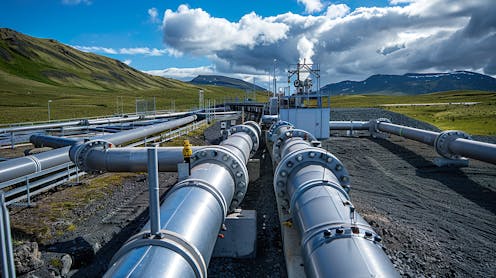
Newly released documents add more detail to the government’s plans for a regulatory framework to enable carbon capture and storage.
But they show indecision on two key matters – the legal framework and the agency that would be in charge.
The plan relates primarily to conventional carbon capture and storage technologies, which remove carbon dioxide from an industrial gas flow and dispose of it deep underground.
It also covers some methods of carbon dioxide removal, an emerging but as yet commercially untested suite of technologies such as enhanced rock weathering, bio-energy capture and direct air capture.
The latter technologies are not predicated on fossil fuel consumption and could operate in many different situations.
Neither kind of carbon removal is a simple answer to the climate challenge and the priority remains on cutting emissions. But we need to have regulatory frameworks in place for both reduction and removal technologies of all kinds, and soon.
Earning credits from emissions trading
Both types of technologies will benefit from the government’s decision to allow companies to get credits in the New Zealand Emissions Trading Scheme (ETS) for the disposal of carbon dioxide from any source. Credits will not be tied to any one technology, according to the released policy discussion documents.
It’s also a positive development that an operator can get credits as a separate removal activity, not merely as a reduction of an existing emissions liability (although official advice was initially against separate credits). This allows for diversity in the players and the systems for removals.
The government has decided it will assume liability for any carbon dioxide leaks from geological storage, but only after verification that fluids in the subsurface are behaving as expected after closure, and no sooner than 15 years after closure.
Leaks this long after injection are unlikely, but we nevertheless need strong regulation, financial assurance to guarantee remedial action and clear liability rules.
The government also states ETS credits will only be available for removals that can be recognised internationally against New Zealand’s commitments to cut emissions. This would apply only to geological storage but not deep-ocean deposition or rock weathering.
But that’s not quite right. The general international rules already allow the inclusion in a national greenhouse gas inventory of removals from any process. Detailed methodologies for carbon dioxide removal are likely to become available within the next few years.
With change underway, New Zealand’s new regime should allow a wide range of removal methods to receive credits.
A new regulatory regime
The documents acknowledge that New Zealand needs a broader regulatory regime, beyond the ETS, to cover the entire process of carbon dioxide removal. The suitability of a disposal site must be verified, a detailed geological characterisation is required and the project design and operation need to be approved.
Approval is also required for closure and post-closure plans, and systematic monitoring. Monitoring is everything; it must be accurate and verifiable but also cost effective. The operator will have to pay for monitoring for decades after site closure.
In agreeing on these features, the government is following the examples of many countries overseas, including Australia, Canada, the UK and the EU.
However, it is intriguing that the government hasn’t decided where this new regime should sit in the statute book, and who should manage it. Much of the apparently relevant text in the documents has been redacted.
Given that carbon dioxide would be stored underground, the Crown Minerals Act is one possibility. But this legislation is all about extraction, not disposal. Although the New Zealand petroleum and minerals unit at the Ministry for Business, Innovation and Employment has expertise in regulating subsurface operations, it focuses largely on oil and gas, not on innovative climate projects.
The Resource Management Act certainly provides a regulatory approval regime, but it is awaiting reform and would need much more than the currently proposed changes to deal with carbon capture and storage or removal properly. So would legislation covering activities within New Zealand’s exclusive economic zone.
Indeed each act would require a whole new part to be added, with its own principles and procedures. There is a lot to be said for a standalone new act, in a form that would fit with the emerging Natural Environment Act that will replace the Resource Management Act.
The new legislation and regulation regime could be administered by the Environmental Protection Authority, which is already involved in Resource Management Act call-ins and fast-track approvals, the legislation covering the exclusive economic zone and the ETS.
One can only guess there might be tensions between contending factions in government. What we should ask for is a legislative and institutional arrangement that allows carbon capture and storage or removal technologies to evolve and grow without being a mere offshoot of the oil and gas industry or any other existing sector.
As part of our efforts to reduce emissions, we must make sure all kinds of removal technologies are available that truly suit New Zealand.
Authors: Barry Barton, Professor of Law, University of Waikato

















