From ‘Stone Age’ treasury boss to National Party Senator: John Stone 1929–2025
- Written by John Hawkins, Head, Canberra School of Government, University of Canberra
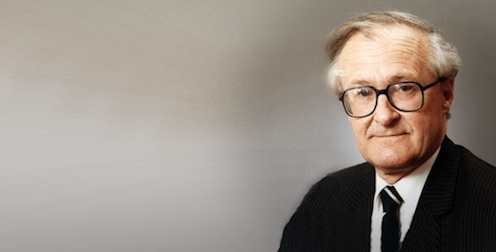
John Owen Stone AO was a legendary leader of the Commonwealth Treasury. He was secretary (departmental head) from January 1979 to September 1984 but was an intellectual driving force before then as deputy secretary from 1971 to 1978.
Over those years he dealt with eight treasurers: Billy Snedden, Gough Whitlam, Frank Crean, Jim Cairns, Bill Hayden, Phillip Lynch, John Howard and Paul Keating.
It is a sign of his influence that those years were dubbed the “Stone Age” by South Australian Premier Don Dunstan and others.
Former Defence Department heads Arthur Tange and Tony Ayers were at various times called the “last of the mandarins” but Stone is probably truly the last.
In 1978 journalist Paul Kelly called Stone “one of the two men who ran the nation”, the other being then prime minister Malcolm Fraser.
It is hard to think of any later public servant about whom that could be said.
Stone’s entry in the Senate’s biographical dictionary captures him well:
he could be charming, witty and flattering, but he is often decried as being obstinate and arrogant.
A Reserve Bank official is said to have said “I wish I was as certain about one thing as John Stone is about everything.”
This obduracy cemented the Treasury’s reputation for arrogance and weakened its influence.
Early years – from physics to economics
John was born in 1929, the elder of two sons of a farmer and a primary school teacher. His childhood was spent in the Western Australian wheat belt. But after his parents divorced when he was 12, he moved with his mother to Perth.
He attended Perth Modern School where contemporaries included Bob Hawke, Rolf Harris and Maxwell Newton.
He graduated with first-class honours from the University of Western Australia in 1950, majoring in mathematical physics, and served as president of the students’ association.
While there he met Billy Snedden, who two decades later would be Prime Minister William McMahon’s treasurer and with whom Stone would work as treasury deputy secretary.
In 1951 he won a Rhodes scholarship. He initially enrolled for a physics degree at Oxford, but switched to economics, graduating with a Bachelor of Arts in Politics, Philosophy and Economics.
He joined Australia’s Treasury, initially in its London office, in 1954. The same year he married Nancy Hardwick, a biochemical researcher, and they would have five children.
The mandarin who put Treasury first
Stone was an admirer of fellow Rhodes scholar Sir Roland Wilson, the longest-serving Treasury secretary with doctorates from Oxford and Chicago.
Along with Wilson, Stone was a strong critic of the 1965 report of the Committee of Economic Inquiry known as the Vernon Report which called for greater planning and an independent economic advisory committee whose advice would have rivalled Treasury’s and succeeded in having Prime Minister Menzies reject it.

In the late 1960s as treasury’s representative he was an executive director at the International Monetary Fund and defied his treasurer William McMahon by voting against the introduction of Special Drawing Rights that gave members rights over other members’ reserves.
Stone believed that was why he was passed over for the secretary’s position when Frederick Wheeler was appointed in 1971.
At treasury in the 1970s, Stone publicly clashed with members of a global environmental group called the Club of Rome about whether there were environmental limits to economic growth.
During a public meeting in Canberra in 1973, he argued the world would not run out of the resources it needed because price rises would create incentives to use them more efficiently and develop substitutes.
These ideas permeated the treasury’s second economic research paper called Economic Growth - is it Worth Having? which he heavily influenced.
Stone claimed to have personally drafted the words in Treasurer Bill Hayden’s 1975 budget statement that said Australia was
no longer operating in that simple Keynesian world in which some reduction in unemployment could, apparently, always be purchased at the cost of some more inflation.
Stone was the driving force behind the subsequent Fraser government’s mantra of “fight inflation first”.
As a senior Treasury officer, Stone was often openly contemptuous of politicians. He would share these views with journalists at the bar of the Hotel Canberra and in later years at the bar of the National Press Club.
He was particularly critical when politicians had the temerity to take advice from what he termed “meretricious players” from outside the treasury.

This attitude led Stone to oppose even the sort of free-market measures he might be expected to like when they were advocated by someone else.
He unsuccessfully opposed the Whitlam government’s cuts to tariffs in 1973 and some of the recommendations of the Campbell Committee of Inquiry into Australia’s financial system in 1981.
Fraser is said to have said Stone “believes in the deregulation of everything he does not regulate”.
Stone also opposed the Hawke government’s decision to float the dollar in 1983.
He argued the timing was wrong and that the dollar would appreciate, weakening the economy. After rising for a short time, the dollar actually depreciated and the economy performed strongly.
Ludicrously, Stone denied having ever opposed it.
Many in the Labor Party had wanted Stone sacked when it came to power in 1983, but Keating kept him on, partly to reassure financial markets. As Keating’s confidence in his own judgement grew, Stone’s influence waned.
Stone announced his resignation just before the August 1984 budget and made a scathing attack on many of the government’s policies in his 1984 Shann Memorial Lecture at the University of Western Australia.
Read more: Happy birthday AUD: how our Australian dollar was floated, 40 years ago this week
Politics post-treasury
Stone isn’t the only treasury official to have gone into politics. Leslie Bury even became treasurer. Jim Short and Arthur Sinodinos became assistant treasurers.
But Stone was the only former head of the treasury to enter politics. He served as a National Party Senator for Queensland from 1987 to 1990, having been part of the Joh for Canberra campaign which had as its organising principle the anointing of Queensland Premier Joh Bjelke-Petersen as prime minister.
He was the Senate running mate to Sir Joh’s wife Flo Bjelke-Petersen.
 Stone joined the Senate in 1987 as part of the Joh for Canberra campaign.
NLA
Stone joined the Senate in 1987 as part of the Joh for Canberra campaign.
NLA
Stone was twice the Coalition’s finance spokesman, but he was something of a loose cannon. John Howard dropped him from the front bench for a time after he said “Asian immigration has to be slowed”.
He apparently held ambitions to be treasurer. In 1990 he resigned from the Senate to contest a seat in the House of Representatives that would have made that easier given treasurers are traditionally members of the lower house.
Stone failed to win it. He then reneged on an earlier promise by nominating to return to his Senate seat. Faced with uproar in the party, he withdrew and his meteoric political career was over.
He co-founded the HR Nicholls Society, which pressed for the deregulation of industrial relations laws, and the Samuel Griffith Society which concerned itself with states’ rights.
Stone was active in the Institute of Public Affairs and wrote frequently in Quadrant. He opposed republicanism, centralism, trade unionism, multiculturalism and climate action.
He died aged 96 and is survived by five children.
Authors: John Hawkins, Head, Canberra School of Government, University of Canberra