

How the Bible helped shape Australian culture
- Written by: Robyn J. Whitaker, Bromby Senior Lecturer in Biblical Studies, Trinity College, University of Divinity
Throughout Australian history, the Bible has been used by those both asserting colonial power and subverting it, as a tool of oppression and as an instrument of justice.
Did you know the anti-Christian slang, “Bible-bashers,” was coined by Australians? Or that the largest crowd ever to gather at the Melbourne Cricket Ground was for Billy Graham in 1959? There were an estimated 143,750 people in attendance. These are just a couple of the historical gems waiting to be discovered in Meredith Lake’s new book, The Bible in Australia: A Cultural History.
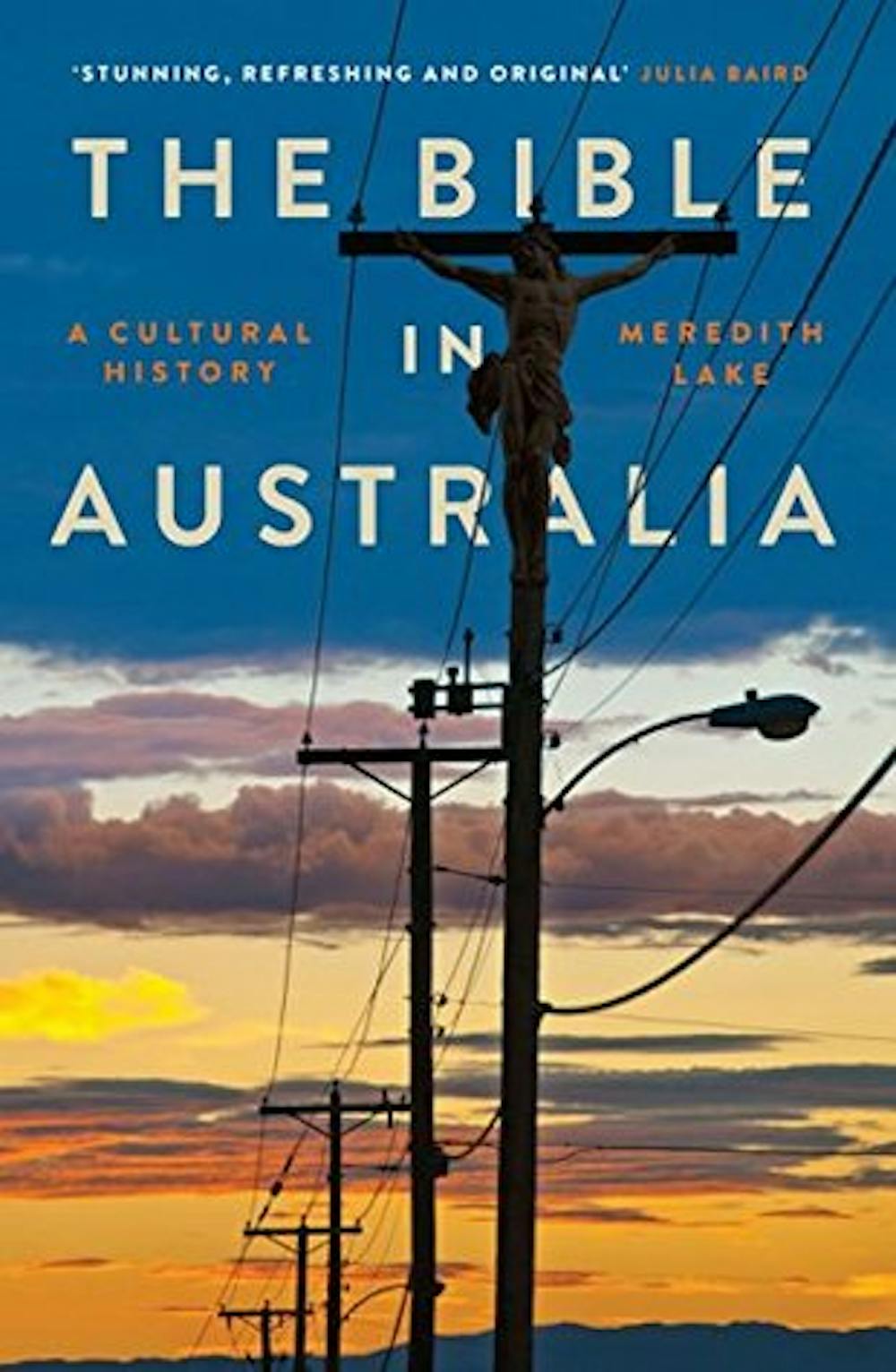 Lake draws on an astonishing range of sources to craft a narrative about the complex and nuanced place the Bible has held in Australian culture since hundreds of copies arrived with the First Fleet in 1787. She argues the Bible has mattered deeply in forming Australian culture, but never in a simple way. Time and time again, Lake traces the multiplicity of biblical interpretations and applications to show that throughout Australian history, the Bible has been used by those asserting colonial power and those subverting it as a tool of oppression and an instrument of justice. In doing so, Lake shatters the dominant competing myths that Australia is either a “doggedly secular society” or a “straightforwardly Christian nation.” We are neither, although both claims continue to rear their heads. The book is organised in four parts, each covering a major period of post-invasion Australian history: colonialisation; missionary expansion and immigration; federation and war; and the 20th century’s turn towards secularism. In each of these periods, Lake highlights the “three main guises” in which the Bible has appeared – “the globalising Bible, the cultural Bible and the theological Bible.” Read more: Note to Margaret Court: the Bible isn't meant to be read that literally The globalising force of the Bible is one that connects people across geographical and cultural boundaries, and is thus marked by adaptation. By 1904, the Bible had been translated into 378 languages, with a global distribution of over 186 million.
 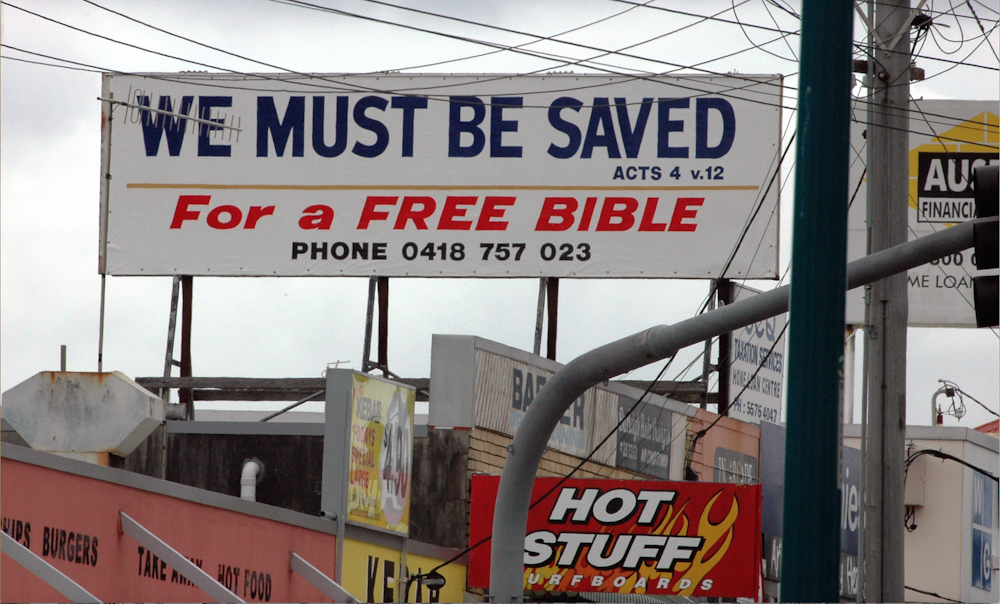 Australia is neither a ‘doggedly secular society’ or a ‘straightforwardly Christian nation’. fox2mike/flickr In Australia, the Bible’s arrival was accompanied by a prevailing European cultural heritage with linear ideas about time, entrenched concepts of government (and imperialism) and a language already shaped by biblical literature. All of which stood in stark contrast to Indigenous Australian culture. As a cultural force, the Bible was a central point of reference for Christians and atheists alike, particularly in the 19th century. It was associated with civilisation (acknowledging the problematic use of that term in British colonial history), with a rich literary and artistic tradition, and as the core text for determining morality and ethics, even by those who were not Christian. As the English agnostic Thomas Huxley wrote in 1870, “there still remains in this old literature a vast residuum of moral beauty and grandeur.” The “theological Bible” is a term Lake uses to describe biblical interpretation that is intimately connected with faith. This type of interpretation considers the Bible the sacred “word of God”: one that is efficacious in continuing to communicate God’s will as revealed in the Bible and to transform lives. Lake acknowledges that this aspect of the Bible in history is the hardest to understand for people who do not share a faith perspective. Yet, she writes, “history always requires openness and imagination” and Lake’s use of these theological sources is sympathetic, accepting them on their own terms.
 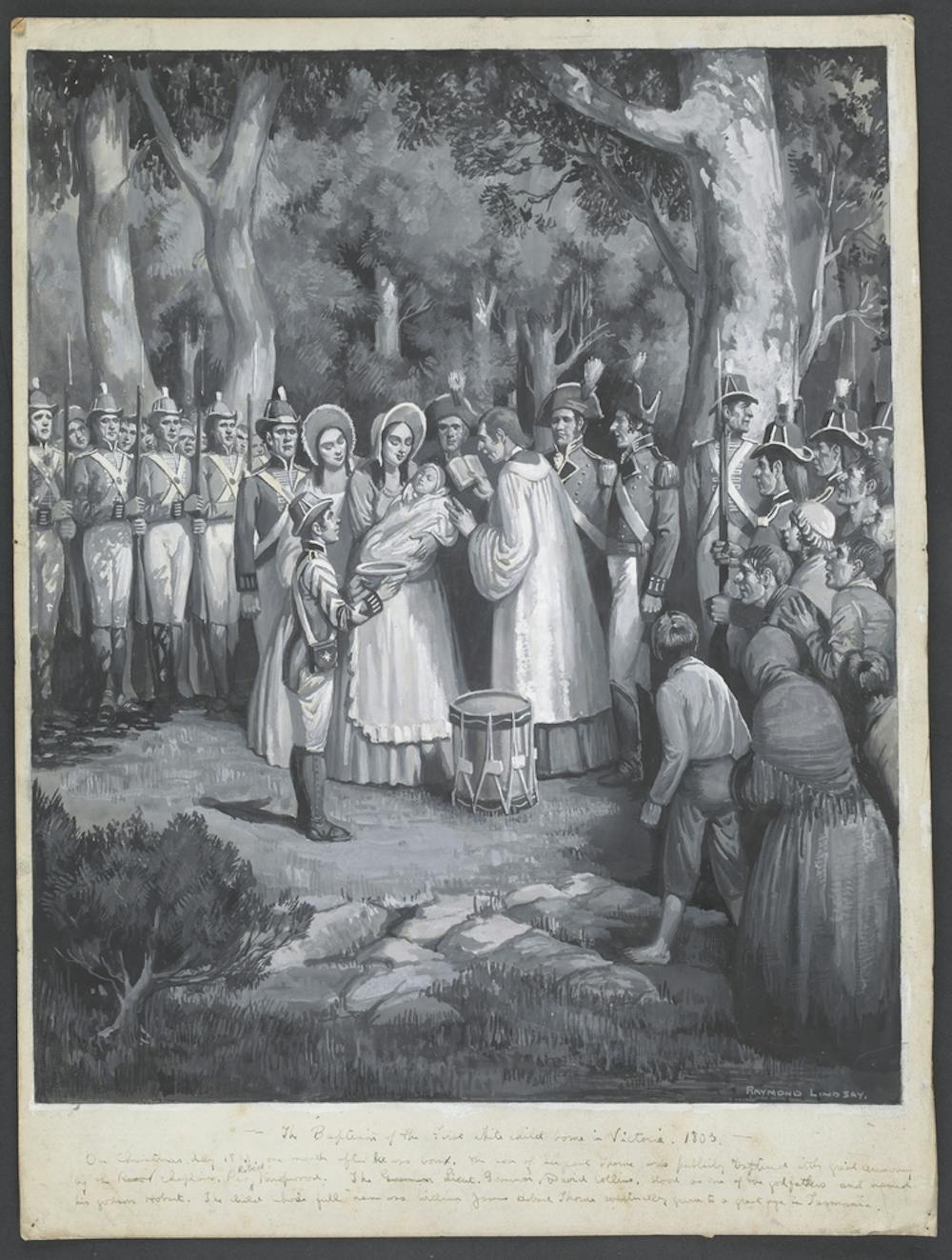 The Baptism of the First White child born in Victoria. 1803, by Raymond Lindsay. State Library of Victoria That the Bible can be used in diverse ways is a thread that runs through this book. Christians interpreted the Bible through the lens of a theology of creation and providence to justify colonisation, the notion of terra nullius, and Australia’s White Australia Policy. But as has so often been the case, the same text was used to subvert these claims. From the very earliest phases of colonisation, convicts identified their gaolers as “Pharisees,” thus identifying themselves as Jesus-like innocent victims. Convict John Hawes, Lake records, mimetically referenced Luke’s crucifixion of Jesus as he prepared for the noose saying, “I forgive all my oppressors.” Indigenous Australians would also, paradoxically, find liberation in the very text that was so often used to oppress them. William Cooper, a Yorta Yorta man, applied what he learned on Maloga Mission to make biblical arguments for Indigenous land tenure and organise a Day of Mourning on 26 January 1938. “In Cooper’s hands, the Bible not only sharpened his critique of colonialism, it nourished his vision for a more truly Christian community.” Cooper reminded white politicians that all humans were created by God and of equal value in “the sight of God”. Several implications emerge from reading Lake’s book, but here I will focus on three. Firstly, Lake implicitly reminds us that the Bible’s chequered history in this country must be acknowledged in order for reconciliation to continue. History serves as a warning to any Christian that biblical interpretation requires care and responsible practice. Simultaneously, her work reveals the constancy with which the life-giving potential of this text rises to subvert injustice and oppressive power. Religious education The second issue relates to the place of the Bible in the Australian education system. The first schools in Australia were denominational; church schools that emerged to serve local populations. Understandably, the Bible was core curriculum in these schools where it was both prayed, preached, and taught in class. In the early 1900s, these schools were subsidised by the state but “without interference” in terms of doctrine or curriculum. Read more: Why our declining biblical literacy matters By the mid-19th century, education was highly contested in terms of accessibility for rural and underprivileged children. In this context, the first government schools emerged. Famously, education was declared “free, compulsory and secular” in the Public Instruction Acts of the 1870s and 80s. As Lake writes, “secular, on this view, meant rejecting sectarian division in favour of common Christianity as a basis for citizenship.” While not denominational, most of these schools (except in Victoria) continued to teach the Bible, emphasising its ethical aspects as a common good for shaping citizens and society. Today, most Australian high school students will, at some point in their education, encounter Shakespeare, but not the Bible. This is despite the fact the Bible’s cultural force and historic import arguably outweighs that of Shakespeare.
 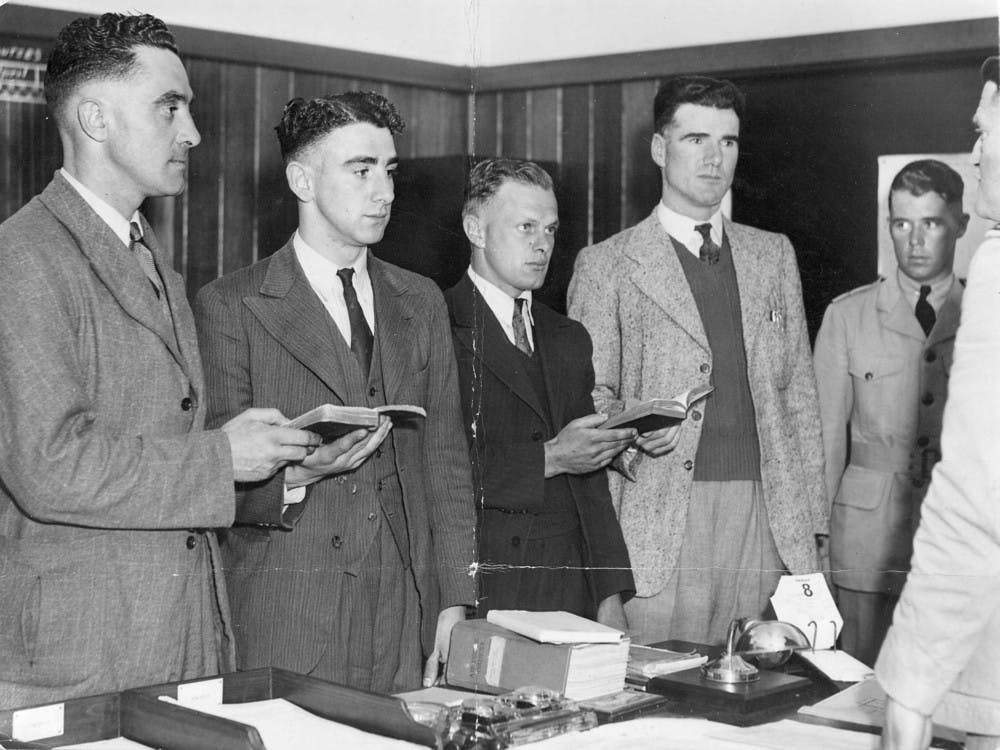 Men taking an oath on the bible during World War II. Argues newspaper/State Library of Victoria As I write, The University of Melbourne commendably offers subjects in Islamic studies (including the Qur’an) and Judaic studies, but nothing on the history of Christianity nor the Bible. While there is increasing recognition that the study of world religions (and their sacred texts) contributes to political and socio-cultural understanding, the historical privileging of Christianity has ironically meant its exclusion from a humanities curriculum in most places. Monash University offers a more rounded religious studies curriculum, with a “Biblical Texts and Contexts” unit. The University of Sydney offers a fuller program again. Despite these latter examples, Australia lags well behind global trends when it comes to our universities offering academic study of religion. The Bible is studied in theological schools and seminaries, too often divorced from a wider curriculum or rigorous critique. How do we expect the next generation to navigate the complexities of the current world without robust, academic religious education that includes Christian sources? Pluralism The third challenge Lake issues relates to pluralism and the kind of country we want to be. Lake argues that to “restrict or exclude religious voices, or to treat religious texts as illegitimate reference points in public conversation, runs counter to the ideal of a plural but inclusive polity and society.” She strongly challenges, rightly so in my opinion, the notion that Christianity or the Bible be given any “particular privilege” in a pluralistic society, but also asserts that “robust pluralism” cannot exclude the religious. This relates to but extends the point above: to have nuanced conversation and public debate, particularly about ethical and moral issues, requires some historical and cultural understanding of the role religion and religious texts have and continue to play in our society. We saw the importance of navigating these texts in last year’s debates about Marriage Equality and Voluntary Assisted Dying. In the Australian context, a degree of biblical literacy remains essential, not least to mitigate against fundamentalism or poor biblical interpretation. I highly recommend this book to anyone seeking to understand more fully the role of the Bible in Australian history as well as in contemporary culture and public debate. It is delightful and informative to read, and will provide much food for thought.
 Authors: Robyn J. Whitaker, Bromby Senior Lecturer in Biblical Studies, Trinity College, University of Divinity
Read more http://theconversation.com/how-the-bible-helped-shape-australian-culture-96265

















