'If at first you don’t succeed, lie, lie again' – in A Country of Eternal Light, Paul Dalgarno explores a life fragmented by grief
- Written by: Catherine McKinnon, Deputy Head—School of the Arts, English and Media, University of Wollongong

Paul Dalgarno’s novel A Country of Eternal Light opens with his narrator, Margaret Bryce, in a bathtub. This is no ordinary bathtub, but one that exists between the world of the living and the dead. Margaret has (it seems) very recently died:
I drop further under, breathing out – no bubbles – the oblong light of the bathtub way up above, a meconium murk all around. Sirens singing … there are none. Mermaids … there are none. A heartbeat marking time in the gloom – no heart.
A bold beginning and one that not only directs the reader’s attention to Margaret’s exuberant spirit, but to the unreliability of her telling. For nothing in this novel is certain, except perhaps that Margaret is unwilling to dissolve into the dark water of the underworld. Despite having no body, no head, no heart, she soon kicks herself back to the “land of […] the living”.
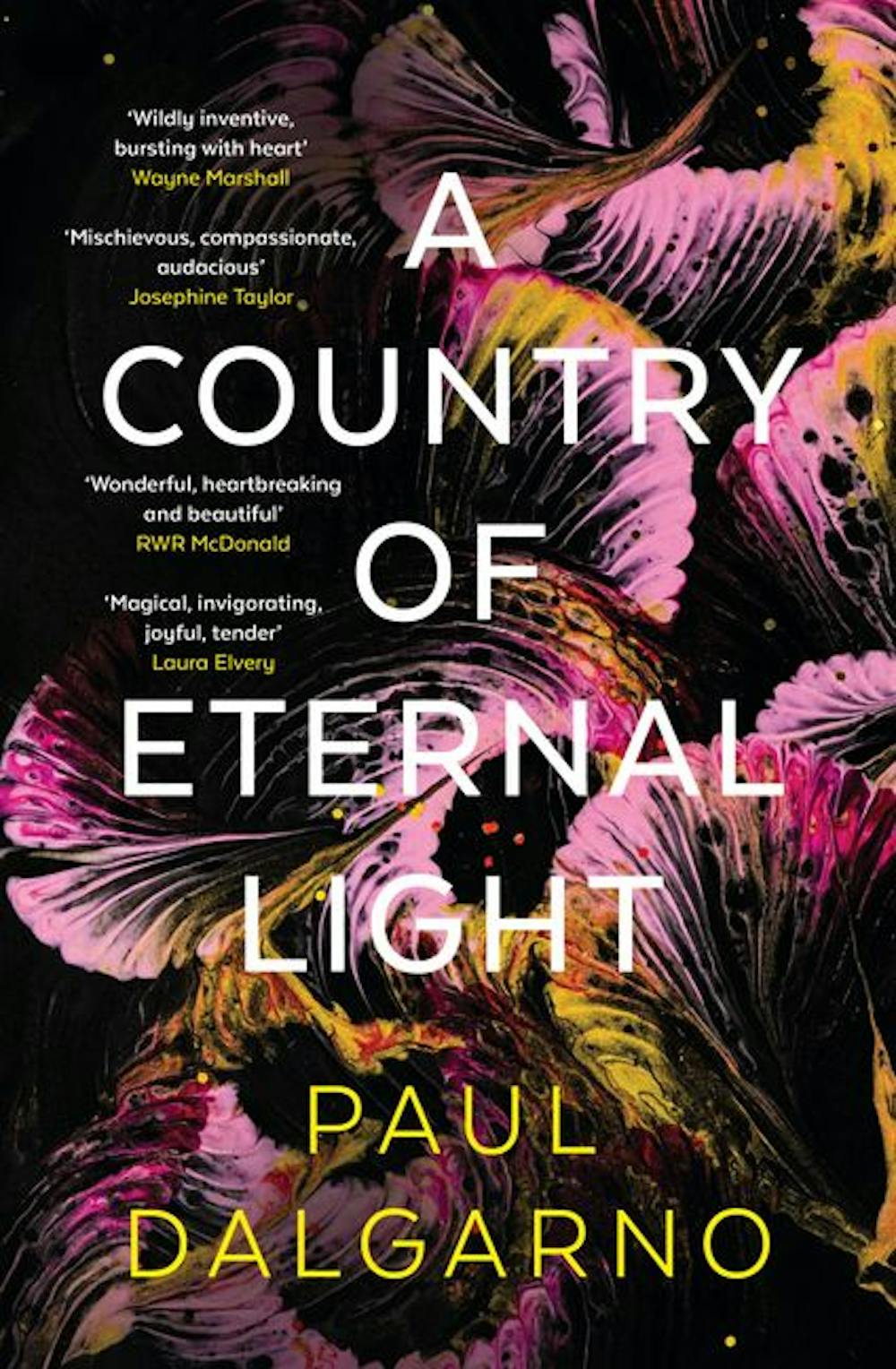
Review: A Country of Eternal Light – Paul Dalgarno (Fourth Estate)
It quickly becomes apparent that her quest – and ours, as co-passengers on this wild ride – is to ascertain what is keeping her tethered to earth. Unlike the ghost of Hamlet’s father, who pleads with his son to avenge his “foul and most unnatural murder”, Ghost Margaret’s mission bewilders her:
I don’t know what I’m doing here, and by here I mean here, there and everywhere […] Is there a purpose? I don’t know. Maybe I can save someone? Save myself? Send myself an SOS.
 Paul Dalgarno.
Harper Collins.
Read more:
Crumb bachelors and millennial HENRYs enliven Ronnie Scott's zeitgeisty new novel
Sacrifices and grief
Although the story is told from Margaret’s perspective, an important theme emerges through Rachel’s character: how does a child repay a mother for the great sacrifices she has made?
Margaret is Margaret, but she is also an everymother figure. At times, life gave her a raw deal, but she refuses (in life and death) to let events get the better of her. Her memory is capricious and we gradually understand there are personal truths hidden from her, even in death.
Dalgarno reminds us of the risks involved in not facing up to grief. In the resolution of Margaret’s quest, Dalgarno creates a narrative surprise that is difficult to discuss without spoiling the story for future readers. It involves an impressive reversal, a moment where we recalibrate everything that has gone before.
As a narrative strategy, it is daring and very nearly works, but not quite. The fragmented chaos that so beautifully shapes the novel’s structure is part of the reason why. We have experienced, to that point, a turbulent and uncanny story-world. Holding on to story threads has not been our readerly focus, so to revise what we know is not a simple task. Instead of being a surprise, the reversal is, at first, confusing. (Maybe I had it wrong? Better go back and check.)
And yet the moment has such lightness of touch there is delight to be had. When the reversal occurs we discover the catastrophe that is keeping Ghost Margaret on this earth. Our unreliable narrator witnesses her great tragedy, which she had been unable to witness in life, and makes peace with it. Troubled no more, Ghost Margaret can finally “sink into the land of eternal darkness”.
A Country of Eternal Light is a journey like no other. The lightness of the prose and Margaret’s adventurous spirit hide a devastating burden, one that Dalgarno suggests can be overcome through attention to the ephemeral. We need to look into the gaps, look beneath the story, to find its hidden truths. The beauty of the novel is that it celebrates Margaret’s life, her ability to love and laugh and forgive and rage, while also acting as witness to her great grief. It is not only a meditation on the sorrows that rip a family apart, but a celebration of the love that threads it back together.
Authors: Catherine McKinnon, Deputy Head—School of the Arts, English and Media, University of Wollongong
Paul Dalgarno.
Harper Collins.
Read more:
Crumb bachelors and millennial HENRYs enliven Ronnie Scott's zeitgeisty new novel
Sacrifices and grief
Although the story is told from Margaret’s perspective, an important theme emerges through Rachel’s character: how does a child repay a mother for the great sacrifices she has made?
Margaret is Margaret, but she is also an everymother figure. At times, life gave her a raw deal, but she refuses (in life and death) to let events get the better of her. Her memory is capricious and we gradually understand there are personal truths hidden from her, even in death.
Dalgarno reminds us of the risks involved in not facing up to grief. In the resolution of Margaret’s quest, Dalgarno creates a narrative surprise that is difficult to discuss without spoiling the story for future readers. It involves an impressive reversal, a moment where we recalibrate everything that has gone before.
As a narrative strategy, it is daring and very nearly works, but not quite. The fragmented chaos that so beautifully shapes the novel’s structure is part of the reason why. We have experienced, to that point, a turbulent and uncanny story-world. Holding on to story threads has not been our readerly focus, so to revise what we know is not a simple task. Instead of being a surprise, the reversal is, at first, confusing. (Maybe I had it wrong? Better go back and check.)
And yet the moment has such lightness of touch there is delight to be had. When the reversal occurs we discover the catastrophe that is keeping Ghost Margaret on this earth. Our unreliable narrator witnesses her great tragedy, which she had been unable to witness in life, and makes peace with it. Troubled no more, Ghost Margaret can finally “sink into the land of eternal darkness”.
A Country of Eternal Light is a journey like no other. The lightness of the prose and Margaret’s adventurous spirit hide a devastating burden, one that Dalgarno suggests can be overcome through attention to the ephemeral. We need to look into the gaps, look beneath the story, to find its hidden truths. The beauty of the novel is that it celebrates Margaret’s life, her ability to love and laugh and forgive and rage, while also acting as witness to her great grief. It is not only a meditation on the sorrows that rip a family apart, but a celebration of the love that threads it back together.
Authors: Catherine McKinnon, Deputy Head—School of the Arts, English and Media, University of Wollongong