

Modern Australian
Men's Weekly

.

When you wish upon a star, is it already dead? An astronomer crunches the numbers

  • Written by Laura Nicole Driessen, Postdoctoral researcher in radio astronomy, University of Sydney
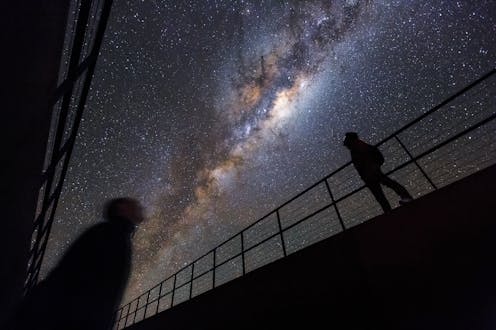
When you wish upon a star, is it already dead? An astronomer crunches the numbers

When you wish upon a star, Jiminy Cricket told us, your dreams come true. But according to an idea doing the rounds on social media, that may not be the case:

According to astronomy, when you wish upon a star you’re a million years too late. The star is dead, just like your dreams.

Is that really true? Did Jiminy Cricket lie to us?

As an astronomer, I’m happy to say that the stars we can see in the night sky are a lot closer and live a lot longer than you would think. It’s pretty unlikely you’ve accidentally wished upon a star that’s already dead.

Stars are closer than you think

When someone hits you with the depressing factoid that the stars we wish on are already dead, they usually start by saying something about how the stars are “millions of light years away”. This means the light from the star has been travelling for millions of years to reach your eyes, so by now the star is millions of years older and – supposedly – most likely dead.

But the stars you’re wishing on probably aren’t that far away. All the stars we can see with our eyes are inside our galaxy, the Milky Way. The Milky Way is approximately 100,000 light years across, and our Solar System is about 26,000 light years from the centre of the galaxy.

So if we could see the stars at the very far edge of the galaxy, they’d still only be about 74,000 light years away. That’s nowhere near a million light years away, let alone “millions of light years”.

A spiral of stars representing the Milky Way galaxy with a bright clump in the middle at the centre of the galaxy. The Sun is about half way between the centre and the edge of the galaxy.
An artist’s impression of the Milky Way galaxy showing the location of the Sun and its distance from the centre and the edges of the galaxy. NASA/JPL-Caltech/R. Hurt (SSC/Caltech)

Visible stars are even closer

In practice, the stars we can see aren’t even that far away. On a dark night, with no Moon and with good vision (which rules me out), the faintest star we can see with our eyes has a brightness of around 6.5 magnitudes.

Brighter stars have lower magnitudes, and dimmer stars have higher ones. The brightest star in the Southern Cross has a magnitude of 0.8 while the faintest star in the Southern Cross has a magnitude of 3.6.

The visible brightness limit of 6.5 magnitudes means we can only see stars out to around 10,000 light years from Earth. So if you happen to wish on one of the more distant stars, the light has travelled 10,000 years to hit your eye.

And if we assume wishes travel at the speed of light, it’ll take another 10,000 years to reach the star. So even the most distant visible star is only 20,000 years older by the time your wish reaches it.

So the question is: do stars live longer than 20,000 years?

An image of the Milky Way showing the pointer stars and the Southern Cross. The Milky Way looks like a wide, fuzzy stripe across the sky made of many stars. You can also see some darker patches of dust blocking some of the light.
Image of the Southern Cross and the ‘pointer stars’. The brightest star in the Southern Cross, Alpha Crucis or ACrux, is 321 light years away. The faintest star, Delta Crucis, is 228 light years away. The pointer stars are Alpha Centauri (around four light years away) and Beta Centauri (around 390 light years away), where Alpha Centauri is the brighter of the two. ESO/S. Brunier

Stars live longer than you think

The Yale Bright Star Catalogue contains 9,096 stars that are brighter than magnitude 7, roughly the limit of what our eyes can see. Many (40%) of the stars in the catalogue are so-called giant stars, which come in three varieties: normal giants, bright giants and super giants.

The more massive the star, the shorter its life. So these giant stars are here for a good time, not a long time.

Image of a very bright, blue star. The star is so bright that there are spokes coming out of it like a cross, these are caused by over exposure. There’s a little tiny blue star to the lower left.
Image of Sirius A, the brightest star in the night sky and second closest star to the Sun, and its fainter companion Sirius B. This image was taken using the Hubble Space Telescope. NASA/ESA/H. Bond (STScI) and M. Barstow (Univ. Leicester)

But in astronomy a “good time” is still at least a few hundred thousand years. Much longer than your wish needs to arrive at a star closer than 10,000 light years.

The rest of the visible stars are what are called main sequence (or mid-life) stars and sub-giant stars. These stick around a lot longer, up to a few billion years. So when it comes to wishes, age is just a (really big) number.

The best stars to wish upon

A bright orange dot (the star) sits at the centre of a blobby ring. Another dot is up and to the right of the ring.
Image of the third closest star to the Sun, Epsilon Eridani or ‘Ran’. The star is at the centre of the ring, which is a disk of debris disk around the star. ALMA (ESO/NAOJ/NRAO)/Mark Booth

If you’re still feeling a bit nervous about wishing upon a dead star, there are a few safe bets.

Alpha Centauri is the closest star to Earth and the fourth brightest star in the sky. Even better, it’s actually three stars and they’re only about four light years away. They’ll definitely last longer than the eight years needed for their light to reach you and your wish to reach them.

The brightest star in the sky, Sirius, is a main sequence star only 8.6 light years away. Epsilon Eridani is approximately ten light years away. It’s similar to our Sun and a little under a billion years old. Since Sirius and Epsilon Eridani are in their mid-life, they still have millions, maybe even billions, of years left to burn.

The safest star to send your wishes to? The Sun! The Sun is only eight light minutes away and it’ll be a main-sequence star for around 5 billion years yet.

Image of the Sun that looks like a bright orange sphere. It has a patchy texture. You can also see streaky bright loops and darker patches. Loops and streaks protrude from the edges. There’s a particularly bright blobby protrusion on the lower left hand s
Image of the Sun as a bright solar flare seen on the left side. NASA/Goddard/SDO

So when you wish upon a star, that star is less than 10,000 light years away and will probably live for at least hundreds of thousands of years, and maybe millions or even billions of years (just like your dreams).

Authors: Laura Nicole Driessen, Postdoctoral researcher in radio astronomy, University of Sydney

Read more https://theconversation.com/when-you-wish-upon-a-star-is-it-already-dead-an-astronomer-crunches-the-numbers-244915

5 Best Dental Clinics in Beecroft, NSW

The best dental clinics in Beecroft, NSW are Beecroft Smiles Dental Surgery, Beecroft Elegant Dental Clinic, McConnell Dental, Dentistry for Life, a...

Executive Recruitment: Finding Leadership Talent That Drives Organisational Success

Hiring the right leadership team can significantly influence the direction and performance of any organisation. Strong executives bring strategic thin...

Understanding the Importance of Abrasive Blasting in Industrial Surface Preparation

Surface preparation is an essential step in many industrial processes. Whether preparing metal structures, removing old coatings, or cleaning equipmen...

Farm Machinery Costs Set to Rise

With steep rises in fuel prices and the need for specialised maintenance, farm machinery costs are set to rise across Australia. The need for transpor...

Why an Employer Recruitment Agency Helps Businesses Build Stronger Teams

Finding the right employees is one of the most important responsibilities for any organisation. Businesses rely on skilled professionals who can con...

Why Quality Trailers Are Essential for Transport and Trade Businesses

Transportation plays a major role in industries ranging from construction and landscaping to logistics and agriculture. Businesses that frequently m...

Why Professional Car Removal Services Are The Best Way To Dispose Of Unwanted Vehicles

When a vehicle reaches the end of its useful life, owners often face the challenge of deciding how to remove it safely and responsibly. Old vehicles...

Why Professional Commercial Carpet Cleaning Matters for Modern Workspaces

Clean office environments influence how employees work, how clients perceive a business, and how long workplace interiors last. Carpets in commercia...

Why Hiring Removalists Makes Moving Easier And More Efficient

Relocating to a new home or office can be an exciting yet demanding experience. Packing belongings, organising transport, and ensuring that items ar...

The Importance of Hiring Local Lawyers in Melbourne for Business Protection

When it comes to protecting a business, the legal support you choose matters just as much as the decisions you make day to day. Working with lawyers...

Why Packaging Boxes Are Important for Product Protection and Logistics

Packaging plays a crucial role in modern commerce, ensuring that products are transported safely from manufacturers to consumers. One of the most wide...

Best Practices for Promoting Crypto Payment Options to Your Customers

Promoting crypto payment options is no longer a futuristic concept but a present-day strategy for venues aiming to reduce transaction costs, attract a...

What Is Allocated vs Unallocated Gold?

Gold has been a trusted store of value for thousands of years, prized for its rarity, durability, and universal recognition. Even in the modern financ...

Physiotherapy Strategies for Improving Independence in Daily Living

For many individuals living with permanent and significant disabilities, the concept of "independence" is not about a total absence of support, but ra...

Mobile Patrol Security vs Static Guards: What’s Best for Brisbane Businesses?

Business security is very nuanced; a cookie-cutter approach doesn’t necessarily always work in a city like Brisbane. The bigger the city, the more...

Your Home Needs Regular Maintenance — And More Than Most Think

Why Regular Home Maintenance Is More Important Than Most Homeowners Think For many Australians, the home is more than just a shelter; it is the mos...

Roof Painting Jimboomba: Protect and Transform Your Home

Your roof plays a crucial role in protecting your home from the harsh Australian climate. Over time, exposure to sun, rain, and changing weather con...

Residential Electrical Services: Reliable Solutions for Adelaide Homes

Electrical systems play a vital role in keeping your home safe, comfortable, and functional. From lighting installations to switchboard upgrades and...

















