

Ants in your house? Here’s how they get everywhere – even high up in tall buildings
- Written by: Tanya Latty, Associate Professor, School of Life and Environmental Sciences, University of Sydney
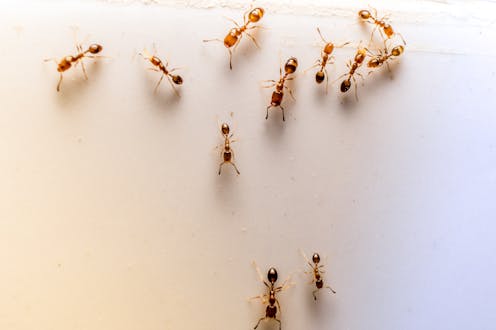
Ants are among nature’s greatest success stories, with an estimated 22,000 species worldwide.
Tropical Australia in particular is a global hotspot for ant diversity. Some researchers believe it could hold some of the richest ant biodiversity on the planet, with an estimated 5,000 species in the tropics alone.
But if ants are so successful out in nature, why do they so often turn up in our homes and even upper-level apartments?
And what can we do to keep them out?
There’s probably an ant near you right now
Ants dominate the planet in terms of sheer abundance.
At any given moment, there are an estimated 20 quadrillion ants alive — that’s 20 followed by 15 zeros.
In fact, for every human being, there are roughly 2.5 million ants.

So the short answer to “Why are there ants in my house?” is simply this: there are a lot of ants.
We live on a planet where ants outnumber us by an almost unimaginable margin. The fact that a few occasionally wander into our homes shouldn’t come as a surprise.
Ants work from home (yours, that is)
Ants owe much of their success to their highly social nature.
Within the colony, some individuals (female queens and male drones) are responsible for reproduction, while others (workers) are busy caring for the young, cleaning or foraging for food. Workers ants are always female.

Ant colonies do not have leaders. They are an excellent example of collective behaviour and swarm intelligence, where individuals following relatively simple rules can collectively achieve far more than any individual could alone.
Just as the individual neurons in your brain can’t compose music, play football, or read articles, the brain as a whole can achieve all these feats and more.
Colonies of co-operating ants are capable of amazingly sophisticated behaviours such as:
Ants even outperform humans on some cooperative cognition tasks.
Credit: Wonder World.The highly social nature of ants is a big part of their success — and a key reason why they are so good at finding their way into our homes.
Each colony contains thousands of intrepid workers, many of which are constantly searching for new food sources. If even a single ant discovers a valuable resource in your home, it can quickly share that information with its nest mates.
Different ant species use different methods of communication, but the ones that most often invade our homes tend to use “pheromone trails”.
When an ant finds a food source, she returns to her nest leaving little drops of pheromones as she goes; this trail guides other ants from their nest directly to the food source.
This highly efficient communication system means a single ant can rapidly recruit thousands of its nest mates to any food it finds.
Ants may also come inside in search of water, particularly when the weather is hot.
Some species prefer to build their nests in humid environments, which might explain why they are often found in bathrooms.
I once discovered an entire colony of sugar ants nesting inside my aquarium filter! The combination of high humidity and an enclosed structure made it an ideal place to build a nest.
On the flip side, heavy rains can flood ant nests, prompting colonies to seek drier ground — sometimes leading them straight into our homes.
 Ants are incredible communicators.
Dhe Tong/Shutterstock
Ants are incredible communicators.
Dhe Tong/Shutterstock
I live in an upper-floor apartment. How did ants get in?
Many ant species are exceptional climbers, thanks to tiny adhesive pads and fine hairs on their feet.
These specialised structures allow ants to stick to walls and find footholds even on surfaces that appear smooth to the human eye.
Remarkably, some canopy-dwelling ants have evolved a behaviour known as “controlled descent” which protects them when they fall. By adjusting the position of their abdomens, falling ants can steer their trajectory, directing themselves back toward the tree trunk and safety.
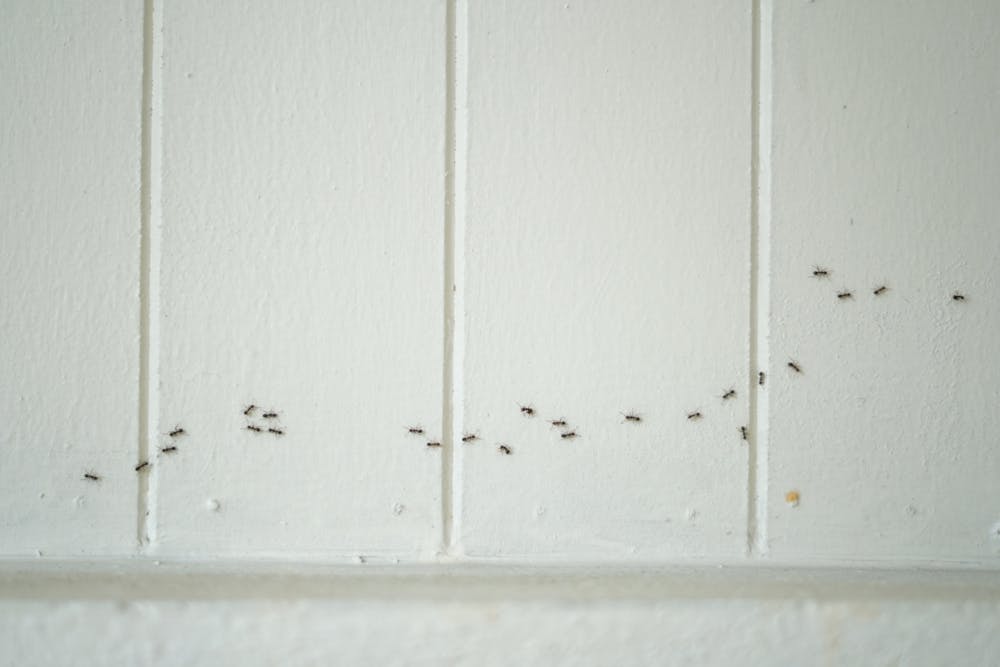 Ants often have tiny adhesive pads and fine hairs on their feet, which help them stick to walls.
Mob_photo/Shutterstock
Ants often have tiny adhesive pads and fine hairs on their feet, which help them stick to walls.
Mob_photo/Shutterstock
How do I keep ants out of my house?
Well, good luck. No matter what you do, ants will probably enter your house at one time or another.
Finding a few ants in your home doesn’t mean your house is dirty. We simply live on a planet that is absolutely teeming with ants.
To minimise unwanted ant visits, start by eliminating any potential food sources that could feed a hungry ant.
Store all food in sealed airtight containers, clean behind the fridge and inside/under the toaster, avoid leaving pet food out longer than needed and make sure your bins are securely sealed.
Ants have tiny stomachs, so even small crumbs or the residue from spilled sugary drinks can be enough to entice them back.
If ants seem to be following each other in a line, try disrupting their chemical trail using vinegar or bleach. Be warned, however: ants are very good at repairing broken trail networks.
Seal any small cracks or entrance points that might allow ants to get into your home and make sure your windows and doors have well-fitting fly screens.
Insecticidal baits can kill ant colonies, but before you deploy the nuclear option, ask yourself: what harm are the ants really doing?
Most common home-invading ants do not sting and are pretty harmless. They can usually be redirected simply by removing their food source.
Ants are nature’s clean-up crew, tirelessly scavenging waste and helping to maintain a healthy, balanced ecosystem.
They also play important roles as predators and seed dispersers.
Before reaching for insecticides, consider whether a few ants in your house are truly a problem.
Authors: Tanya Latty, Associate Professor, School of Life and Environmental Sciences, University of Sydney


















