

80 years after Benito Mussolini’s death, what can democracies today learn from his fascist rise?
- Written by: Matthew Sharpe, Associate Professor in Philosophy, Australian Catholic University
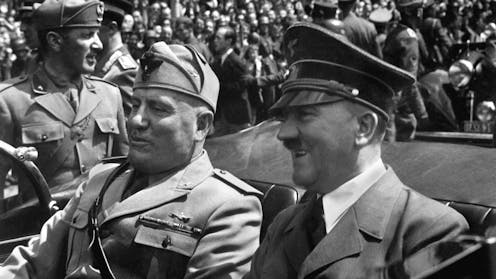
This Monday marks 80 years since Italian dictator Benito Mussolini was killed in an Italian village towards the end of the Second World War in 1945. The following day, his body was publicly desecrated in Milan.

Given the scale of Adolf Hitler’s atrocities, our image of fascism today has largely been shaped by Nazism. Yet, Mussolini preceded Hitler. Il Duce, as Mussolini was known, was Hitler’s inspiration.
Today, as commentators, bloggers and scholars are debating whether the governments of US President Donald Trump, Hungarian Prime Minister Viktor Orban and Russian President Vladimir Putin are “fascist”, we can learn from Il Duce’s career about how democracies fail and dictators consolidate autocratic rule.
The early years
The term “fascist” itself originated around the time of Mussolini’s founding in 1914 of the Fasci d'Azione Rivoluzionaria, a militaristic group promoting Italy’s entry into the First World War.
Mussolini had been raised in a leftist family. Before WWI, he edited and wrote for socialist newspapers. Yet, from early on, the young rebel was also attracted to radically anti-democratic thinkers like Friedrich Nietzsche, George Sorel, and Wilfred Pareto.
When WWI broke out, Mussolini broke from the socialists, who opposed Italy’s involvement in the conflict. Like Hitler, he fought in the war. Mussolini considered his front-line experience as formative for his future ideas around fascism. His war experience led him to imagine making Italy great again – an imperial power worthy of the heritage of ancient Rome.
In March 1919, Mussolini formed the Fasci Italiani di Combattimento in Milan. This group brought together a motley collection of war veterans, primarily interested in fighting the socialists and communists. They were organised in squadristi (squads), which would become known for their black shirts and violence – they forced many of their targets to drink castor oil.
The political success of Mussolini’s fascist ideals, however, was neither instant nor inevitable. In the 1919 Italian elections, Mussolini received so few votes, communists held a mock funeral march outside his house to celebrate his political death.
The rise to power and the march on Rome
Fascism became a part of national political life in 1920-21, following waves of industrial and agricultural strikes and worker occupations of land and factories.
As a result, rural and industrial elites turned to the fascist squadristi to break strikes and combat workers’ organisations. Fascist squads also overturned the results of democratic elections in Bologna and Cremona, preventing left-wing candidates from assuming office.
Mussolini’s political capital, remarkably, was boosted by this violence. He was invited to enter Prime Minister Ivanoe Bonomi’s first government in July 1921.
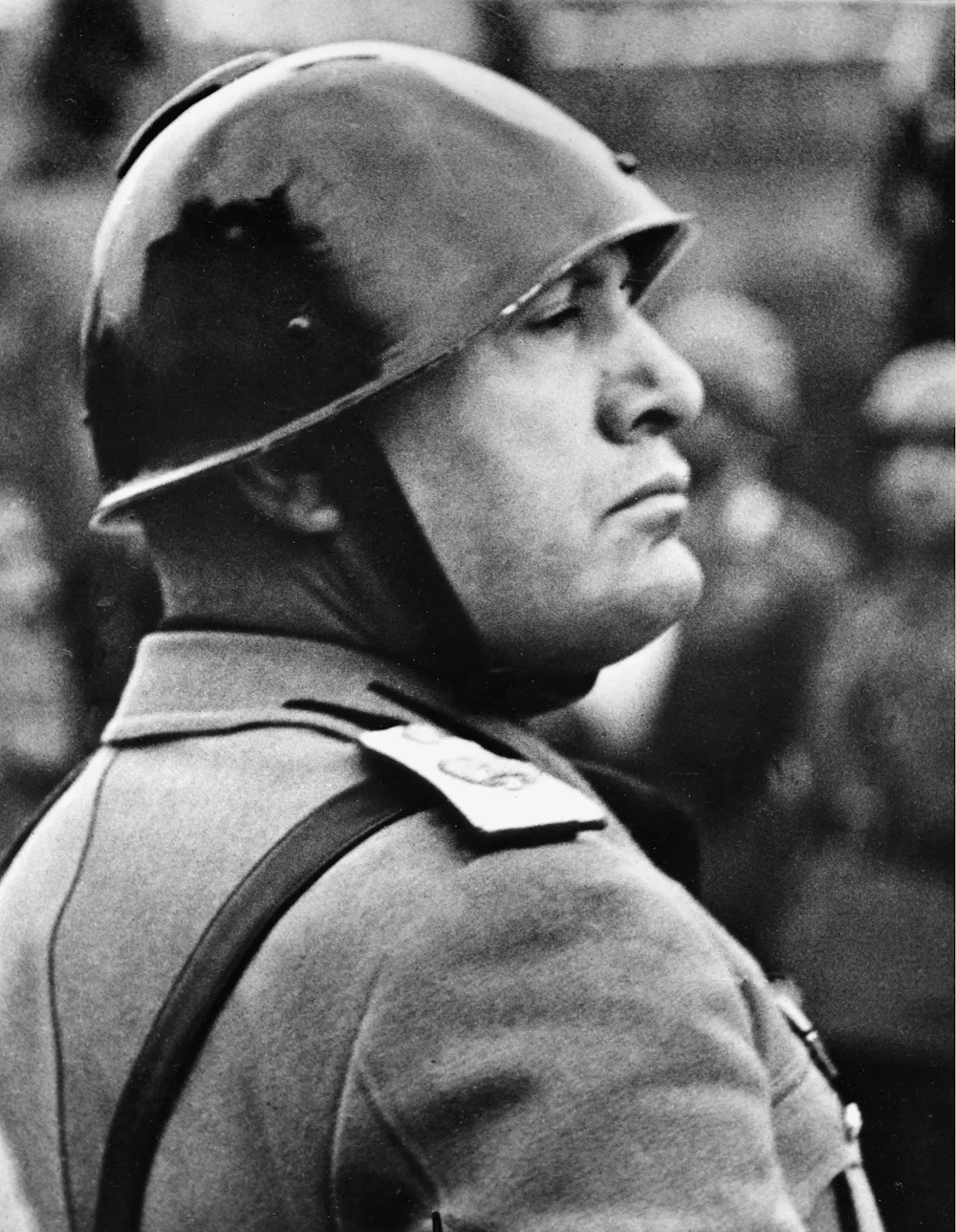
The following October, fascists occupied the towns of Bolzano and Trento. The liberals, socialists and Italian monarchy were indecisive in the face of these provocations, allowing Mussolini to seize the moment. Mustering the fascist squads, he ordered the famous “march on Rome” in late October 1922 to demand he be appointed prime minister.
All the evidence suggests if the government had intervened, the march on Rome would have disbanded. It was a bold piece of political theatre. Nevertheless, fearing civil war — and the communists more than the black shirts — King Victor Emmanuel III caved in without a shot being fired.
Mussolini was made leader of a new government on October 31, 1922.
The consolidation of dictatorship
Like Hitler in 1933, Mussolini’s rule started as the head of a coalition government including non-fascist parties. Yet, with the repressive powers of the state now at his disposal, Mussolini exploited the division among his rivals and gradually consolidated power.
In 1923, the communist party was targeted with mass arrests and the fascist squads were brought under official state control as a paramilitary force. Mussolini began to use state powers to surveil all non-fascist political parties.
In the 1924 general election, with fascist militia menacingly manning the polls, Il Duce won 65% of the vote.
 Mussolini also pursued an imperialist dream by invading Ethiopia.
AP Photo via AAP
Mussolini also pursued an imperialist dream by invading Ethiopia.
AP Photo via AAP
Then, in June, socialist leader Giacomo Matteotti was kidnapped and murdered by black shirts. When investigations pointed to Mussolini’s responsibility, he at first denied any knowledge of the killing. Months later, however, Mussolini proudly admitted responsibility for the deed, celebrating the fascists’ brutality. He faced no legal or political consequences.
The last nail in the coffin of Italy’s enfeebled democracy came in late 1926. Following an assassination attempt in which Mussolini’s nose was grazed (he wore a bandage for a time afterwards), Mussolini definitively banned all political opposition.
The “lesser evil”
Following his death in April 1945, Mussolini’s dictatorship was often portrayed as “dictatorship-lite”, a “lesser evil” compared to Nazism or Stalinist Russia. This narrative, bolstered by German crimes against Italians in the last months of the war, has understandably been embraced by many Italians.
Yet, Mussolini’s was the first regime to advertise itself as totalitarian. Styling himself as a “man of destiny”, Mussolini claimed that fascism embodied the “spiritual renewal” of the Italian people.
His goal of making Italy a power again required total control of the state. His 1932 “Doctrine of Fascism” describes the need “to exercise power and to command” all administrative, policing, and judicial institutions. This included censorship of the press and educational institutions.
While portraying fascism as a “populist” movement, Mussolini also shut down independent trade unions, bailed out big banks, and prevented the right to strike. As a result, economic inequality between Italians actually grew wider under his rule.
Mussolini also pursued an imperialist dream by invading Ethiopia. Defying international conventions, Il Duce’s troops used chemical weapons and summary executions to quell acts of resistance. Over 700,000 Ethiopians are estimated by scholars to have been killed by the invaders, with around 35,000 forced into internment camps.
Mussolini’s fascists ran over 30 concentration camps from 1926–45, almost all of them offshore. Some 50–70,000 Libyans alone died in camps set up under Italy’s brutal colonial regime from 1929–34. Many more died through executions, starvation and ethnic cleansing.
When the notorious SS leader Heinrich Himmler visited Libya in in 1939, he deemed the Italian colony a successful model to emulate.
And after Mussolini’s forces aided the Axis invasions of Yugoslavia, Albania and Russia in the Second World War, more than 80,000 more prisoners were interned in camps. At the camp on the Croatian Island of Rab, more than 3,000 prisoners died in grossly inhumane conditions in 1942–43, at a mortality rate higher than the Nazi camp at Buchenwald.
From late 1943, Italian fascists also participated in the rounding up of over 7,000 Italian Jews to transfer to Auschwitz. Almost all of them were murdered.
Following the war, even with Il Duce dead, few perpetrators faced justice for these atrocities.
Lessons for democracies after 80 years
The infamy of the crimes associated with the word “fascism” has meant that few people today claim the label – even those attracted to the same kinds of authoritarian, ethnonationalist politics.
Mussolini, even more than Hitler, can seem a bombastic fool, with his uniform, theatrical gestures, stylised hyper-masculinity and patented steely jaw.
Yet, one of the lessons of Mussolini’s career is that such political adventurists are only as strong as the democratic opposition allows. To fail to take them seriously is to enable their success.
Mussolini pushed his luck time and again between 1920 and 1926. As the wonderful recent teleseries of his ascent, Mussolini, Figlio del Seculo shows, time and again, the opposition failed to concertedly oppose the fascists’ attacks on democratic norms and institutions. Then it was too late.
Democracies mostly fall over time, by a thousand cuts and shifts of the goalposts of what is considered “normal”. Fascism, moreover, depends in no small measure on shameless political deception, including the readiness to conceal its own most radical intentions.
Fascist “strongmen” like Mussolini accumulate power thanks to people’s inabilities to believe that the barbarisation of political life – including open violence against opponents – could happen in their societies.
And there is a final, unsettling lesson of Mussolini’s career. Il Duce was a skilled propagandist who portrayed himself as leading a popular revolt to restore respectable values. He was able to win widespread popular support, including among the elites, even as he destroyed Italian democracy.
Yet, if the monarchy, military, other political parties and the church had attempted a principled, united opposition to fascism early enough, most of Mussolini’s crimes would likely have been avoided.
Authors: Matthew Sharpe, Associate Professor in Philosophy, Australian Catholic University

















