

Modern Australian
Men's Weekly

.

Can we confront cancel culture by finding common ground between moderate leftists and ‘wokists’?

  • Written by Hugh Breakey, Deputy Director, Institute for Ethics, Governance & Law, Griffith University
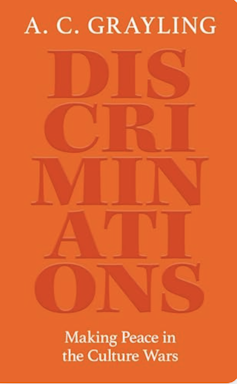
Cover of Discriminations

A.C. Grayling’s new book Discriminations: Making Peace in the Culture Wars sees the renowned philosopher wading into the ethical minefields of “woke” activism, cancellation, and conservative backlash.

Filled with thoughtful analysis, deep reflection, and fascinating historical detail, Discriminations argues the differences between leftist moderates and “woke activists” centrally concern means rather than ends.

Review: Discriminations: Making Peace in the Culture Wars (Oneworld Publications)

The book’s core contribution lies in Grayling’s searching examination of “othering”. This allows him to explain the core ethical concern about racism and sexism while simultaneously providing a principled basis to resist the more intolerant strategies that might be used in the struggle against such evils.

Defining ‘woke’

“Woke” and “wokist” now have pejorative implications and are terms used mainly by critics of progressive views. Grayling defines “wokism” in terms of the passionate advocacy of things like:

• Critical Race Theory in history classes

• Campaigning for same-sex marriage

• Educating about diversity in sexuality

• Supporting medical gender transition

• Advocating changes in language use, such as with non-gendered pronouns

• Encouraging Me Too avowals.

A significant number of identity politics activists, he adds, “promote no-platforming and cancellation as weapons in the struggle”.

This last point is critical in the way Grayling pictures the differences between moderate leftists like himself and “woke activists”. After all, the bulleted list above – apart perhaps from the reference to Critical Race Theory – includes many concerns broadly shared across the political left.

Cover of Discriminations
Goodreads For Grayling, the differences between moderates and activists are mainly ones of strategies they employ to achieve their shared social justice goals. Through their justifiable anger at systemic injustice, he argues, some “woke activists” have been drawn into employing weapons like no-platforming and cancellation. These tactics can sometimes be morally mistaken, especially when driven by online mobs. Grayling worries that the use of these practices can “other” their targets, without any attempt at due process and constraints of proportionality. A contrasting view? Discriminations stands in stark contrast to another recent work on wokism: Yascha Mounk’s The Identity Trap. Like Grayling, Mounk is a moderate leftist. Like Grayling, he is critical of woke activism. But that is where their similarities end. For Mounk, wokism is not a continuation of traditional leftist civil rights struggles but a sharp deviation from them. On this view, wokism (which Mounk calls “the identity synthesis”) differs from liberal progressivism not merely in means but fundamentally in ends. Mounk sees wokism as committed to three foundational claims: the world must be understood through the prism of identities like sex, race and gender; supposedly universal rules merely serve to obscure how privileged groups dominate marginalised groups; and a just society requires norms and laws that explicitly treat (and require citizens to treat) different identity groups differently. None of these are claims about means; they concern fundamental values and goals. For Mounk, woke intolerance – in the form of cancellation and no-platforming – is a feature, not a bug. In contrast, Grayling sees online cancellations (when they go wrong) as a betrayal of the traditional leftist values he shares with the woke activists. Cancelling Grayling understands cancelling as efforts to “deprive opponents not only of a platform to state their views, but to deprive the persons and groups themselves of a presence.” This can include social ostracism and getting people fired. Discriminations contains no detailed discussions of contemporary cases of cancellation and their impacts. This is deliberate. Grayling worries that discussing current cases might invite an automatic identification with the cancelled target. Alternatively, it might counter-productively draw attention to victims who have already been excessively targeted. Granting these points, the absence of any case studies carries costs. For one thing, it’s never shown in the book that these objectionable practices are widespread enough to warrant a movement against them. Equally, there is no appeal to the reader’s sympathies by examining cases of cancellation through social media pile-ons and the human costs involved. Unless the reader already believes these practices to be widespread and harmful, they are unlikely to see what all the fuss is about. Without examination of actual cases, it also can be hard to know exactly what Grayling is recommending. Grayling believes cancelling is often justified. However, he wants to make clear the serious problems it creates in the cases where it is not justified. The problem is that different readers, interpreting some of his terms differently, might be led to see an act of cancellation as justified accountability where another reader would see objectionable mob justice. ‘Othering’ Grayling defines “othering” as the practice of treating individuals and groups, typically on the basis of stereotyping and prejudice, as a ground for discriminating against them; and discrimination involves exclusion. Othering occurs any time one group of people decides they are different to another group (which they see as the “other”), thus treating that group in a morally different and worse way. Racism and sexism are examples of othering and “exclusion”. Grayling argues the goal of social justice is necessarily opposed to all such othering, especially if the exclusion is done without proportionality and safeguards, like due process. (Grayling allows that criminal punishment can be a type of justified othering.) Crucially, Grayling argues that acts of cancellation and no-platforming are instances of othering. These practices explicitly involve attempted punishment, shaming and ostracism and often occur without due process. Suppose you are a progressive activist concerned about the injustices of systemic racism and sexism. You might have strategic reasons that constrain the methods you use in fighting those injustices. However, your concerns with racism and sexism will generally not themselves restrain the methods you use. But suppose now you accept Grayling’s argument that the root social justice concern is not with racism or sexism specifically, but rather with the more fundamental injustices of othering and exclusion. Because cancelling and no-platforming are themselves instances of such things, you now have a deeply held reason not to cancel others (except perhaps in the most compelling cases). You do not want to become the very thing you are fighting against. Should we accept Grayling’s argument? There are some worries his notions of othering and exclusion are over-broad, given they capture commonplace practices like national borders and criminal justice punishments. Overall though, Grayling shows through his historical discussions that political othering for ideological or doctrinal reasons has caused enormous injustices and even horrifying slaughters. A black and white photo of two men in long, paper dunces' hats amid of a crowd of people.
People wearing dunce caps are held to public shame on a city street during the Cultural Revolution in 1967. AAP

It turns out that political and ideological intolerance – Grayling recounts religious massacres and China’s Cultural Revolution – has a history every bit as awful as racially motivated massacres like the Holocaust. As he sombrely concludes: “tragedy attends entrenched positions that make mutual comprehension impossible”.

Grayling stresses it is right to feel anger at the world’s injustices. But a wariness of being drawn into othering should incline us towards what he terms “Aristotle’s Principle”: to be “angry with the right person, in the right degree, at the right time, for the right purpose”.

Rights versus interests

Grayling adopts a human-rights-based approach as his moral compass, seeing it as a system that can transcend different cultures and parochial outlooks. He endorses the provisions of the Universal Declaration of Human Rights – importantly including the right to free speech.

Cancelling can impinge on people’s free speech rights. As well as being wrong in itself, Grayling emphasises it’s also a strategic mistake. Activism itself requires free speech and it is unwise to “gift the high moral ground on free speech” to one’s political opponents. (That said, the political right in the United States is currently showing itself to be no friend of free speech either.)

Grayling distinguishes rights and interests. He argues, “no exercise of any right can deny the fundamental rights of others.” Too often, he insists, figures on both sides of politics interpret their opponents as violating their rights when the opponents are just impacting on their interests.

Grayling is surely correct that all sides of politics could benefit from seriously thinking through the differences between rights and interests. Setting back someone’s interests is not the same as violating their rights. Interests are inevitably in conflict and always require negotiation and compromise.

Still, there remains something of an elephant in the room. What if an opponent’s words or actions don’t violate anyone’s rights, but nevertheless plausibly contribute to a world where such violations are more likely?

Arguably, the problem of political intolerance isn’t driven by a conflation of rights with interests, but instead the ease with which any attack on a group’s interests can be represented as an indirect attack on their rights.

Does Grayling get ‘woke’ right?

It is a hard task to define an amorphous, contested and evolving concept like “wokism”. Grayling’s definition seems to map reasonably onto the original idea of being “woke to” (that is, newly aware of) structural racism and other inequities.

A head shot of John McWhorter. John McWhorter. Columbia University

But as Grayling himself observes, “woke” is now more commonly used as a pejorative term. The linguist John McWhorter argues the term has evolved from describing those with a leftist political awareness to referring to “those who believe anyone who lacks that enlightenment should be punished, shunned or ridiculed.”

This is very different from Grayling’s understanding of the term. Most of the attributes Grayling ascribes to “the woke” are standard leftist positions. Worryingly, this sometimes seems to prevent him from engaging seriously with what many of the “woke” actually say and believe.

For example, Grayling reflects on those who say that wokist social justice has been strongly influenced by postmodernism. Postmodernism includes the denial of things like “objective truth” and “factual knowledge” on the basis that these are constructs of power and discourse.

But Grayling finds this confusing. After all, postmodernism seems to undercut the objective values of equality and social justice. He concludes:

What this suggests is that those who begin with the postmodern analysis of objectivity and knowledge are not actually saying that there are no such things, but that how they have been constituted in the past should be replaced by new and better conceptions of them.

This is simply not what the postmodernists are saying. The worry here is that Grayling takes it upon himself to stipulate what another school of thought is “actually” saying, rather than listening carefully to their ideas and arguments, and being open to the possibility that these may differ profoundly from his own.

Given the book aims to persuade the woke activists he thinks are going too far in cancelling others, the possibility Grayling is misreading their actual position is a concerning one.

Throughout, he appeals to the importance of democracy, free speech, human rights, the rule of law and due process, and the Enlightenment. He argues from what he sees as empirical evidence and “common knowledge”. But all these notions are wide open for criticism (from the woke perspective) that they are inventions of racist, patriarchal, and colonialist systems of oppression.

As such, Grayling’s arguments may fall flat for the very group he is trying to persuade because he does not take their beliefs seriously enough to engage directly and critically with them.

So who is right? Is Grayling correct that woke activists are just like him, except they have been led by their shared passions for social justice to indulge in often counter-productive and mistaken strategies of cancellation? Or is Yascha Mounk correct? Is wokism a profound departure from traditional leftist social justice goals?

Perhaps time will tell.

Authors: Hugh Breakey, Deputy Director, Institute for Ethics, Governance & Law, Griffith University


Read more https://theconversation.com/can-we-confront-cancel-culture-by-finding-common-ground-between-moderate-leftists-and-wokists-254571

The Ultimate Guide to Automating Your Weekend Yard Chores

We all look forward to the weekend as a chance to unwind after a long week of work. You probably picture yourself relaxing on the patio with a cold ...

How Ignoring Regular Car Servicing Can Lead to Costly Repairs

Owning a car gives you a sweet sense of freedom and comfort. You can go wherever you want, whenever you want. But with that freedom comes responsibili...

Someone Trips at Your Fundraiser. Now What? Understanding Public Liability for NFPs

Three months of planning. Volunteers giving up their weekends. Sponsorships chased, catering sorted, tables decorated. And then, about an hour into ...

Stainless Steel Tube: A Complete Specification Guide for Engineers, Project Managers, and Industrial Buyers

Few materials in the industrial and manufacturing world are as universally relied upon — or as frequently misspecified — as stainless steel tube...

How to Choose the Right Barber Shears Scissors for Professional Results

Since a barber is only as good as their tool, choosing the right barber shear scissor must not be taken lightly. Most barbers end up buying the first ...

Why Commercial Construction Companies Play A Critical Role In Modern Urban Development

Urban development requires highly organised planning, engineering expertise, and professional construction teams capable of delivering complex build...

Essential Features for Comfortable Family Caravan Trips

Choosing the right van for family travel requires careful consideration of how the space will be used on a daily basis. Families have specific needs...

Chatswood Tutor: Helping Students Achieve Academic Success With Personalised Learning

Education plays a crucial role in shaping a student’s future, and many students benefit from additional academic support outside the classroom. A pr...

How External Consulting Can Guide Enterprise IT Strategy and Procurement

Internal IT teams carry deep operational knowledge, but that familiarity can create blind spots in strategic decisions. An external IT consultant br...

Why Sports Nutrition Australia Is Important for Performance and Recovery

Athletes and fitness enthusiasts place significant demands on their bodies during training and competition. Maintaining energy levels, supporting mu...

How Body Contouring Bundoora Helps Improve Shape And Confidence

Modern aesthetic treatments have made it possible to refine body shape without the need for invasive surgery. One of the most popular non-surgical o...

Why Plantation Shutters Are a Stylish and Practical Choice for Modern Homes

Window coverings play a major role in the comfort, privacy, and overall design of a home. Homeowners often look for solutions that provide both visu...

Why a Retractable Hose Reel Is Essential for Efficient Water Management

Managing hoses efficiently is important for both residential and commercial environments. Whether watering gardens, cleaning outdoor areas, or maint...

Best Ways to Trade In Your Old Tech for Cash in Australia

Upgrading your mobile is exciting, but many Australians are left wondering what to do with the device they no longer use. Instead of leaving it in a...

Why Doctors in Bundoora Play an Important Role in Community Health

Access to quality healthcare is essential for maintaining a healthy lifestyle and managing medical conditions effectively. Visiting experienced doctor...

Backyard Aesthetics Decoded: Mediterranean, Coastal, Retro, Rustic, and Beyond

Backyard design has come a long way from a patch of lawn, a barbecue in the corner, and a few chairs chosen purely for practicality. Today, outdoor ...

What Stops a Home From Feeling Flat-Pack Generic

There is nothing wrong with convenience. Flat-pack furniture, fast styling decisions, and online checkouts have made it easier than ever to furnish ...

5 Best Dental Clinics in Beecroft, NSW

The best dental clinics in Beecroft, NSW are Beecroft Smiles Dental Surgery, Beecroft Elegant Dental Clinic, McConnell Dental, Dentistry for Life, a...
















