

Surviving swamps on South Australia’s parched Fleurieu Peninsula are a lifeline to wildlife – and farmers
- Written by: Christopher Auricht, Visiting Research Fellow in Natural Resources Management, University of Adelaide
South Australia is famously the driest state on the driest inhabited continent.
But even for South Australia, the current drought is extreme. Rainfall has been the lowest on record across large areas.
When drought strikes and water sources dry up, life becomes hard for wildlife. In these conditions, perennial water sources become enormously valuable.
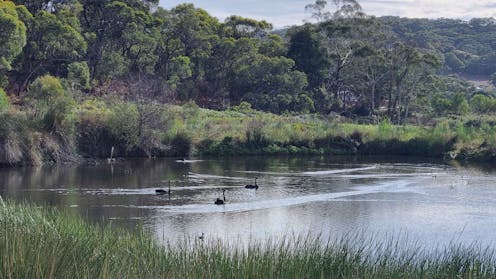
Dotted across the drought-stricken Fleurieu Peninsula south of Adelaide are more than 850 swampy wetlands. When the landscape dries out, these swamps act as refuges. Animals, birds, insects and reptiles come from far and wide, drawn by permanent spring-fed water, good habitat, diverse plant species and cooler, more humid micro-climates. These swamps are vital habitat for the critically endangered Mount Lofty Ranges southern emu-wren.
Drainage channels were cut through many of these swamps in the early days of settlement, in an effort to turn them into pasture. The Fleurieu swamps are now considered an endangered ecological community. More than 90% of the remaining swamps are located on private property.
Keeping these swamps intact and restoring dried out wetlands comes with real benefits for farmers. Birds and insects seek refuge in the swamps, but feed on pest species on nearby farmland.
As drought tightens its grip on South Australia, these swamps will only become more important to wildlife. Restoring these swamps by bringing back the water and restoring plants and pollinators could go some way to help.
Important for nature – and humans
The swamps of the Fleurieu are some of the most diverse and productive habitats on Earth. Many species of plants, birds, frogs, fish, insects, mammals and reptiles rely on them to survive.
Before colonisation, swamps and wetlands covered large areas of the Fleurieu Peninsula. Three First Nations language groups lived in these areas on the central and eastern peninsula. The importance of these wetlands is recorded in the shared story of Tjilbruki, a Kaurna ancestor whose tears at the death of his nephew gave rise to six freshwater springs.
Over the last 200 years, most of this region has been cleared for pasture, crops and vineyards. Only 4% of the swamps are conserved. They are now listed as a critically endangered ecological community. These swamps are still declining due to threats such as more human settlement, land clearance, water extraction and invasive species such as blackberries.
Many were drained to make way for agriculture. We don’t fully know how many remain, as many are not well captured in current maps.
But we know these wetlands are vital, not just for nature but for farmers too. Farmers would miss them if they were gone.
We can see this most clearly during droughts. As the land gets drier and ephemeral water sources evaporate, ibises, eastern great egrets, white-faced herons and masked lapwings move into these swamps, seeking water. During the days, though, they spread out and feed on pasture pests such as grasshoppers and cockchafer beetle grubs.
Similarly, these wetlands act as a haven for important insect pollinators and predators. Hoverflies and native bees help farmers by pollinating pasture legumes such as clover, while predators keep down the numbers of pest species.
As adults, parasitic wasps rely on the nectar from swamp plants such as woolly teatree. But they lay their eggs on common pasture pests such as caterpillars and grubs. When their larvae hatch, they eat these pests. Carnivorous insects such as ladybirds and assassin bugs eat other insects which can trouble farmers.

Restoration is possible
Swamps don’t have a great reputation. Throughout human history, they have been seen as sources of foul air and a haven for insects and disease. A common response was to dig channels to drain them.
We now know much more about how important swamps and other wetlands for the natural world – and for humans. Wetlands naturally store water and carbon, tame floods and offer refuges during drought. Correcting these historic mistakes will take time.

Peatlands like these store huge volumes of carbon in their waterlogged soils. Our research estimated the carbon storage of a peat swamp at Yundi at more than 2,500 tonnes of carbon dioxide equivalent per hectare. The depth of carbon-rich organic peat was up to three metres in places. By contrast, a healthy woodland stores around 650 tonnes per hectare.
This natural carbon sink will remain as long as the peat remains moist and annual increments from plant growth and decay add to the stock.
When an agricultural drain is cut through a swamp, water gradually leaches out of the peat profile. Over time, enough water leaves to dry out the peat, beginning with the surface layer. This means long-stored carbon and methane can be released back to the atmosphere.
Conserving remaining peatlands and restoring those already drained is essential if the climate goals of the Paris Agreement are to be achieved, according to the Food and Agriculture Organization.
On the Fleurieu Peninsula, there’s huge potential to return water to the soils and expand these once-thriving wetlands.
The good news? Community groups and farmers have already embarked on several restoration projects. Around 50 farmers in the region have formed the Fleurieu Swamp Restoration Network. To date, in cooperation with Yundi Nature Conservancy, 25 swamp restoration plans have been developed and 15 are under way. If successful, these will restore more than 100 hectares of swamp.
Authors: Christopher Auricht, Visiting Research Fellow in Natural Resources Management, University of Adelaide


















